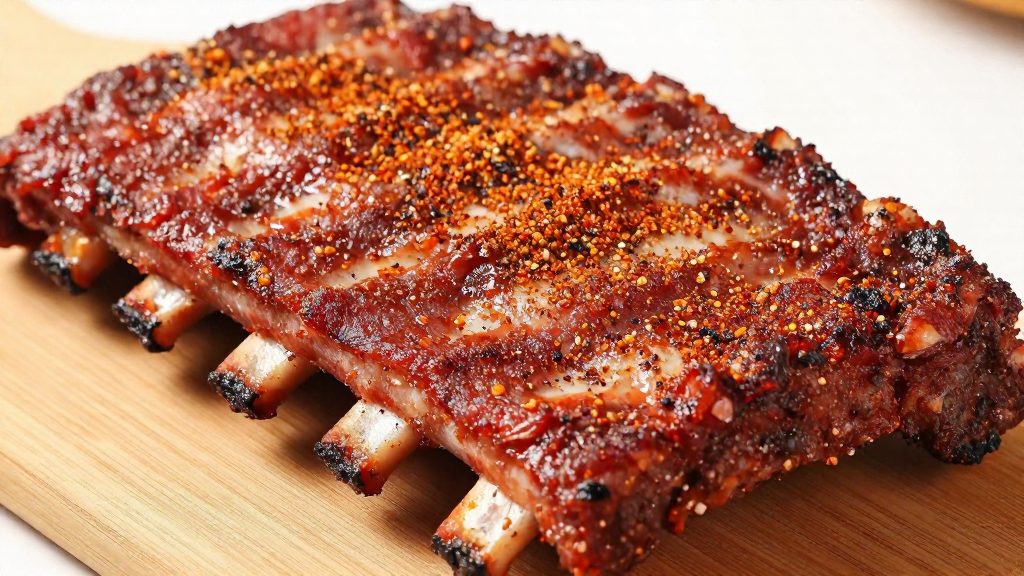
What goes into a classic rib rub
A classic pork rib rub yields about 1¼ cups and is built on brown sugar, smoked paprika and coarse salt, with black pepper, powdered aromatics, cumin and Aleppo pepper completing the blend. The proportions below follow the recipe published by Smoked BBQ Source (2026), which lists each ingredient by volume.
Full ingredient proportions
| Ingredient | Amount (about 1¼ cups batch) |
|---|---|
| Brown sugar | ½ cup |
| Smoked paprika | ¼ cup |
| Coarse salt | 2 tbsp |
| Black pepper | 1 tbsp |
| Onion powder | 1 tbsp |
| Garlic powder | 1 tbsp |
| Mustard powder | 1 tbsp |
| Cumin | 1 tbsp |
| Aleppo pepper | ½ tbsp |
The sweet and smoky base
Brown sugar is the largest measure in the batch at ½ cup. Smoked paprika follows at ¼ cup and supplies the smoky character of the rub. Together they make up the bulk of the blend’s volume, so their proportions set the overall color and flavor profile of the mix.
Salt
Coarse salt is measured at 2 tbsp and is the only salt in the blend. Its coarse grain makes it easy to see and spread evenly across the rub when mixing by hand.
Pepper, powdered aromatics and spices
Black pepper is added at 1 tbsp. The powdered aromatics are onion powder, garlic powder and mustard powder, each at 1 tbsp, and they round out the savory side of the mix. Cumin, also at 1 tbsp, adds an earthy note. Aleppo pepper is the smallest measure at ½ tbsp and contributes a light warmth without dominating the other ingredients.
Sweet, salty, smoky: balancing the flavors
The 1¼ cup batch balances on a sugar-to-paprika ratio of 2:1 by volume: ½ cup (8 tablespoons) of brown sugar against ¼ cup (4 tablespoons) of smoked paprika. Brown sugar supplies the sweetness, and smoked paprika supplies the smoky, reddish backbone that defines the rub. Because the sugar is twice the volume of the paprika, the sweetness stays dominant over the smoky backbone.
Salt is the counterweight. The batch uses 2 tablespoons of coarse salt against 8 tablespoons of brown sugar, a salt-to-sugar ratio of 1:4. This keeps the sweetness from reading as one-note and gives the rub its savory edge. The same 1:4 salt-to-sugar ratio appears in the smaller batch, which shows how the proportion holds when the recipe is scaled.
| Component | 1¼ cup batch | Smaller batch (about ½ cup) |
|---|---|---|
| Brown sugar | ½ cup (8 tbsp) | ¼ cup (50 g packed) |
| Smoked paprika | ¼ cup (4 tbsp) | 1 tbsp |
| Sugar-to-paprika ratio | 2:1 | 4:1 |
| Salt-to-sugar ratio | 1:4 | 1:4 |
The aromatic powders fill out the profile. The large batch includes 1 tablespoon each of black pepper, onion powder, garlic powder, mustard powder and cumin, five powders totalling 5 tablespoons. Onion and garlic powder add savoury depth, mustard powder adds a sharp note, and cumin adds an earthy background. Together they sit around the sweet-and-smoky core without overpowering it.
If a rub contains no salt, Smoked BBQ Source (2026) recommends salting the meat with ½ teaspoon of kosher salt per pound, bone excluded, and letting it rest overnight. This restores the salt balance that the rub would otherwise provide.
How much rub do you need per rack?
The small batch is the practical choice for one rack. According to Jessica Gavin (2026), a batch of about ½ cup covers a single 2–3 lb rack of ribs. Its key quantities are:
| Ingredient | Small batch (about ½ cup) | Large batch (about 1¼ cups) |
|---|---|---|
| Packed brown sugar | ¼ cup (50 g) | ½ cup |
| Smoked paprika | 1 tbsp | ¼ cup |
| Salt | 1 tbsp kosher salt | 2 tbsp coarse salt |
The large batch comes from Smoked BBQ Source (2026), which also specifies black pepper, onion powder, garlic powder, mustard powder and cumin at 1 tbsp each, plus ½ tbsp Aleppo pepper. The small batch uses 2 tsp black pepper, 1 tsp each of mustard, garlic and onion powder, and ½ tsp each of cayenne and nutmeg.
The two recipes are not simple multiples of each other. Salt and brown sugar keep the same ratio in both (1 tbsp salt per ¼ cup sugar in the small batch, 2 tbsp per ½ cup in the large), but the small batch contains about 1 part paprika to 4 parts sugar, while the large batch contains about 1 part paprika to 2 parts sugar. Scaling the small recipe up would therefore give a sweeter, less paprika-forward blend than the large recipe, which is not a direct double of it.
Choose by quantity and flavour:
- One rack (2–3 lb): use the small batch, which is sized for that amount.
- Several racks or a rub kept on hand: use the large batch, which yields about 1¼ cups.
Should you use a binder?
A binder is a thin layer applied to the meat before the rub, giving the dry seasoning a surface to cling to. The recipe names two options, yellow mustard and olive oil, and asks for a light coat of either. Mustard is listed first, but the method does not rank the two, so the choice comes down to what you have in the kitchen.
Mustard or oil
Use just enough binder to create a tacky film. A heavy layer of mustard or oil pools in the grooves between the bones and dilutes the rub where it sits, so the seasoning ends up uneven. Oil spreads more smoothly across a dry surface, while mustard is thicker and needs a light hand with a brush or your fingers. Either way, the goal is coverage, not a wet coat.
Applying the binder and rub
- Start with a dry rack. Surface moisture makes the binder bead up instead of spreading, so pat the ribs dry with paper towel first.
- Coat the meat lightly. Spread the binder across the meaty side and the bone side with your hands or a brush.
- Sprinkle the rub evenly. Hold the rub a short distance above the rack and move the shaker in a steady pass so no area receives a heavy clump.
- Cover every side. Turn the rack and repeat on each face, including the bone side and the ends. Rub that covers only the top surface leaves the underside unseasoned.
- Press lightly. Pat the rub gently into the surface so it adheres, then leave the rack to rest before it goes on the grill.
Working in this order keeps the binder thin, the rub even, and every side of the rack seasoned.
How long should the rub sit on ribs?
Seasoned ribs have two options before cooking: a short rest of 15 minutes, or a refrigerated rest covered for up to 12 hours, according to Jessica Gavin (2026). The right choice depends on how far ahead of the cook you season the rack.
| Option | Maximum duration | Best suited to |
|---|---|---|
| Short rest | 15 minutes | Seasoning and cooking in the same session |
| Refrigerated rest (covered) | Up to 12 hours | Seasoning ahead, such as the morning before an evening cook |
The short rest is the faster route. Once the rub is applied evenly to all sides, wait 15 minutes, then place the rack on the grill or smoker. It fits a same-day plan where prep and cooking follow each other closely.
The refrigerated rest separates seasoning from cooking. Keep the rack covered in the refrigerator for as long as your schedule requires, up to 12 hours. This lets you prepare the ribs earlier in the day and reduces the work needed right before the cook starts.
To choose between them, compare your available prep time with the cooking start time:
- Less than an hour before cooking: use the short rest.
- Several hours or more before cooking: use the refrigerated rest, staying within the 12-hour limit.
- Longer than 12 hours before cooking: season closer to the start time, since Jessica Gavin (2026) sets 12 hours as the upper limit for a covered, refrigerated rest of seasoned ribs.
Salt in the rub or on the meat?
Whether salt goes in the rub or directly on the meat depends on one check: does the rub already contain salt? Salting the ribs twice makes the meat over-seasoned, so you count the salt once, either in the rub or on the meat.
Salted rub: The 1¼-cup homemade pork rub from Smoked BBQ Source (2026) includes 2 tbsp coarse salt alongside ½ cup brown sugar and ¼ cup smoked paprika. With this recipe, apply the rub and add no extra salt to the ribs.
Unsalted rub: If the rub contains no salt, salt the meat with ½ tsp kosher salt per pound. The bone weight is excluded, so weigh the meat after removing the bones before you calculate the amount. Smoked BBQ Source (2026) recommends letting the salted meat sit overnight before cooking. Keep it covered in the refrigerator during that time.
| Rub composition | Salt action | Amount |
|---|---|---|
| Contains coarse or kosher salt (e.g., 2 tbsp coarse salt per 1¼-cup batch) | Apply rub only | No additional salt |
| Contains no salt | Salt the meat before applying the rub | ½ tsp kosher salt per pound, bone excluded |
Check the ingredient list of any rub before you season the meat, since a salted rub combined with a salted meat step can make the ribs overly salty.
How do you store homemade rib rub?
According to Smoked BBQ Source (2026), a homemade rib rub keeps for several months when stored in an airtight container in a cool, dry place. The same source recommends using the blend within three months for the best flavor, so that window is the practical target for most cooks. Because the rub is a dry mixture of brown sugar, smoked paprika and ground spices, the storage goal is to keep it sealed and protected from heat and humidity.
Storage steps
- Mix thoroughly. Combine the sugar, paprika, salt, pepper and spices until the colour is even, so every portion of the blend tastes the same.
- Transfer to a sealed container. Use a jar or tin with a tight-fitting lid to create an airtight container.
- Choose a cool, dry cupboard. Keep the container away from the grill, smoker, stove and direct sunlight.
- Keep the lid closed between uses. Spoon out only what you need, rather than leaving the container open during preparation.
Batch size and the three-month window
Batch size determines whether you can finish a rub within the recommended period. Smoked BBQ Source’s full batch yields about 1¼ cups, while Jessica Gavin (2026) describes a smaller blend.
| Batch | Yield or coverage | Storage implication |
|---|---|---|
| Full batch (Smoked BBQ Source) | About 1¼ cups | Suits frequent cooks who will use it within three months |
| Small batch (Jessica Gavin) | About ½ cup | Suits occasional cooks who may not finish a larger batch in that window |
For occasional smoking, the smaller batch limits how much of the blend ages before it is used. Mixing a fresh batch before each cook is a simple way to keep flavor consistent.
Related reading
- Homemade Carolina Vinegar Barbecue Sauce Recipe: Step-by-Step
- Easy Mop Sauce for Smoked Chicken: Vinegar Recipe Guide
- Smoke Pork Shoulder at 225°F Overnight: Method Guide
Adjusting heat and spice
The main batch of this rub uses ½ tbsp of Aleppo pepper as its only chili ingredient. Smoked BBQ Source (2026) notes that crushed red pepper or cayenne can replace it for more heat, which makes the chili the simplest lever for changing the rub’s heat level without altering the rest of the blend.
| Pepper | Role in the rub | Heat direction |
|---|---|---|
| Aleppo pepper | Chili in the main batch, ½ tbsp | Baseline |
| Crushed red pepper | Direct replacement for Aleppo | Higher heat |
| Cayenne | Direct replacement for Aleppo; ½ tsp in the smaller ½-cup batch by Jessica Gavin (2026) | Higher heat |
Raising the heat
- Replace the Aleppo pepper with crushed red pepper or cayenne, using the same position in the recipe.
- Mix a small test portion first and taste it before scaling up the full batch.
- Cayenne is the replacement that appears in the smaller batch, so it is the reference point if you want a rub built around a sharper chili.
Lowering the heat
- Leave out the chili entirely. Aleppo pepper is the only chili named in the main batch, so removing it removes the chili element of the rub.
- Keep the other ingredients in their listed amounts. The smoked paprika, black pepper, onion powder, garlic powder, mustard powder and cumin remain in the blend.
- Adjust one variable at a time. Changing the chili while keeping everything else fixed makes it easier to judge the result on the meat.
Changing the chili is the only swap the recipe itself suggests for heat, so keep the substitution limited to that ingredient when you want a predictable change.
Frequently asked questions
What if my rub has no salt? How much should I add to the ribs?
If the rub is salt-free, Smoked BBQ Source (2026) recommends seasoning the meat with ½ tsp kosher salt per pound, not counting the bone, and letting it sit overnight. This lets the salt penetrate the meat before the rub goes on.
How long can I keep homemade rub?
Store it in an airtight container in a cool, dry place. It keeps for several months, but Smoked BBQ Source (2026) suggests using it within 3 months for the best flavor.
Can I make a smaller batch for one rack?
Yes. Jessica Gavin (2026) gives a half-batch of about ½ cup, made with ¼ cup (50 g) packed brown sugar, 1 tbsp smoked paprika, 1 tbsp kosher salt, 2 tsp black pepper, 1 tsp each of mustard, garlic and onion powder, ½ tsp cayenne and ½ tsp nutmeg. That quantity covers a single 2–3 lb rack of ribs.