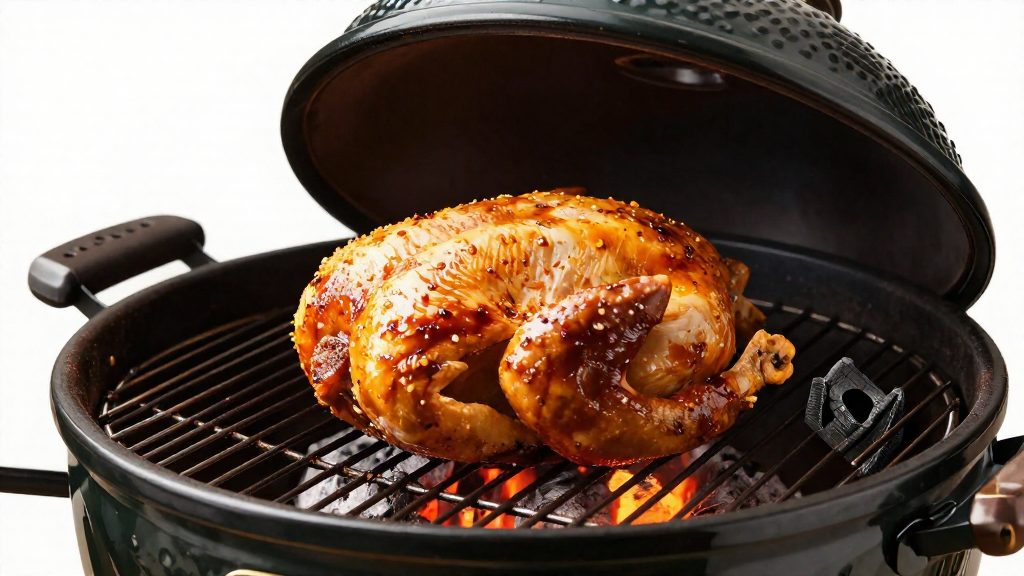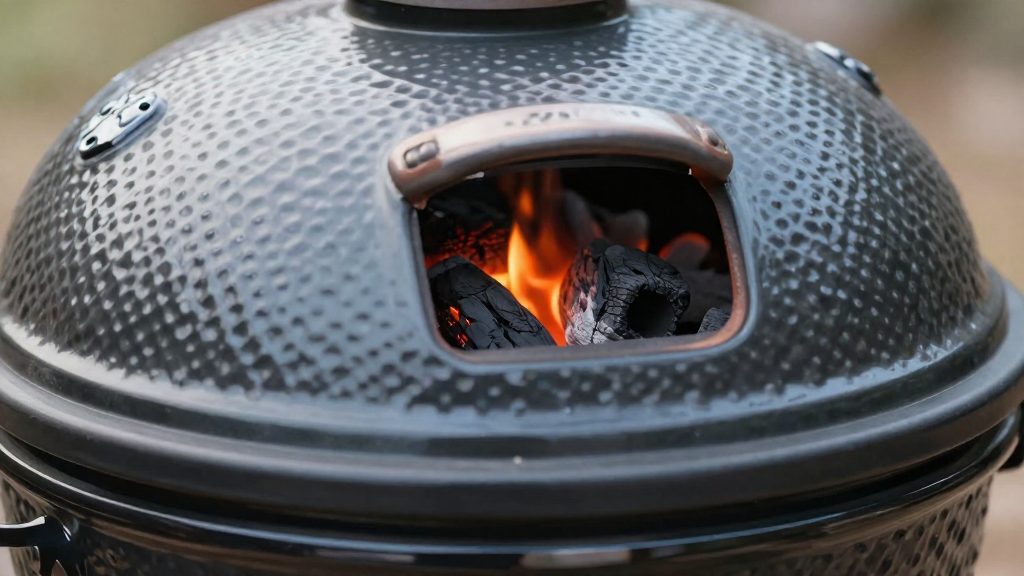
A kamado is a single thick ceramic shell in which the fire and the food share one chamber. An offset smoker is a steel cooker whose fire burns in a separate side firebox that sends heat and smoke into the cooking chamber. That structural difference determines how each cooker holds heat and how evenly it cooks: the kamado changes temperature slowly within one enclosed body, while the offset builds a temperature gradient across its chamber and needs more firebox attention.
Kamado vs offset: the short answer
Ceramic shell versus steel firebox
The kamado’s ceramic shell is one enclosed body, so its walls surround the whole cooking space. According to BBQ Host (2026-03-13), this ceramic body holds heat steadily. GoShindig (2023-01-22) notes the trade-off: the thick ceramic heats slowly, so an overshoot during preheating takes time to correct.
The offset uses a separate firebox. Because the fire sits outside the cooking chamber, heat and smoke enter from one end and travel across the grate. This makes the cooking area uneven. GoShindig (2023-01-22) reports that the zone nearest the firebox can run 50–75°F hotter than the far end.
Airflow path
On a kamado, air enters through the vents, and the airflow dampers regulate how the fire burns. The fire, the walls and the grate share one enclosed space, so adjusting a damper changes the whole cooker, with the ceramic mass carrying that change gradually.
On an offset, airflow is controlled at the firebox, and the chamber receives whatever heat and smoke the firebox produces. A change to the fire affects the near end first, and the far end responds later.
Kamado and offset smoker differences, as reported by BBQ Host (2026) and GoShindig (2023).
| Factor | Kamado | Offset smoker | Source |
|---|---|---|---|
| Learning curve | Short (GoShindig); moderate (BBQ Host) | Biggest disadvantage (GoShindig); not beginner-friendly (BBQ Host) | GoShindig (2023); BBQ Host (2026) |
| Temperature stability | Ceramic body holds heat steadily; holds steady in cold weather | Notorious for temperature swings; low temperatures are hard to hold | BBQ Host (2026); GoShindig (2023) |
| Temperature range | About 225–750°F with dampers | — | GoShindig (2023) |
| Heat distribution | — | Area nearest the firebox runs 50–75°F hotter than the far end | GoShindig (2023) |
| Fuel use | Highly fuel-efficient; noticeably less charcoal than offsets | Noticeably more charcoal than kamados | GoShindig (2023) |
| Fire tending | — | Regular fire monitoring and added wood; propane or electric hybrids reduce tending | BBQ Host (2026); GoShindig (2023) |
| Preheat | Thick ceramic heats slowly; overshooting is slow to correct | — | GoShindig (2023) |
| Recommended fuel | Lump charcoal plus wood chunks | — | BBQ Host (2026) |
| Price and weight | High price; heavy | — | BBQ Host (2026) |
| Flavor and maintenance effort | — | Rated highest for flavor and for maintenance effort | BBQ Host (2026) |
| Lifespan | 20+ years | — | BBQ Host (2026) |
Which is easier to learn: kamado or offset smoker?
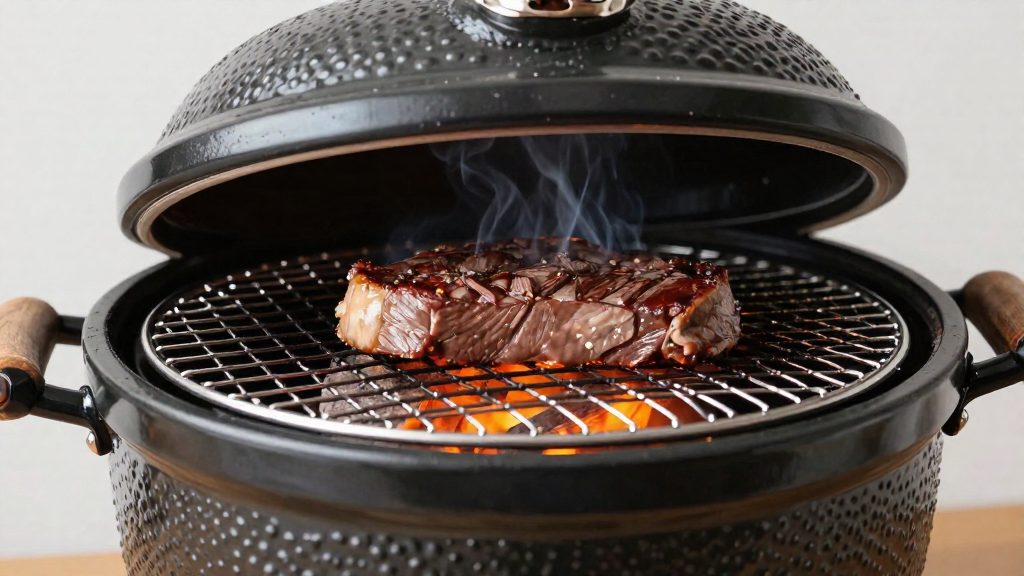
Kamado grills look easier for a newcomer than offset smokers. GoShindig (2023-01-22) calls the kamado’s learning curve short, while BBQ Host (2026-03-13) rates it as moderate. GoShindig (2023-01-22) describes the kamado’s learning curve as short, while BBQ Host (2026-03-13) rates it as moderate. BBQ Host calls the offset not beginner-friendly, and GoShindig calls its learning curve the offset’s biggest disadvantage. For a first purchase, expect a learning period before temperature control feels routine.
On a kamado, the vents control the heat. Once the dampers are set, the cook needs less constant adjustment.
Offset smokers demand more hands-on work. BBQ Host (2026-03-13) calls them notorious for temperature swings and not beginner-friendly. GoShindig (2023-01-22) identifies the learning curve as the offset’s biggest disadvantage, because holding low temperatures is hard.
Firebox tending and added wood during long cooks
On an offset, firebox tending is the main hands-on task. The fire needs regular monitoring, and wood must be added during long cooks. Beginners should expect to check the fire and feed it at intervals for the whole session.
- Kamado: the cook mainly adjusts the vents; no separate firebox needs feeding.
- Offset: the cook manages a separate firebox, adding fuel and wood as the cook progresses.
Hybrid offsets using propane or electricity
Hybrid offsets that use propane or electricity assistance reduce firebox tending, according to GoShindig (2023-01-22). These models give beginners a way to keep the offset’s smoking style while reducing the constant attention a wood-and-charcoal firebox requires.
Temperature control and fuel use
Both designs hold a target temperature by controlling airflow, but they respond differently. On a kamado, the dampers and vents set the airflow. According to GoShindig (2023-01-22), dampers adjust a kamado across about 225–750°F. BBQ Host (2026-03-13) notes that the vents can hold about 225°F for smoking or open up to raise the heat for searing. Make vent changes in small steps and wait for the dome thermometer to settle before adjusting again.
An offset smoker has a separate firebox, and temperature control is less direct. Check temperatures at both ends of the grate before committing to a long cook, and rotate the meat, because the area nearest the firebox can run 50–75°F hotter than the far end.
Fuel use is the other clear difference. GoShindig (2023-01-22) states that kamados are highly fuel-efficient and burn noticeably less charcoal than offsets. For a kamado, BBQ Host (2026-03-13) recommends lump charcoal combined with wood chunks. Kamados are fuel-efficient, so a kamado needs less charcoal than an offset for a long smoke. Offsets consume more charcoal over the same cook, so plan to restock the firebox during longer sessions.
Flavor: does an offset really taste better?
Offset smokers carry the strongest flavor reputation among home smokers. BBQ Host (2026-03-13) rates them highest for flavor. Whether a kamado can match that output depends less on the shape of the cooker than on how it produces smoke.
Where the smoke comes from
An offset burns fuel in a separate firebox, and smoke travels across the cooking chamber. Smoke output therefore depends on how often the fire is fed with wood. A kamado produces smoke and heat in the same chamber. In that setup, the lump charcoal supplies steady heat and the wood chunks supply the smoke. Adding chunks during the cook lets you adjust smoke density without starting a new fire.
Low-and-slow versus hot-and-fast
The same cooker can run low-and-slow at around 225°F for smoking or at higher settings for hot-and-fast cooking. Low-and-slow cooking and hot-and-fast cooking give different results on the same cooker. BBQ Host still rates offsets highest for flavor.
The offset’s flavor reputation holds for cooks who accept frequent fire tending. A beginner who wants smoke flavor with fewer fire adjustments can use a kamado with lump charcoal and wood chunks, though BBQ Host rates offsets highest for flavor.
Versatility: smoking, grilling and searing
A kamado and an offset smoker can both sear, grill directly and smoke, but they get there differently.
Searing and direct grilling
On a kamado, searing means opening the vents and letting the body reach temperature before placing food close to the coals. Because the ceramic holds heat steadily, the cooker should stay near temperature during the sear. Lower the vents afterward to bring the same cooker down for smoking.
On an offset, direct grilling takes place over the firebox end. Sear steaks or chops there, then move them to the cooler far end to finish. Expect uneven results across the grate.
Multi-zone setups
A two-zone fire is the simplest way to combine searing and smoking on one cooker. On a kamado, bank lump charcoal against one side of the firebowl and leave the other side open. The banked side sears directly over the coals, and the open side cooks indirectly for smoking. Adjusting the grate height changes how close the food sits to the heat.
On an offset, the firebox gradient already creates two zones. The hot end suits searing and the far end suits low-and-slow cooking, so the layout is built in.
What differs when switching modes
On a kamado, the switch is made at the vents. BBQ Host (2026-03-13) reports that the vents can hold about 225°F for smoking or open up to raise the heat for searing. The grate and dome stay in place, and only the airflow changes.
On an offset, the switch is made by moving food between zones and feeding the firebox. Grilling depends on the hot end and smoking on the far end, so the cook changes position on the grate rather than the airflow of a single chamber.
What does maintenance involve?
Maintenance differs most between the two designs. BBQ Host (2026-03-13) rates offset smokers highest for maintenance effort, meaning they demand the most upkeep, so their routine centres on the firebox. As general practice, a kamado’s upkeep is mostly ash clearance and gasket checks.
Ash removal and firebox cleaning
Ash builds up in the firebox of an offset and in the bowl of a kamado, where it restricts airflow to the fire. Remove ash when the buildup starts to restrict airflow, only once the cooker is fully cold and the ash is completely out, using a metal ash tool or a vacuum rated for ash. On an offset, scrape loose residue from the firebox floor and the grease area, then check that the air inlet and the passage into the cooking chamber are clear. A clear firebox also makes it easier to hold a steady fire.
Rust prevention on the offset firebox
Steel firebox surfaces rust when they stay damp or sit in contact with ash moisture. After cleaning, let the interior dry completely, then wipe the metal with a light coat of high-heat cooking oil. Store the cooker under a breathable cover rather than a sealed plastic bag, which traps condensation. At each session, inspect welds and seams for flaking paint or scale. Treat early spots by scraping them back and re-oiling before corrosion spreads.
Gasket wear and seasoning
A kamado relies on a gasket between the dome and base to seal the cooker and control airflow. Check it before each cook for flattening, cracking or gaps. Replace a worn gasket promptly, because an unsealed kamado is harder to hold at a set temperature. Seasoning, meaning a thin protective layer of oil on cast-iron or steel cooking grates, is a general upkeep step that depends on the grate material. Clean the ceramic interior with a brush or scraper rather than detergent.
Cost and durability
Long-term ownership of a kamado or an offset smoker depends on three factors: the purchase price, the expected lifespan of the body, and the weight of the cooker.
Purchase price: BBQ Host (2026-03-13) describes the price of a kamado as high, which makes it a significant purchase. The source gives no price bracket, so compare current retail listings for the same cooking area before deciding.
Lifespan: The same article states that a ceramic body can last 20+ years. A kamado bought once can therefore serve for many seasons, which offsets its higher upfront cost. Judge the offset’s durability by its condition. Steel bodies are more exposed to rust, so keep the firebox and cooking chamber dry, store the cooker under a cover when idle, and check the seams and hinges regularly for corrosion or gaps that let smoke escape.
Weight and mobility: BBQ Host (2026-03-13) classifies the kamado as a heavy cooker. Its weight makes it difficult to relocate once it is set up, so choose a permanent spot on a level, stable surface before the first cook. Moving a heavy ceramic unit is also a safety concern when it is hot, so plan its position around the space you have for storage and cooking.
Which should a beginner buy?
Four factors usually settle the choice: how much attention you can give each cook, how often you will cook, how much space and mobility you have, and how much you can spend. Work through them together, because budget sets the ceiling and the other factors decide among the options within it.
Choose a kamado if you want stable temperatures with less fire management and accept a heavy cooker. Choose an offset if smoke flavor matters more than consistency and you will tend a fire throughout the cook.
Starter models
The sourced characteristics above apply to each type, not to specific models. Compare current listings for models of the type you choose, using the same cooking area and your fixed maximum price.
Budget thresholds
Set a fixed maximum before you compare models. BBQ Host (2026-03-13) describes kamados as high-priced, so confirm that your budget covers that price level before comparing features. Take the exact figure from current retail listings.
Frequently asked questions
Which cooker is easier for a beginner to learn, a kamado or an offset smoker?
GoShindig (2023-01-22) describes the learning curve of a kamado as short, while BBQ Host (2026-03-13) rates it as moderate. Both sources treat the offset as the harder cooker, with BBQ Host calling it not beginner-friendly and GoShindig naming its learning curve as the offset’s biggest disadvantage. The kamado’s trade-offs are its weight and high price, according to BBQ Host.
Does an offset smoker give better smoke flavor than a kamado?
BBQ Host (2026-03-13) rates offset smokers highest for flavor, so a kamado should not be expected to match them on that criterion. The same source recommends lump charcoal plus wood chunks for the kamado, which is the setup to use if you want to keep fire adjustments low.
Can I reduce the firebox tending on an offset?
GoShindig (2023-01-22) reports that hybrid offsets using propane or electricity reduce the amount of firebox tending needed. This is a documented option for beginners who want the offset’s cooking style with less fire management.