What makes Carolina vinegar sauce different?
Carolina vinegar sauce, in the eastern North Carolina style, is a vinegar-forward condiment that is thin and balances tangy, sweet and spicy flavors. It departs from the thick, tomato-based sauces common in American barbecue because vinegar, not tomato, is its main ingredient.
Vinegar as the dominant base
Apple cider vinegar supplies most of the liquid in this style, which is why the sauce reads as sharp rather than sweet. Ketchup is a minor addition. Billy Parisi (2026) uses about one-third of a cup of ketchup against three cups of vinegar, and A Southern Soul (2026) uses two tablespoons against two cups. The tomato note stays in the background, and the vinegar sets the character.
How the flavour balance works
Each ingredient has a distinct role:
| Component | Role in the sauce |
|---|---|
| Apple cider vinegar | Dominant base, sharp and acidic |
| Light brown sugar | Sweetness that softens the acidity |
| Red pepper flakes | Heat, scaled to the sauce’s overall intensity |
| Ketchup | Light tomato note, secondary to the vinegar |
Garlic granules, onion granules and black pepper add savoury depth without changing the sauce’s core profile.
Consistency: thin enough to baste
The sauce is thin, which separates it from thick barbecue sauces that cling to meat as a glaze. Because it is a liquid, it is applied by brushing or basting rather than spread as a heavy coat. This makes it suited to moist, slow-cooked meats, where repeated thin layers keep the surface seasoned.
Related reading
- Homemade barbecue sauce recipes
- Smoking pork shoulder
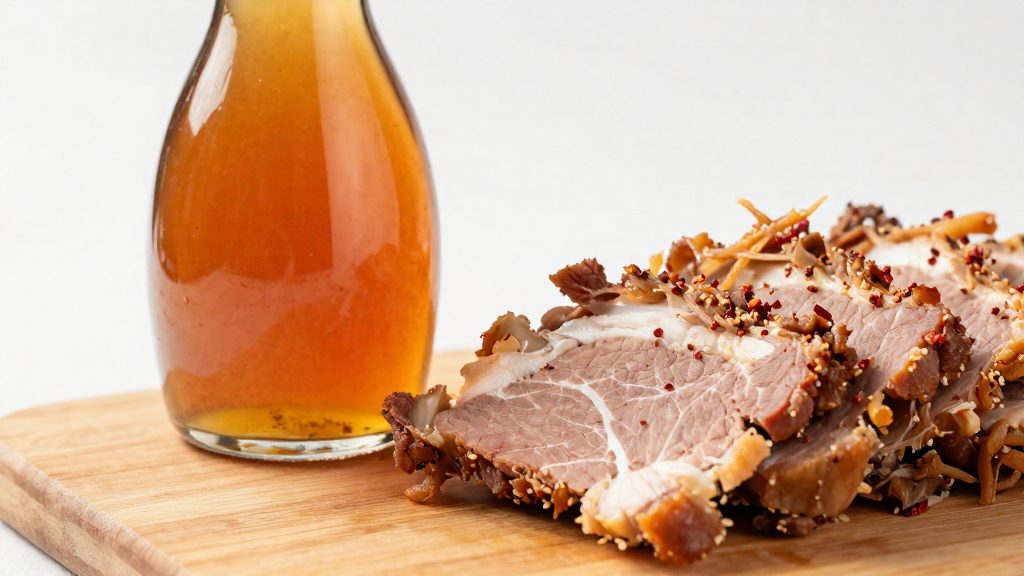
Ingredients for homemade Carolina vinegar sauce
According to Billy Parisi (2026), one full recipe uses the ingredient set below and yields about 4 cups.
| Ingredient | Amount | Role in the sauce |
|---|---|---|
| Apple cider vinegar | 3 cups | Acid base that sets the tangy character |
| Light brown sugar, packed | ¼ cup | Sweetness that offsets the acidity |
| Salt | 2 tsp | Seasons the whole batch |
| Granulated garlic | 2 tsp | Savoury seasoning base |
| Granulated onion | 2 tsp | Savoury seasoning base |
| Black pepper | ½ tsp | Background pepper heat |
| Red pepper flakes | 1 tbsp | Primary chilli heat |
| Hot sauce | 1 tsp | Additional heat |
| Ketchup | ⅓ cup | Tomato-based sweetness |
Vinegar base: the 3 cups of apple cider vinegar make up most of the liquid, and the other ingredients are kept in small amounts so the vinegar stays in front.
The seasoning base is built from granulated garlic and granulated onion, each at 2 tsp. The recipe uses granules rather than fresh aromatics, which keeps the seasoning dry and disperses it evenly through a thin liquid. Together with the salt, these two ingredients give the sauce its savoury depth.
The sweet and hot components are balanced against each other. Light brown sugar and ketchup supply the sweetness, while red pepper flakes, black pepper and hot sauce provide three layers of heat: the flakes give the most noticeable spice, the black pepper adds a milder background, and the hot sauce adds a final kick. The combination is designed to keep the sweetness and spice in check against the vinegar, rather than letting any one element dominate.
How do you make Carolina vinegar sauce?
The four-cup method has four steps:
- Bring the apple cider vinegar, light brown sugar and salt to a boil in a pot.
- Add the granulated garlic, granulated onion, black pepper, red pepper flakes, hot sauce and ketchup.
- Reduce the heat and simmer on low for about 15 minutes.
- Let the sauce cool before serving. According to Billy Parisi (2026), the apple cider vinegar, brown sugar and salt go into the pot first and are brought to a boil. The remaining ingredients, which are garlic granules, onion granules, black pepper, red pepper flakes, hot sauce and ketchup, are then added to that boiling base.
Once everything is combined, the heat drops to a low simmer for about 15 minutes. The recipe’s introduction mentions 5 minutes, but the method’s 15-minute timing is the one followed here. After simmering, let the sauce cool before serving, since the cool-down is part of the method.
The shorter eastern-style version from A Southern Soul (2026) uses a much briefer heating step. The vinegar, brown sugar and salt are simmered for about 2 minutes, just until the sugar and salt dissolve, and then cooled. The table below compares the two sequences.
| Stage | Four-cup version (Billy Parisi, 2026) | Two-cup version (A Southern Soul, 2026) |
|---|---|---|
| Heating | Boil vinegar, sugar and salt, then add remaining ingredients | Simmer until sugar and salt dissolve |
| Simmer time | About 15 minutes on low | About 2 minutes |
| Endpoint | Simmer on low until the flavours are combined | Sugar and salt fully dissolved |
| Cooling | Cool before serving | Cool |
The main practical difference is the simmer time. The four-cup version simmers roughly seven times longer, and its extra ingredients are added before that simmer begins, which makes it the more involved of the two methods.
Can you adjust the heat and sweetness?
Because the recipe’s variables are few, you can shift the profile by changing one of them at a time and tasting between adjustments.
Heat controls
Two ingredients set the heat. In the Billy Parisi (2026) recipe they are 1 tbsp of red pepper flakes and 1 tsp of hot sauce. Red pepper flakes give a dry, lingering heat that stays in the sauce, while hot sauce adds a sharper, more immediate pepper note. To make the sauce hotter, increase the red pepper flakes or the hot sauce in small steps and taste after each change. To reduce the heat, lower the flakes first, since they make up the larger share of the recipe’s heat (1 tbsp against 1 tsp of hot sauce).
Sweetness controls
Sweetness comes from two sources: ¼ cup packed light brown sugar and ⅓ cup ketchup in the same recipe. Brown sugar adds sweetness with a light molasses note. Ketchup adds sweetness and tomato flavour, and it also darkens the sauce. Ketchup adds sweetness and tomato flavour together, so it gives a sweeter, fuller result than brown sugar alone. Increase brown sugar when you want sweetness without extra tomato flavour.
Balancing vinegar against sugar
The vinegar-to-sugar ratio determines how tangy the sauce tastes. In the Billy Parisi (2026) recipe, 3 cups of apple cider vinegar to ¼ cup of sugar gives a ratio of about 12:1 by volume. The simpler version from A Southern Soul (2026), with 2 cups of vinegar and 2 tbsp of brown sugar, is about 16:1. A lower ratio, meaning more sugar relative to vinegar, produces a sweeter and less sharp sauce. A higher ratio keeps the sauce closer to the traditional sharp profile.
| Control | Recipe value (Billy Parisi, 2026) | Effect when increased |
|---|---|---|
| Red pepper flakes | 1 tbsp | More heat |
| Hot sauce | 1 tsp | Sharper pepper heat |
| Light brown sugar | ¼ cup, packed | More sweetness |
| Ketchup | ⅓ cup | More sweetness and tomato flavour |
How long does it keep in the fridge?
Homemade Carolina vinegar sauce in the eastern North Carolina style keeps for up to 21 days when refrigerated and covered, according to Billy Parisi (2026). The table below sets out the working window.
| Stage | Guideline |
|---|---|
| Make-ahead window | Prepare up to 3 days before use |
| Refrigerated storage | Covered, for up to 21 days |
| Freezing | Not recommended, since the sauce does not freeze well |
Make-ahead preparation lets the flavours settle before the sauce is needed. Parisi’s version makes about 4 cups, so a full batch can be stored in a single covered container rather than split across several.
Refrigerated storage is the only storage method recommended for this sauce. A simpler eastern-style recipe from A Southern Soul (2026) also specifies a covered jar kept in the refrigerator, which matches Parisi’s approach. Use the 21-day guideline for Parisi’s recipe, and apply the same covered-jar practice to the simpler version.
Freezing is not a suitable way to extend storage. Because the sauce does not freeze well, keep it in the refrigerator, covered, for up to 21 days, and make a smaller batch if you will not use all of it within that time.
Can you can it?
Canning is not advised for this sauce. A Southern Soul (2026) reports that the simpler eastern-style version was not tested for safe home canning, and its author advises against canning it, suggesting refrigeration instead.
Home canning depends on a processing method validated for a specific formula. Because this recipe has not been validated, there is no verified procedure for preserving it at room temperature in jars. Changing the proportions or swapping ingredients does not fix this, since the adjusted version is equally untested.
What to do if you want a shelf-stable sauce
- Choose a tested home-canning method. Use a vinegar sauce recipe whose publisher provides a validated processing procedure, and follow its steps exactly.
- Do not adapt this recipe for canning. Changing the vinegar, sugar, salt or ketchup to fit a canning method moves the sauce away from anything tested.
- Treat this sauce as fresh. Make it for immediate or near-term use.
What to serve it with
Eastern North Carolina vinegar sauce is built for pork. The sauce suits pulled pork and other smoked meats: the acidity cuts through rendered fat, and the sweetness and pepper rounds out the smoke flavour.
The sauce works in two main ways:
| Use | When to apply | Why it suits the sauce |
|---|---|---|
| Mop | During the cook, brushed on the meat as it smokes | The thin liquid spreads evenly and keeps the surface moist |
| Finishing condiment | After the meat is pulled or sliced, before serving | The acidity lifts rich, fatty bites |
When mopping, the brown sugar in the recipe can darken and burn if it stays on the surface of the meat for a long time over heat.
For pulled pork, add the sauce gradually and toss the shredded meat just before serving. This lets you control the level of acidity and keeps the texture of the meat intact. Serve extra sauce in a small jug on the side so each person can add more to taste. The same light-handed approach works with other smoked pork cuts, such as sliced pork shoulder, where a light coating adds tang without masking the meat’s flavour.
A finishing sauce should be added last, after the meat has been cooked and rested, so the vinegar stays sharp rather than cooking off. Use the sauce on its own or alongside a sweeter sauce, so the meat keeps its smoky character.
Frequently asked questions
How far ahead can I make Carolina vinegar sauce, and how long does it keep?
You can make it up to 3 days ahead. Store it covered in the refrigerator for up to 21 days, according to Billy Parisi (2026). Do not freeze it, because the recipe does not hold up well in the freezer.
Can I can the sauce to keep it on the shelf?
No. A Southern Soul (2026) advises against home canning because the recipe was not tested for safe canning. Keep the sauce in a covered jar in the refrigerator instead.
How does the simpler A Southern Soul version differ from the full recipe?
It uses 2 cups of apple cider vinegar instead of 3 cups, and 2 tablespoons of ketchup instead of ⅓ cup. It also drops the garlic granules, onion granules and hot sauce, and uses 1 teaspoon of red pepper flakes instead of 1 tablespoon. Simmer it for about 2 minutes, just until the sugar and salt dissolve.