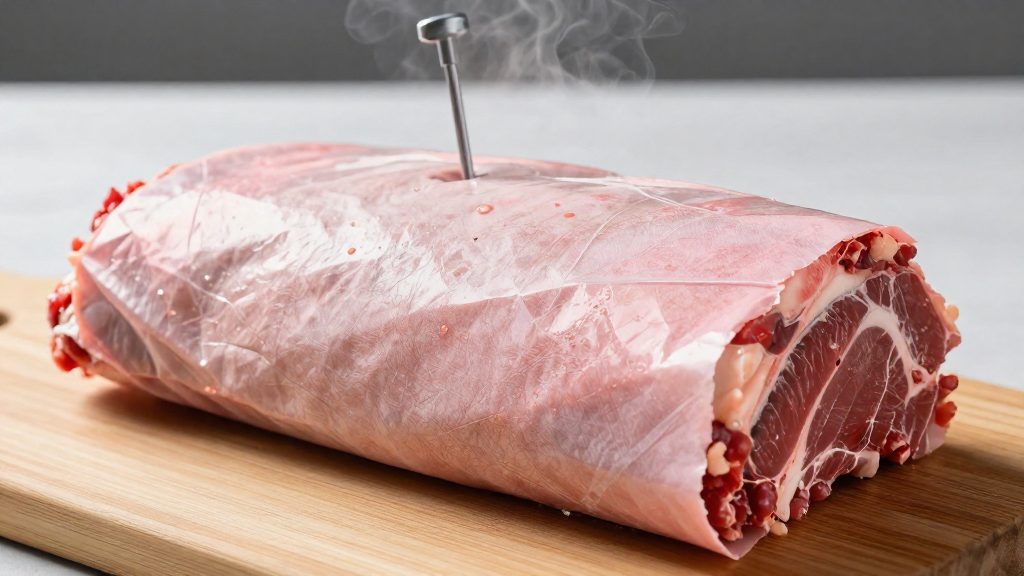
Brisket should rest at least one hour before slicing, according to Smoking-Meat.com (2026). Pitmasters commonly rest it two to three hours, and some rest it longer. Home cooks can plan on about two hours, or rest the meat until it cools to 145°F.
How long should brisket rest after smoking?
The minimum rest
Treat the minimum rest of one hour as a floor. It is the shortest period the cited guidance allows before carving, not a target for every cook. The rest is what lets the brisket settle after the long cook, so cutting too early tends to produce a drier slice.
Typical ranges
| Guideline | Rest time |
|---|---|
| Minimum before slicing | At least 1 hour |
| Common pitmaster practice | Two to three hours, sometimes longer |
| Home-cook plan | About 2 hours |
| Cool-down endpoint | Until the internal temperature falls to 145°F |
Tasting Table (2024) gives home cooks the two-hour plan or the 145°F endpoint, whichever is reached. Smoked BBQ Source (2024) describes its author aiming for a rest of at least two hours, which sits at the lower end of the pitmaster range above.
Using the 145°F cool-down endpoint
The 145°F cool-down endpoint works as a check on the clock. Insert a probe thermometer into the thickest part of the flat and monitor the reading during the rest. Once the meat has cooled to 145°F, the home-cook endpoint is reached and it is ready to slice. It should still be above 140°F (60°C) at that point. If it is still well above 145°F when the timer runs out, keep resting it.
For planning, set a two-hour timer as a starting point and check the probe at that point. A brisket that is still hot at two hours simply needs more time.
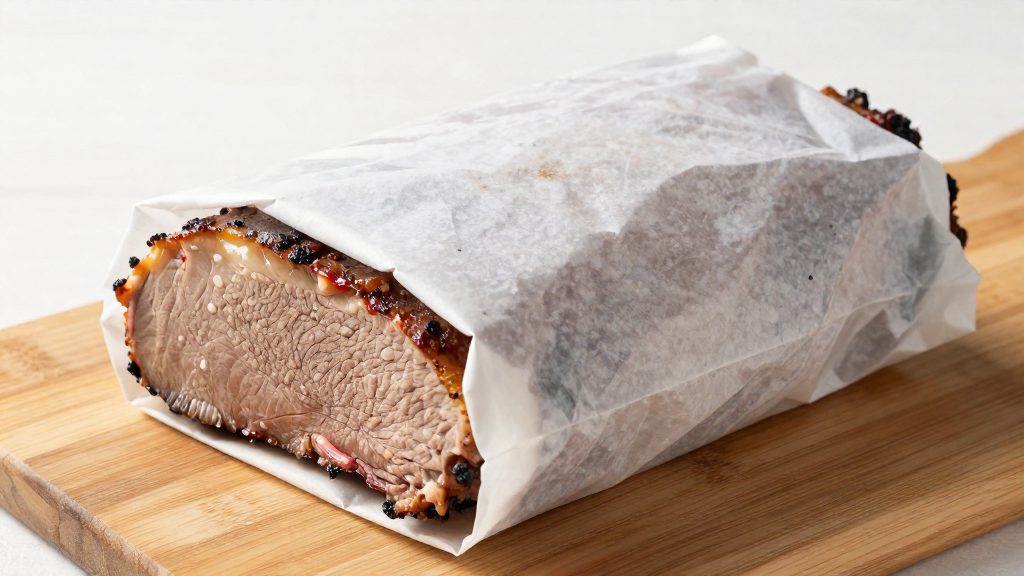
Why does resting brisket matter?
Resting is the stage where the meat’s internal moisture settles after cooking. During the smoke, heat pushes liquid toward the centre of the muscle, and the connective tissue breaks down into gelatin that holds water more stably. Cutting straight off the smoker interrupts this process, so the liquid that has not yet settled runs onto the cutting board instead of staying in the meat.
Juice redistribution is the main reason cooks give for resting: the liquid has time to settle in the meat instead of running onto the board when it is cut. A brisket sliced too early often shows a drier band near the surface than the same piece would have shown after a proper rest.
Temperature equalisation is the second effect. Immediately after removal, heat continues to travel from the hotter core toward the cooler exterior, so readings differ between the flat and the point. Letting the piece sit evens out these differences, so the slices cut from different sections have a more consistent texture and moisture level.
Moisture retention at the cut matters once slicing begins. Each cut exposes muscle fibres that release liquid faster than an intact surface does. A brisket that has finished redistributing its juices loses less liquid during slicing and serving, which keeps each portion moister on the plate.
Pull temperature before the rest
The usual pull point is 200–205°F (93–96°C) internal, the range where brisket is most tender according to Smoked BBQ Source (2024). Check the flat and the point with a probe thermometer, since the two sections can differ. Treat the range as a window rather than a single target, and pull once the probe slides in with little resistance. That feel is a more dependable sign than any one reading.
Why 203°F is partly superstition
Smoked BBQ Source (2024) describes the commonly cited 203°F mark as “a little more superstition than anything else.” The number is a useful guide, not a threshold that guarantees tenderness. Two briskets reading the same temperature can still differ in how easily the probe enters, so use the 200–205°F window as a starting point and confirm with probe feel in both sections.
Long smokes: drop to 180°F, then wrap
Tasting Table (2024) advises a different sequence for cooks that run past eight hours. Let the brisket fall to 180°F (82°C) before wrapping it, rather than pulling it at the standard window. Wrap it at that point, then begin the rest of at least one hour.
| Cook length | Internal temperature | Action |
|---|---|---|
| Standard cook | 200–205°F (93–96°C) | Pull from the smoker when the probe slides in easily |
| Longer than 8 hours | Fall to 180°F (82°C) | Wrap, then begin the rest |
How to rest brisket in a cooler
A cooler works as a holding vessel because its insulation slows heat loss. According to Smoking-Meat.com (2026), a brisket wrapped in towels inside an empty insulated cooler can stay hot for several hours. The method is simple, but results depend on how you load the cooler and how you keep it closed.
Loading the cooler
- Wrap the brisket in towels before it goes into the cooler. Wrap it snugly so the towels stay in contact with the meat.
- Place the wrapped brisket in the cooler and pack any gaps around it with additional towels so it does not shift during handling.
- Close the lid and leave it closed. Each time the lid opens, warm air escapes and the held meat loses heat faster.
Keep the cooler empty
Keep the cooler empty apart from the wrapped brisket. Ice, water, or other food takes up space and changes the conditions inside the container, which makes the holding time harder to predict. A brisket alone in an insulated cooler is the simplest setup to control.
Judging readiness
Holding time depends on the cooler and the amount of meat. Use a probe thermometer to check the internal temperature of the brisket before you slice it. Once the meat has been held, unwrap it on a cutting board and slice it against the grain.
Can you rest brisket at room temperature?
Only briefly, and only while the brisket stays wrapped. Smoked BBQ Source (Breanna Stark, 2024-10-16) limits a room-temperature rest to about one hour. A brisket resting on the counter loses heat over time, so the one-hour limit is a ceiling on counter time, not a target to fill.
Wrapping is the other half of the rule. The same source advises keeping the brisket wrapped during the rest, so an unwrapped rest at room temperature falls outside that guidance. Wrap the brisket before it starts resting, and keep it covered until the one-hour window ends. Resting it uncovered on the counter for the same period does not meet the advice.
Anything beyond about one hour at room temperature exceeds this guidance. A longer wait therefore requires active temperature control rather than leaving the meat on the counter. Because the cap applies to ambient resting specifically, the total time before slicing has to be split: up to one hour at room temperature, then a controlled method for any remaining wait.
Plan the timing so the brisket leaves the counter within the hour. Treating room temperature as an open-ended holding stage is the mistake the one-hour limit is designed to prevent.
Keep brisket above 140°F
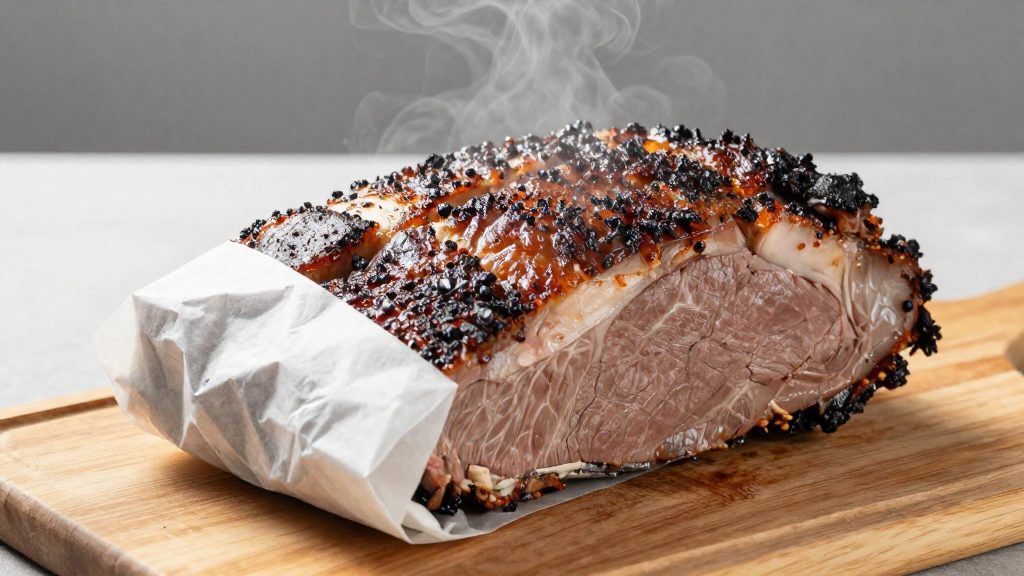
Hold a rested brisket above 140°F (60°C) for the whole rest. According to Smoking-Meat.com (Jeff Phillips, 2026), the brisket should stay above this temperature for as long as it is held. Smoked BBQ Source (Breanna Stark, 2024-10-16) explains why: once the internal temperature falls below 140°F, bacteria can spread rapidly.
The 140°F floor is a temperature the meat must maintain. It is not a property of the holding equipment, so it applies in every setup:
- Cooler: Tasting Table (Nikita Ephanov, 2024-05-10) warns against letting the brisket drop below 140°F inside a cooler.
- Any other holding setup: the same 140°F (60°C) minimum applies, and the meat must stay above it.
- Counter or table: a short rest at room temperature is governed by its own limit, so the floor here is a reminder that the meat must not cool past 140°F.
Insulation slows heat loss, but it does not raise the temperature of the meat. A well-insulated container can still let the brisket fall below 140°F if it starts cool or is opened often.
Checking the internal temperature with a probe
Confirm the temperature rather than relying on how warm the wrap feels.
- Insert the probe into the thickest part of the flat, away from bone and the outer fat layer.
- Read it at the start of the hold, to confirm the brisket is still above 140°F when it goes in.
- Recheck at regular intervals for the full hold, and note each reading.
- Act before the reading reaches 140°F. Waiting until it is already below the floor leaves no margin.
- Keep the probe in place where possible, so you can read the temperature without unwrapping the meat and losing heat.
How long is too long to rest brisket?
Hold safety is governed mainly by holding temperature, although a room-temperature rest also has a time cap of about one hour. Smoked BBQ Source (Breanna Stark, 2024-10-16) reports that its author aims for a rest of at least two hours. The same author aims for a rest of at least two hours and has held briskets in an insulated container for up to eight hours. Eight hours is one pitmaster’s practice, not a fixed ceiling, so the reading that matters is the internal temperature during the hold.
Smoking-Meat.com (Jeff Phillips, 2026) sets the threshold at 140°F (60°C): the brisket should stay above it while held. A wrapped brisket in an empty insulated cooler can remain hot for several hours, but a long hold only stays safe if the core remains above that line.
Holding limits and resting guidance answer different questions. Resting guidance concerns when to start slicing. A holding limit concerns how long the brisket can stay in the cooler before it enters the unsafe range. The thresholds below come from three sources and show how they relate:
| Threshold | Source | What it governs |
|---|---|---|
| Above 140°F (60°C) while held | Smoking-Meat.com (Jeff Phillips, 2026) | Safe holding in an insulated cooler |
| About one hour at room temperature | Smoked BBQ Source (Breanna Stark, 2024-10-16) | Ambient resting limit |
| Cooled to 145°F, or about two hours | Tasting Table (Nikita Ephanov, 2024-05-10) | Home-cook endpoint for resting |
The 145°F endpoint and the 140°F floor describe different stages. The first marks when a home cook can stop resting and serve. The second marks the point below which the hold is no longer considered safe. A brisket that has cooled to 145°F still has a margin above 140°F, but that margin shrinks with each additional hour. Use the internal probe reading, not the elapsed time, to decide whether a hold is still safe.
Slicing after the rest
Slicing determines how the brisket eats, so the direction and consistency of each cut matter as much as the cooking. Cut across the grain, perpendicular to the muscle fibres visible on the surface. Cutting with the grain leaves long, chewy fibres in each bite, while cutting across them shortens the fibres and makes each slice easier to chew. On a whole packer brisket, the grain runs in different directions in the flat and the point, so check each section before cutting instead of assuming one direction for the whole piece.
Use a long, sharp knife and make single, smooth strokes from heel to tip rather than sawing back and forth. Sawing tears the meat and breaks the bark, the dark crust that forms on the outside during smoking. A thin slicing blade reduces tearing and gives cleaner edges.
Aim for even thickness across the piece. Uniform slices give every guest the same texture and make the board look consistent. Because the flat is wider and the point is thicker and more irregular, adjust your cutting as you move between them. Slice the flat first, keeping the slices at a steady width, then separate the point and cut it to a similar thickness or set it aside for another use.
Work out the number of portions before you start. Cut only what the first round of guests will eat, and keep the rest whole and wrapped. A sliced surface loses heat faster than an intact piece, so cutting everything in advance leaves the whole batch cooling on the board.
Once sliced, serve promptly. Arrange the slices in a single layer on a warmed platter, or stack them in a pan with a lid or foil so they stay covered between servings. Return the remaining whole brisket to its wrapping, and slice more as needed rather than leaving a finished tray exposed to the air.
Frequently asked questions
Can brisket rest longer than two hours?
Yes, if it is held in an insulated cooler and stays hot. Smoked BBQ Source (2024) reports holding briskets this way for up to 8 hours, and the internal temperature should not fall below 140°F (60°C) during that time.
Is it safe to rest brisket on the counter?
Only briefly. Room-temperature resting should be limited to about one hour, and the brisket should stay wrapped, because bacteria spread rapidly once the internal temperature drops below 140°F (Smoked BBQ Source, 2024).
How does a long smoke change the rest?
After more than 8 hours of smoking, let the brisket fall to 180°F before wrapping it, then rest it for at least one hour. Tasting Table (2024) advises against letting it drop below 140°F while it sits in a cooler.