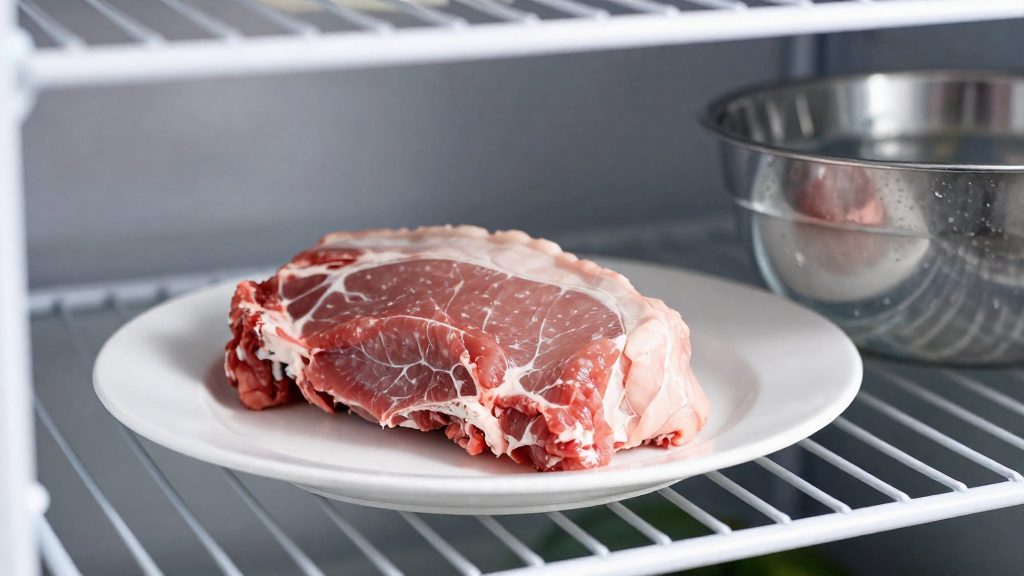
Thawing meat before grilling matters for three reasons: a frozen centre heats unevenly, the ice in the core must melt first, which absorbs energy, so the outside browns long before the middle is ready, and the thawing method determines how safely the meat reaches the grill. Planning the thaw in advance affects texture, cooking time and food safety.
Why is thawing meat before grilling important?
Uneven cooking when the centre stays frozen
When a cut is still frozen at the core, the surface receives the grill’s heat while the interior remains near freezing. The exterior develops a dark crust while the middle lags behind. Cooks then face a choice: overcook the outside to bring the centre up to temperature, or serve meat that is cooked unevenly. Thawing the meat fully first lets the heat reach the centre at the same pace as the surface, so the whole piece cooks with more uniform results.
Heat travel through ice slows the cooking process
Before the temperature of the meat can rise above freezing, the ice inside it has to melt. That phase change absorbs energy, so a frozen piece takes longer to cook than the same cut at fridge temperature. Grilling times given in most recipes assume unfrozen meat. A frozen cut placed on the grate under those timings will run behind schedule, and the cook has to extend the cooking time, which increases the risk of drying the surface.
Thawing as a food safety step before heat
Health Canada’s guidance, relayed by BC Hydro in 2022, identifies the refrigerator as the safest thawing method. It estimates about 24 hours per 2.5 kg (5 lb) of poultry and about 24 hours for most other meats, so the thaw should be scheduled before the cookout rather than improvised on the day.
Thawing in the fridge: the safest method
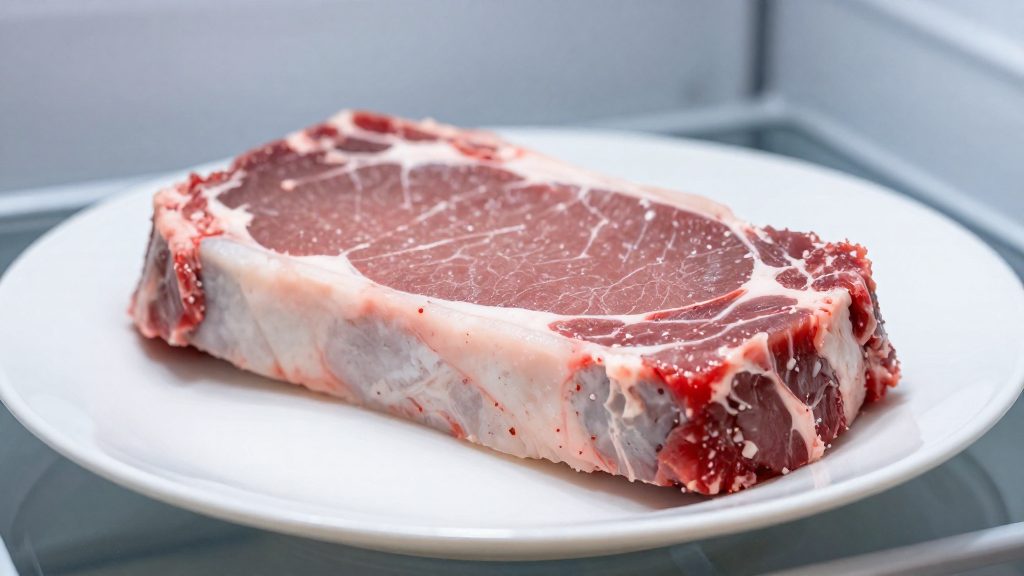
According to BC Hydro, citing Health Canada (2022), the refrigerator is the lowest-risk method for thawing frozen meat before grilling. The meat stays at refrigerator temperature for the whole thaw. The trade-off is time: this method takes a day or more.
Container placement
Place the frozen meat in a clean container on the bottom shelf of the refrigerator. The container catches juices released as the meat thaws, which keeps the liquid from dripping onto other foods. Leave the meat in the container until it is fully thawed, then move it to the grill area of your kitchen for preparation.
Estimated thaw durations
| Item | Estimated time in the refrigerator |
|---|---|
| Poultry, per 2.5 kg (5 lb) | About 24 hours |
| Most other meats | About 24 hours |
The poultry figure applies per 2.5 kg (5 lb), so the estimate is a reference point for typical portions rather than a fixed timetable.
How do you thaw meat quickly in cold water?
The cold water method is the faster alternative to refrigerator thawing. According to BC Hydro, citing Health Canada (2022), the method is to seal the meat in leak-proof plastic and submerge it in ice water. Use a bag or wrap that is fully sealed, and check the seal before the package goes into the water, so that water cannot leak into the packaging.
Follow these steps:
- Seal the meat. Place the cut in leak-proof plastic and close it completely.
- Prepare ice water. Fill a container with water and plenty of ice. The water must stay at or below 4°C, which you confirm with a thermometer rather than by estimate. Add ice as it melts to keep the temperature down.
- Submerge the package. Keep the sealed meat fully underwater for the whole thawing period.
- Allow about 30 minutes per pound. Use the table below to estimate the time for common weights.
| Meat weight | Approximate cold water thaw time |
|---|---|
| 1 lb (about 0.45 kg) | about 30 minutes |
| 2 lb (about 0.9 kg) | about 1 hour |
| 4 lb (about 1.8 kg) | about 2 hours |
| 5 lb (about 2.3 kg) | about 2.5 hours |
The 30-minute figure is a per-pound estimate, so larger cuts need proportionally longer. Check the meat before cooking, and do not extend the water time beyond what the cut needs.
Can you use the microwave to thaw meat?
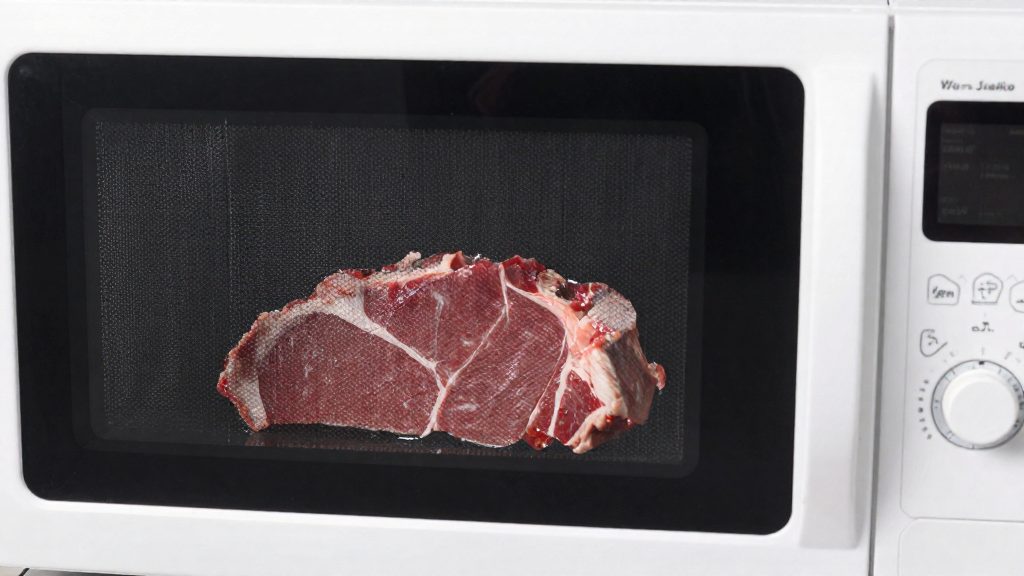
Yes, but only under strict conditions. According to BC Hydro (citing Health Canada, 2022), microwave thawing is acceptable only in microwave-safe containers. Treat the microwave as a fast option for meat you are about to grill, not as a storage method. Heat can build unevenly across a cut, so parts may start to cook while other areas remain frozen.
Choosing the right container
The packaging matters as much as the power setting. The same source identifies three materials to avoid:
| Packaging | Status for microwave thawing |
|---|---|
| Polystyrene trays | Avoid |
| Plastic wrap | Avoid |
| Cardboard | Avoid |
| Microwave-safe glass or ceramic dish | Acceptable |
Remove the meat from its supermarket tray and any plastic film, then place it in a microwave-safe dish before starting the cycle.
Checking the defrost button manually
The defrost button can be unreliable, so the programmed setting may not match the weight, thickness or shape of your cut. Do not leave the process unattended. Pause the microwave at intervals, separate or turn the pieces, and feel for areas that are soft while others are still hard. Stop as soon as the meat is pliable enough to handle, and do not let any section begin to warm or cook.
Cooking the meat straight after thawing
Because cook immediately is the required rule, plan the grilling session before you start. Preheat the charcoal, gas, pellet or kamado grill, or the plancha, and prepare seasoning and tools in advance. Once the meat has thawed, move it straight to the heat. Leaving microwave-thawed meat to wait before cooking goes against the guidance from BC Hydro (citing Health Canada, 2022).
Why you should never thaw on the counter
Thawing on the counter exposes the outside of the meat to room temperature, which is well within the range where bacteria multiply quickly. According to BC Hydro, citing Health Canada (2022), at 5°C or above, bacteria multiply quickly, and room-temperature thawing is not acceptable for that reason. The surface of the meat reaches that range long before the centre has thawed.
The problem is uneven heat transfer. As a frozen steak, roast or cut of meat sits on the counter, its outer layers absorb ambient warmth and rise above 5°C first, while the core stays frozen. The surface therefore spends the longest time in the growth range, and it is also the part most exposed to handling and contact with work surfaces. Because the centre is still solid, you cannot judge by feel whether the whole piece has thawed, so the outer layer may already have been in the growth range for a considerable time without any visible sign.
Brief exposure still carries risk. Bacteria begin multiplying once the surface passes 5°C, so a short period on the counter is not a neutral step. It adds to the bacterial load that the meat carries into the cooking stage. The same reasoning applies to every cut and to ground meat, since the warm surface is the problem regardless of the piece’s size or shape.
Related reading
- Safe fridge thawing and juice containment
- Cooking immediately after thawing
- Target internal temperatures for meat
Can you grill meat straight from frozen?
Grilling meat straight from frozen is possible, but it changes how heat must be managed. The cut needs a deliberate heat plan rather than a standard sear over the whole grate.
Set up two heat zones
Light the grill so that one area carries direct heat and the other is off the flame or coals. Place the frozen cut on the indirect zone with the lid closed. The enclosed air warms the centre gradually, which lets the interior catch up with the surface. Once the core is no longer frozen, move the cut over direct heat for a short finishing sear.
Watch for surface charring
Surface charring is the main risk. Over direct heat, the outside can blacken while the middle is still icy. If the surface darkens faster than expected, move the cut to the indirect zone and keep the lid closed. Sugary marinades and rubs char more quickly, so apply them sparingly or after the meat has cooked through.
Mind the thickness
Thin cuts, such as sliced steak or thin chops, are the most practical candidates for cooking from frozen, because heat penetrates them faster. Thick roasts and large steaks are harder to manage this way: the exterior can overcook well before the centre is done. For these cuts, a partial thaw before grilling gives more predictable results.
Safe internal temperatures once it hits the grill
Health Canada sets minimum internal temperature targets for each type of meat, and the centre of the thickest piece must reach the target value before the meat leaves the grill. For beef steak, the target depends on the doneness you want, from 63°C (145°F) for medium-rare to 77°C (170°F) for well done. Other meats have fixed minimums, and poultry has the highest.
| Meat | Minimum internal temperature |
|---|---|
| Beef steak, medium-rare | 63°C (145°F) |
| Beef steak, medium | 71°C (160°F) |
| Beef steak, well done | 77°C (170°F) |
| Fish | 70°C (158°F) |
| Ground meat (beef, veal, lamb, pork) | 71°C (160°F) |
| Pork pieces and whole cuts (ham, loin, ribs) | 71°C (160°F) |
| Veal and lamb pieces and whole cuts | 63°C (145°F) medium-rare, 71°C (160°F) medium, 77°C (170°F) well done |
| Ground poultry and poultry pieces | 74°C (165°F) |
| Whole birds | 82°C (180°F) |
Ground meat carries a higher limit than whole steak because grinding spreads surface bacteria through the entire mass, so there is no rare option. Whole birds need the highest figure of all, 82°C, while poultry pieces stop at 74°C.
For thick steaks, insert a probe thermometer into the thickest part, away from bone and fat, and read the value before resting the meat. Thin cuts reach the target faster, so check them earlier. Mechanically tenderized steak needs particular attention, since blade or needle tenderizing carries surface bacteria into the interior.
Fish reaches its minimum at a lower temperature than poultry, but it still needs a reading. Flaky flesh that separates easily is a visual sign, not a substitute for the 70°C (158°F) check.
Frequently asked questions
Can I leave frozen meat on the counter to thaw while the grill heats up?
No. Thawing at room temperature is unsafe because bacteria multiply quickly at 5°C or above, so use the refrigerator, cold water or microwave instead. Once the meat has thawed by any method, cook it right away rather than holding it.
How long does a cold-water thaw take before grilling?
According to BC Hydro, citing Health Canada (2022), seal the meat in leak-proof plastic and submerge it in ice water kept at or below 4°C, allowing about 30 minutes per pound (roughly 0.45 kg). Check the water temperature with a thermometer during the thaw, since warmer water raises the risk of bacterial growth.
Can I use the microwave to thaw meat and grill it straight away?
Yes, but only in microwave-safe containers, because polystyrene trays, plastic wrap and cardboard are unsuitable. The defrost setting can be unreliable, so the meat may begin cooking unevenly. Grill it immediately after thawing and do not refreeze it.