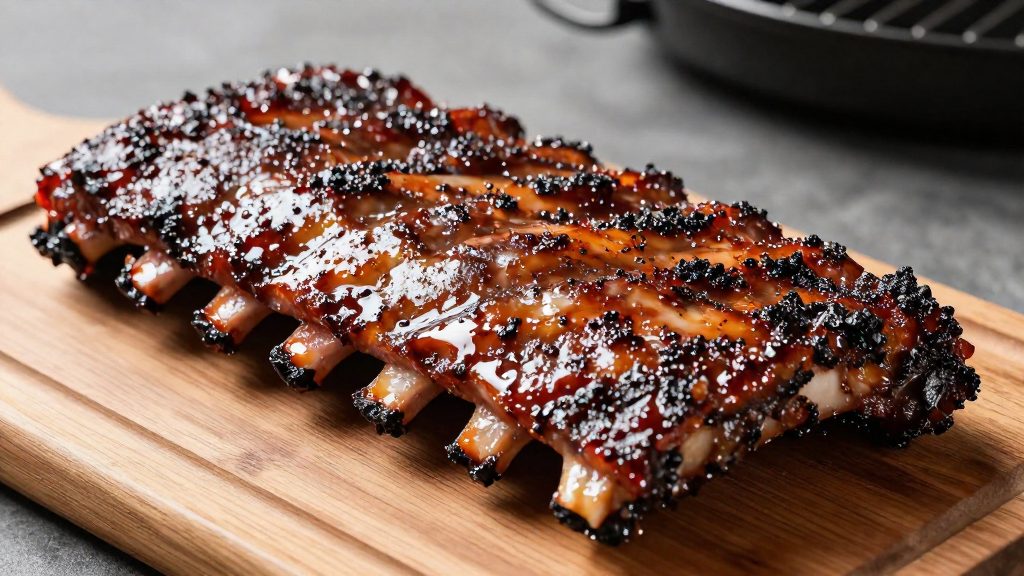
A baby back rib dry rub is built by counting parts, not measuring by volume. You choose one total weight, assign whole-number parts to sugar, salt and spices, then divide the total weight by the total parts to get the weight of one part. Because every ingredient is a fixed multiple of that unit, the balance of sweet, salty and spiced stays the same whatever the batch size.
Dry rub ratio for baby back ribs: the basic formula
Core ratio of sugar, salt and spices by parts
The mix has three groups of ingredients, and each has a distinct job on the surface of the meat:
| Component | Role in the mix | Share of the total |
|---|---|---|
| Sugar | Sweetness and browning of the surface | Largest share |
| Salt | Seasons the meat | Smaller share than the sugar |
| Spices | Colour, heat and aroma | Remaining parts, split between a base spice and accents |
Sugar is the largest share because it drives the sweetness and the dark crust. Salt is always a smaller portion than sugar, so that the sweetness stays dominant. Spices take the remaining parts, and can be divided between one base spice and smaller accents.
Converting parts into grams with a kitchen scale
Volume measures such as spoons vary with how loosely an ingredient is packed. Weighing removes that variable:
| Step | Action |
|---|---|
| 1 | Choose the total weight of the finished mix in grams |
| 2 | Add all the parts together to get the total number of parts |
| 3 | Divide the total grams by the total parts to get grams per part |
| 4 | Multiply each ingredient’s parts by grams per part |
Hypothetical example: a 300 g batch with 6 parts sugar, 2 parts salt, 1 part base spice and 1 part accent spice gives 10 parts in total. That makes 30 g per part, so the sugar weighs 180 g, the salt 60 g, and each spice 30 g.
Grinding and blending spices for an even mix
Whole spices should be ground before they are weighed and mixed, so that the particles are uniform. Brown sugar often forms lumps, which must be broken up by pressing the sugar through a sieve or crushing it with the fingers. Lumps left in the mix concentrate flavour in some spots and leave others bare.
Once the ingredients are weighed, combine them in a sealed container and shake or whisk until the colour is uniform across the whole mix. Check the bowl edges and base, where unmixed powder tends to collect. Store the blend in an airtight container until use so that the sugar does not absorb moisture and clump again.
What is the 8:3:1:1 rub ratio?
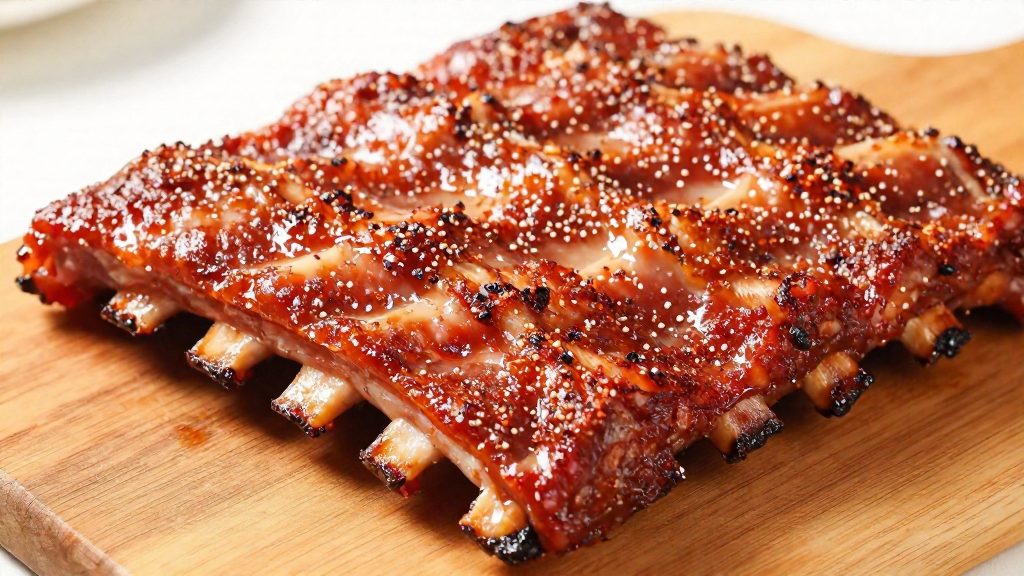
The 8:3:1:1 ratio is a formula for a dry rub expressed in parts rather than fixed weights. Alton Brown’s baby back rib rub, as described by Tasting Table (2026), uses 8 parts brown sugar, 3 parts kosher salt, 1 part chili powder, and 1 part of a spice blend. Because the ratio is relative, you can mix any unit of measure (spoons, cups, or grams) as long as each ingredient keeps its proportion to the others.
| Ingredient | Parts | Role in the rub |
|---|---|---|
| Brown sugar | 8 | Forms the bulk of the rub and caramelizes on the surface during cooking |
| Kosher salt | 3 | Seasons the meat and balances the sweetness |
| Chili powder | 1 | Adds mild heat and a base of earthy chile flavor |
| Spice blend | 1 | Adds layered pepper, heat and savory notes |
The spice blend is itself a mix of six ingredients. Tasting Table (2026) lists black pepper, cayenne, jalapeño seasoning, Old Bay, thyme and onion powder, with each ingredient at about ½ tsp in the reference recipe.
Sugar makes up a little over three fifths of the rub by parts (8 of 13, about 62%), which explains why the ratio is considered sweet-forward. The salt share (3 parts) is high enough to season the meat thoroughly without dominating the sugar. Chili powder and the spice blend, at one part each, provide heat and aromatic depth without overwhelming the sweetness.
How to apply the rub across a rack of ribs
Tasting Table (2026) describes patting the rub generously on both sides of the ribs, so the quantity question becomes one of dividing a single batch between the two faces. Rather than weighing a fresh portion for each rack, mix one batch and treat it as the pool you draw from.
Split the batch into two roughly equal piles before you start. Use one pile for the meat side and the other for the bone side. Keep a small reserve in a separate bowl so you can fill any gaps without re-dusting the whole rack.
- Lay the rack meat side up on a board or tray. Pat the first portion across the surface with your palm, pressing gently so the grains adhere.
- Check the edges and the thinner tips at each end, which are easy to miss.
- Turn the rack over and apply the second portion to the bone side, again pressing rather than sprinkling.
- Inspect both faces under good light. Any bare patches get a pinch from the reserve.
Both faces should look evenly coated. The spice blend includes ingredients such as black pepper and cayenne, so an uneven layer will show as dark specks and blank areas once the ribs are cooked.
Adjusting for different rack sizes comes down to surface area. A larger rack, with more meat and a longer bone run, needs a bigger share of the batch. A smaller or trimmed rack needs less. Because quantities are judged by eye here, the test is coverage: each face should be visibly covered with no bare meat showing.
Sugar and salt balance by style
Rib rubs differ mainly in how much of the mix is sugar and how much is salt, and that balance sets the flavour and the surface colour. The sugar share controls sweetness and bark darkening, while the salt share controls seasoning depth and how much moisture the meat holds. Changing the ratio moves the rub toward one of three profiles.
| Style | Sugar share | Salt share | Heat source |
|---|---|---|---|
| Sweet-forward | Highest; brown sugar leads the mix | Moderate, enough to season | Little or none |
| Savoury | Reduced, so the meat and spices stand out | Higher, to carry the seasoning | Optional, often none |
| Spicy | Moderate, to balance the heat | Moderate to high | Chili powder and cayenne, scaled up |
Sweet-forward rubs use brown sugar as the main component. The sugar caramelises during a long, low cook and produces a dark, sticky surface. Because sugar burns at higher temperatures, a sweet rub needs close watching on a hot grill, and a rib that has been sauced late can scorch.
Savoury rubs cut the sugar and raise the salt, so the seasoning reads as the primary flavour rather than sweetness. Salt penetrates the meat more deeply than sugar, so a higher salt share gives more even seasoning through the cut. Use a salt-to-sugar balance that suits how much sauce you plan to add afterwards.
Spicy rubs keep a moderate sugar share to round off the heat. Increase chili powder and cayenne gradually, in small steps, and taste the rub before applying it. Cayenne is the stronger of the two, so a small increase in cayenne changes the heat level more than the same increase in chili powder. Mix the powders thoroughly so that no pockets of heat sit on a single area of the rack.
Record the proportions you use, in parts, so you can repeat or adjust a rub from one cook to the next.
How long should the rub sit on the ribs?
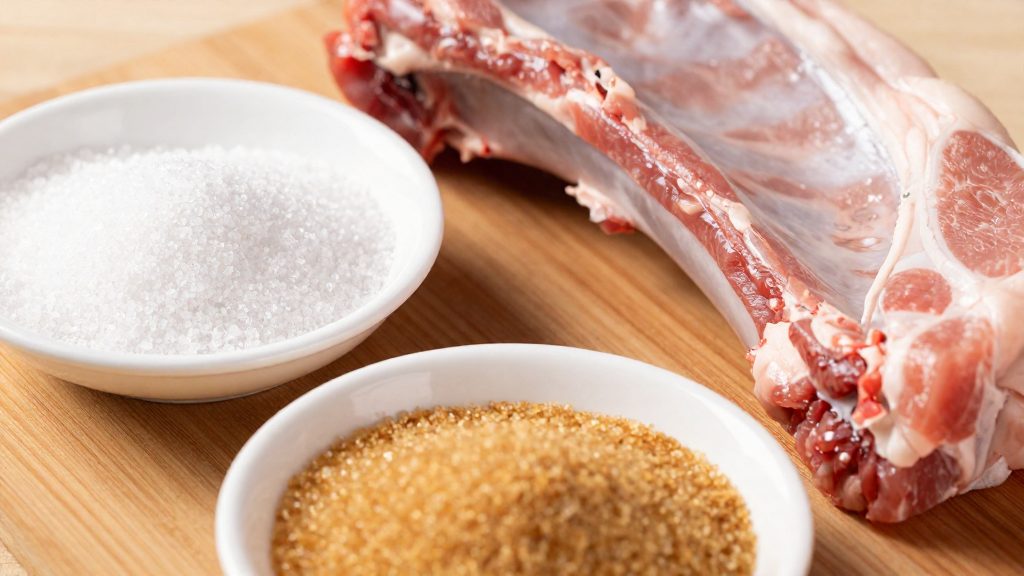
Tasting Table (2026) recommends a minimum rest of one hour in the refrigerator, with longer being better, after the rub is applied. The ribs are wrapped in foil before they go in the fridge, so the rub stays against the meat while it rests. Rest the ribs in the refrigerator and cook them afterwards, rather than cooking straight after applying the rub.
The same rule applies whichever cooking method follows. Tasting Table (2026) gives one rest guideline for all three options:
- Baking: wrap the rubbed ribs in foil, refrigerate for at least one hour, then bake.
- Grilling: wrap the rubbed ribs in foil, refrigerate for at least one hour, then grill.
- Combination: wrap the rubbed ribs in foil, refrigerate for at least one hour, then use the combined method.
The source does not give separate rest times for baking and grilling, so the one-hour minimum is the only sourced figure for both. Because longer rests are described as better, a practical approach is to apply the rub in the morning or the evening before and leave the wrapped ribs in the refrigerator overnight, provided the cooking plan allows it.
For the cook itself, keep the wrapped ribs cold until you start. Unwrap them when you are ready to place them on the heat or in the oven, so the rub and the surface of the meat are in the state the recipe expects.
Adapting the rub for charcoal, gas, pellet or kamado
The same rub behaves differently depending on the cooker because the sugar reacts to how the heat reaches the meat. The cooking setup has a strong influence on bark colour.
| Grill type | Heat delivery | Sugar risk | Bark behaviour |
|---|---|---|---|
| Charcoal | Radiant heat from embers, often direct | High if ribs sit over the coals | Dark and fast-forming, with smoke flavour |
| Gas | Direct burner heat, flare-prone | High, plus drippings can ignite | Forms on the rub itself, little smoke contribution |
| Pellet | Indirect, controlled by the controller | Low to moderate | Even, slow colour; smoke coats the rub |
| Kamado | Indirect with stable ceramic heat | Low when used in indirect mode | Deep, glossy bark over long cooks |
Sugar caramelisation on direct high heat is the main risk on charcoal and gas. Brown sugar darkens quickly over direct heat and can turn bitter before the meat is tender. Keep the ribs on the cooler side of the grill, or move them off direct heat once the surface has set, rather than reducing the sugar in the rub.
Indirect smoking on kamado and pellet grills suits a sugar-heavy rub. Steadier surface heat gives the sugar time to form a glaze instead of scorching, and the tacky surface the rub creates holds smoke well. Kamado cookers hold heat for long periods, so vent adjustments change temperature slowly. Pellet grills respond to controller settings, which makes them easier to adjust mid-cook.
Gas grill flare-ups with sugar-heavy rubs happen when rendered fat and sugar drip onto a lit burner, especially when the lid is opened. Set up two zones with the burners under the ribs turned off, and trim excess fat before applying the rub so less material falls onto the flame.
Common rub mistakes to avoid
Most rub problems on baby back ribs come from three habits: applying too much, applying unevenly, and storing the blend in damp conditions. Each one shows up on the plate as a specific fault, and each has a practical fix.
Over-applying the rub
Salt is the ingredient most likely to overshoot. A heavy hand concentrates seasoning on the surface quickly. The recommended method is to pat the rub generously onto both sides of the rack, which means covering the surface, not building a thick crust. Doubling up with a second coat can leave ribs tasting salty on the outside while the meat beneath remains under-seasoned. Take the blend from a small bowl rather than directly from the jar, pat it on, and stop once the surface is evenly covered.
Uneven coverage and patchy bark
Clumps and missed areas produce patchy bark: dark, over-seasoned patches beside bare meat. Work in thin layers from a short distance, then press the rub into the meat with your palm so it adheres. Check the thin bone side and the edges of the rack, which are easy to skip. Even coverage gives the sugar and spices a consistent surface to bond with, so the bark forms uniformly during cooking.
Storing blended rub in humid conditions
Rub is a mixture of fine sugar, salt and ground spices, and moisture makes it clump and cake. Lumpy rub cannot be spread evenly, so the first two mistakes follow. Keep the blend in an airtight container in a dry cupboard, away from the grill, the sink and any steam. Mix it in small batches, and discard any batch that has hardened or smells stale, since the ground spices lose potency over time.
Frequently asked questions
How do I turn the 8:3:1+1 ratio into a weighed batch?
Add the parts together: 8 brown sugar, 3 kosher salt, 1 chili powder and 1 spice blend make 13 parts. Divide your target weight in grams by 13 to get the weight of one part, then multiply each ingredient’s parts by that figure.
Why is the sugar share so high, and when should the rub go on?
Brown sugar makes up 8 of 13 parts, about 62% of the mix, which is what drives the sweetness and dark crust. Pat the rub generously onto both sides of the ribs, wrap them in foil, and refrigerate for at least an hour before cooking, with longer resting giving the rub more time to work into the meat.
What goes into the one-part spice blend?
The blend is black pepper, cayenne, jalapeño seasoning, Old Bay, thyme and onion powder, with each ingredient at about ½ tsp in the original recipe. Because those amounts are given by volume, weigh your version as spice parts to keep the batch consistent with the ratio.