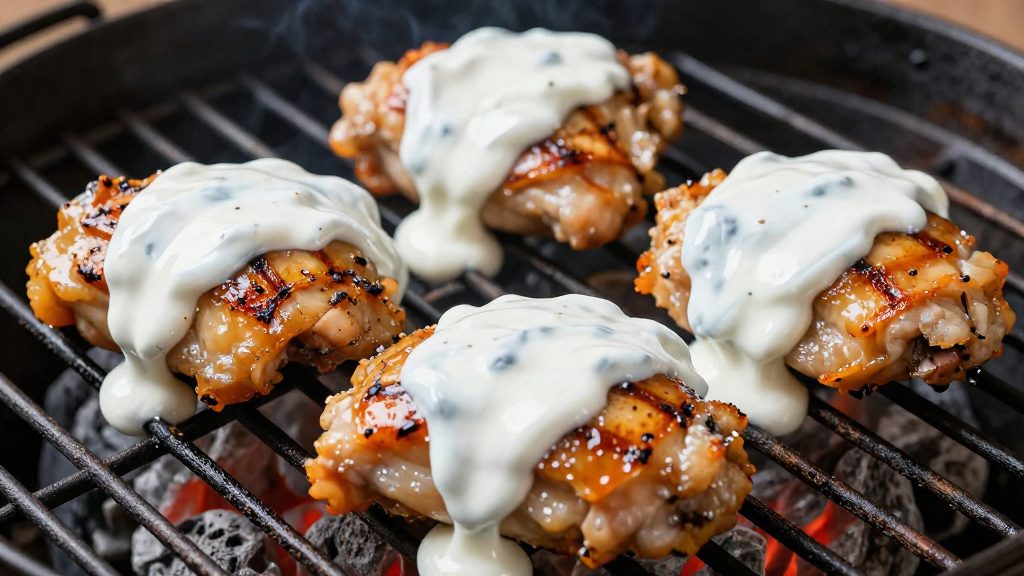
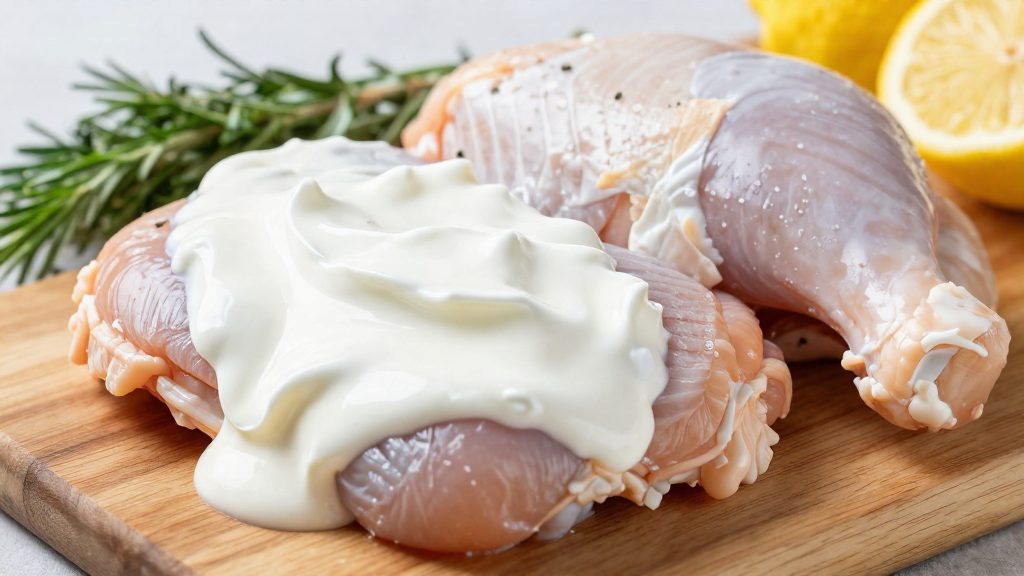
Greek yogurt suits a chicken marinade because its lactic acid acts gently on the surface of the meat, and its thick body forms a coating that stays on the chicken instead of dripping off. Compared with thin citrus-only mixtures, it gives a more even layer of garlic, herbs and spices. Used with lemon juice, as in the Well Plated recipe, it combines a dairy base with a citrus acid.
Why use Greek yogurt to marinate chicken?
How lactic acid affects the meat
Greek yogurt contains lactic acid, the mild acid that gives it its tang. In a marinade, it works slowly on the outer layer of the poultry rather than breaking down the muscle quickly. This is why yogurt is best treated as a gentle tenderiser that needs time to act, not a fast one.
Dairy proteins and the thick coating
The proteins and body of plain Greek yogurt form a thick coating that clings to the chicken’s surface. Because the layer is dense, it stays in place when the pieces are placed on the grates, so the seasoning remains on the meat rather than pooling in the bowl. Many cooks rely on this layer to help limit surface drying during cooking.
Comparison with citrus-only marinades
Citrus juice is acidic, but on its own it is a thin liquid that does not form a comparable layer on the chicken. The Well Plated recipe pairs yogurt with lemon juice, using the two together rather than choosing one. The yogurt supplies the coating and the lactic acid, while the lemon adds a brighter citrus note.
Handling the marinated chicken safely
Health Canada advises keeping the refrigerator at 4°C (40°F) or lower, so chicken should marinate in the fridge rather than on the counter.
Basic Greek yogurt marinade ingredients
A basic Greek yogurt marinade for grilled chicken is built on a fixed ratio: 1/2 cup of plain Greek yogurt for 1.5 lb of boneless chicken, according to Well Plated (2025). The yogurt forms the base, garlic, olive oil and lemon juice add flavour and acidity, and the herbs and spices complete the blend. Because the ratio is tied to weight, a larger batch means scaling every ingredient together.
The core set is:
| Ingredient | Amount for 1.5 lb chicken | Approximate amount per 1 lb |
|---|---|---|
| Plain Greek yogurt | 1/2 cup | about 1/3 cup |
| Garlic cloves | 4 | about 2.7 |
| Olive oil | 2 Tbsp | about 1.3 Tbsp |
| Lemon juice | Juice of 1 lemon | about 2/3 of a lemon |
The per-pound column is calculated by dividing each amount by 1.5.
The seasoning group is oregano, thyme, salt, paprika and cumin. These go into the same bowl as the wet ingredients rather than being applied separately, so the whole mixture coats the meat evenly. The recipe specifies plain yogurt, so flavoured Greek yogurts fall outside this ratio and change the balance of sweetness and seasoning.
To prepare the base, whisk the yogurt, crushed or minced garlic, olive oil, lemon juice and seasonings in a bowl large enough to hold the chicken with room to turn it. Add the chicken and toss until every surface is coated. Cover the bowl before refrigerating so the mixture does not dry out or pick up odours from the fridge.
How long should you marinate chicken in yogurt?
The marinating window depends on the recipe and the cut. In the classic Greek yogurt marinade, Well Plated gives a window of 2 to 24 hours for 1.5 lb (about 680 g) of boneless chicken before it goes on high heat. The lighter version, made with 1% plain Greek yogurt and boneless thighs, has a shorter window of 1 to 8 hours in the fridge, according to Skinnytaste. The two windows overlap between 2 and 8 hours.
Classic recipe: boneless chicken, 2 to 24 hours
The classic marinade combines 1/2 cup plain Greek yogurt, 4 garlic cloves, 2 Tbsp olive oil, the juice of 1 lemon, oregano, thyme, salt, paprika and cumin. Its window is wide. Two hours is the shortest recommended rest, and 24 hours is the longest. That range lets you marinate the chicken either shortly before cooking or the day before.
Lighter version: boneless thighs, 1 to 8 hours
The lighter recipe uses 2 lb (about 900 g) of boneless thighs with 1/2 cup 1% plain Greek yogurt, olive oil, red wine vinegar, garlic, oregano, turmeric and salt. Its ceiling is 8 hours, so an overnight rest falls outside its recommended window. Use the lighter recipe for a shorter, same-day marinade.
Choosing same-day or overnight marinating
Match the timing to the recipe before you start. The table below shows which recipe fits each marinating time.
| Marinating time | Classic recipe (2 to 24 h) | Lighter thigh version (1 to 8 h) |
|---|---|---|
| 1 hour | No | Yes |
| 2 to 8 hours | Yes | Yes |
| 24 hours | Yes | No |
For same-day cooking, a 2 to 8 hour marinade fits both recipes. For overnight planning, choose the classic recipe, since only its window extends to 24 hours. Set a timer when the chicken goes into the marinade so you can track the window accurately.
Best cuts of chicken for the grill
Boneless breast and boneless thigh are the two cuts behind the two Greek yogurt marinades in this article, and they respond differently on the grate. Well Plated’s version uses 1.5 lb of boneless chicken, with 1/2 cup of plain Greek yogurt.
| Recipe | Cut | Weight | Yogurt | Source |
|---|---|---|---|---|
| Classic Greek yogurt marinade | Boneless breast portions | 1.5 lb | Plain Greek yogurt | Well Plated |
| Lighter Greek yogurt marinade | Boneless thighs | 2 lb | 1% plain Greek yogurt | Skinnytaste |
Breast is the leaner cut. It has less surface fat, so the yogurt marinade and oil do more of the work in keeping the meat moist, and it dries out faster if left on the grill too long. Thigh has more intramuscular fat, which gives it more margin for error and a juicier bite. The two recipes also differ in batch size: the lighter recipe is written for 2 lb of thighs, and the classic one for 1.5 lb of boneless chicken.
Cutting for even cooking on the grate
Whichever cut you choose, uniform thickness matters more than the cut itself. Thick and thin areas on the same piece finish at different rates, so a thin edge can overcook while the center is still underdone.
- Pound breast portions to an even thickness before marinating, using a meat mallet or a flat-bottomed pan.
- Trim thigh pieces so they are roughly the same size and thickness, and butterfly any thick sections so they match the rest.
- Lay pieces in a single layer with space between them, so the heat reaches all surfaces.
How to grill yogurt-marinated chicken
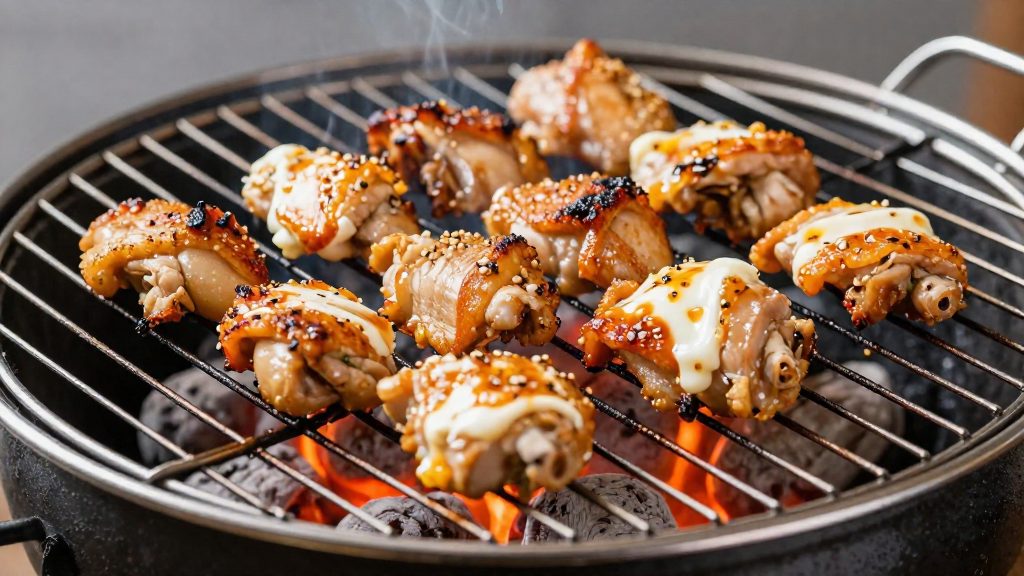
Grilling yogurt-marinated chicken depends on two choices: the heat level and how long the meat stays over the flame. The two reference recipes in this review differ on both. A Greek yogurt recipe from Well Plated, written for 1.5 lb of boneless chicken, calls for high heat for 8 to 12 minutes total. A lighter Skinnytaste version, written for 2 lb of boneless thighs, uses medium-low heat for about 5 to 7 minutes per side.
| Recipe | Cut | Heat | Cooking time |
|---|---|---|---|
| Greek yogurt marinade | Boneless chicken | High | 8 to 12 minutes total |
| Lighter yogurt marinade | Boneless thighs | Medium-low | 5 to 7 minutes per side |
The sources disagree because the first method sears quickly and the second cooks more gently, taking roughly 10 to 14 minutes in total. For most home grills, the medium-low timing is the safer starting point. It leaves room to correct the heat, and the yogurt coating is less likely to char before the centre is cooked. Check doneness with a thermometer rather than relying on the clock alone.
Setting up heat zones
Set up two zones on a charcoal or gas grill: one side at full heat and one side off or on low. Start the chicken over the hot side only long enough to colour the surface, then move it to the cooler side to finish cooking through. This prevents the marinade from burning while the inside is still raw. On a kamado or pellet grill, the same approach works with the deflector or the heat deflector plate, with the chicken placed on the indirect side.
Managing drips and flare-ups
Yogurt and olive oil drip off the meat and can ignite on contact with the flame or burner. Several steps reduce this:
- Shake off excess marinade before the chicken touches the grate.
- Keep the grill lid closed when cooking with indirect heat, so the drips land on a cooler surface.
- If a flare-up starts, move the chicken to the cooler zone until the flames die down.
- Never pour leftover marinade over the chicken once it is on the grill.
Clean the grates and drip tray between cooks, since residue from yogurt and oil builds up quickly and feeds future flare-ups.
What internal temperature is safe for chicken?
Health Canada (canada.ca) sets the safe internal temperature for chicken by type of cut. For poultry pieces, such as grilled chicken breasts or thighs, the target is 74°C (165°F). For a whole bird, the target is 82°C (180°F). Check these values against the thickest part of the meat, since the surface of a grilled piece browns long before its centre reaches temperature.
| Chicken format | Health Canada safe internal temperature |
|---|---|
| Poultry pieces (breasts, thighs) | 74°C (165°F) |
| Whole bird | 82°C (180°F) |
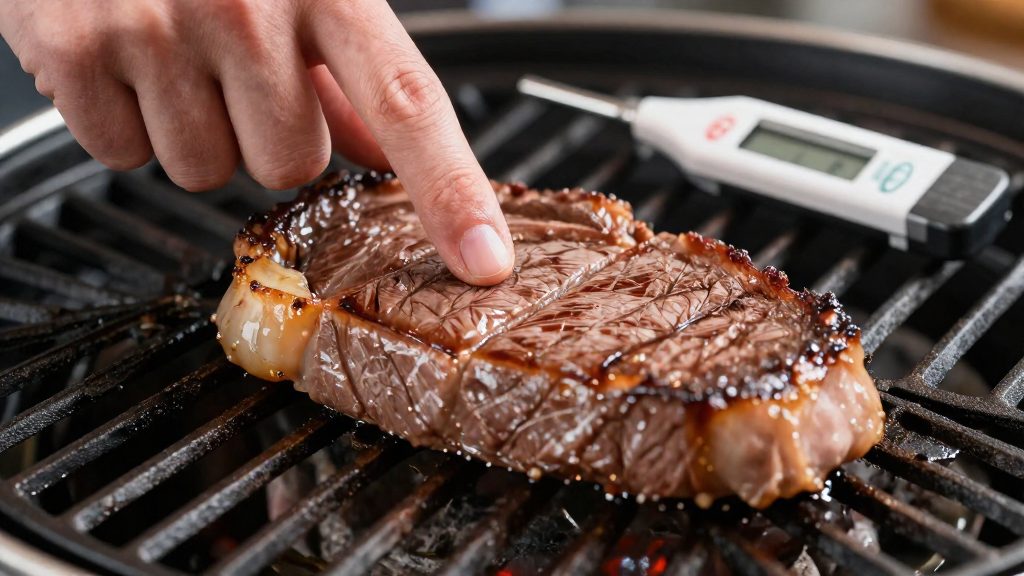
Health Canada advises checking doneness with a digital food thermometer. The same source says to keep the probe from touching bone. A probe resting against bone reads the bone rather than the surrounding meat, which can produce a misleading number.
How to place the probe
- Insert the probe sideways into the thickest part of the piece, aiming for the centre of the meat rather than the surface.
- Keep the tip clear of bone. On bone-in thighs, angle the probe so the tip sits in muscle, away from the bone.
- Read the temperature before moving the chicken off the grill. If it is below the target, close the lid, move the piece away from direct heat, and check again in a different spot.
- Check a whole bird in more than one place, such as the thickest part of the breast and the innermost part of a thigh, and confirm both readings reach 82°C (180°F).
Food safety tips for marinating and grilling
Safe handling starts before the grill is lit. Health Canada (2025) sets the storage limits for raw chicken and its marinade, and the table below lists them with the thawing rule that applies to poultry.
| Storage situation | Requirement |
|---|---|
| Refrigerator | 4°C (40°F) or lower |
| Freezer | -18°C (0°F) or lower |
| Refreezing thawed poultry | Only if it is still at 4°C or colder |
Keep the marinade and the raw chicken in the refrigerator until you are ready to cook. Yogurt marinades are dairy-based, so they should not sit at room temperature during prep. Plan frozen chicken ahead by thawing it in the refrigerator, not on the counter. Once poultry has thawed there and is still at 4°C or colder, it can be returned to the freezer. If it has warmed beyond that point, cook it or discard it rather than refreezing it.
Cross-contamination is the main risk during marinating. Use a separate bowl for the raw chicken and a clean plate for the cooked meat. Do not reuse the marinade that touched raw chicken as a sauce unless it is boiled first. Health Canada advises washing the thermometer and any utensils that touched raw or partly cooked poultry before reusing them. Wash them with hot, soapy water, then rinse and dry them before they touch cooked food.
Thermometer hygiene matters as much as the meat itself. Clean the probe after every check, because a thermometer that has been inserted into raw chicken can carry bacteria to the next piece of food. Wash it between each piece of poultry you test, not only at the end of the session.
Serving ideas and variations
The lighter version swaps the classic plain Greek yogurt for 1% plain Greek yogurt and uses red wine vinegar instead of lemon juice. The table compares it with the classic Greek yogurt marinade published by Well Plated, which is built for 1.5 lb of boneless chicken.
| Component | Classic version (Well Plated) | Lighter version (Skinnytaste) |
|---|---|---|
| Yogurt | 1/2 cup plain Greek yogurt | 1/2 cup 1% plain Greek yogurt |
| Acid | Juice of 1 lemon | Red wine vinegar |
| Fat | 2 Tbsp olive oil | Olive oil |
| Seasoning | Oregano, thyme, salt, paprika, cumin | Oregano, turmeric, salt |
| Meat | 1.5 lb boneless chicken | 2 lb boneless thighs |
The lighter base has fewer spices and a sharper, vinegar-led flavour, and the turmeric gives the thighs a yellow colour. Because thighs carry more fat than breast meat, the reduced-fat yogurt keeps the marinade lighter without changing the basic method: coat the meat evenly, then let the yogurt cling to the surface before it meets the grate.
The turmeric and olive oil thigh variant works best when you keep the proportions simple. Use 2 lb of boneless thighs, keep the olive oil in the mix to carry the turmeric, and season with salt. This version suits a weeknight batch because a single marinade covers the whole load.
For serving pairings, slice the grilled thighs across the grain so the yogurt-coated surface stays on each piece. Served with a crisp green salad, warm flatbread, or grilled vegetables, the chicken needs little else. A cucumber and yogurt sauce made from the same plain yogurt base ties the sauce to the meat and adds cooling contrast to the smoky char.
Frequently asked questions
How long can chicken stay in a Greek yogurt marinade?
The Well Plated recipe allows 2 to 24 hours, while Skinnytaste’s lighter version suggests 1 to 8 hours. Choose the shorter end for thinner pieces and the longer end for bone-in or larger cuts, keeping the bowl covered in the refrigerator throughout.
What internal temperature should grilled chicken reach?
Health Canada gives 74°C (165°F) for poultry pieces and 82°C (180°F) for a whole bird. Check the thickest part with a digital food thermometer, keeping the probe clear of the bone so the reading reflects the meat rather than the bone.
Can I use low-fat yogurt for a lighter marinade?
Yes. Skinnytaste uses 1% plain Greek yogurt in a marinade with olive oil, red wine vinegar, garlic, oregano, turmeric and salt for 2 lb of boneless thighs. It grills over medium-low heat for about 5 to 7 minutes per side, which is a gentler setting than the high heat used for the full-fat version.