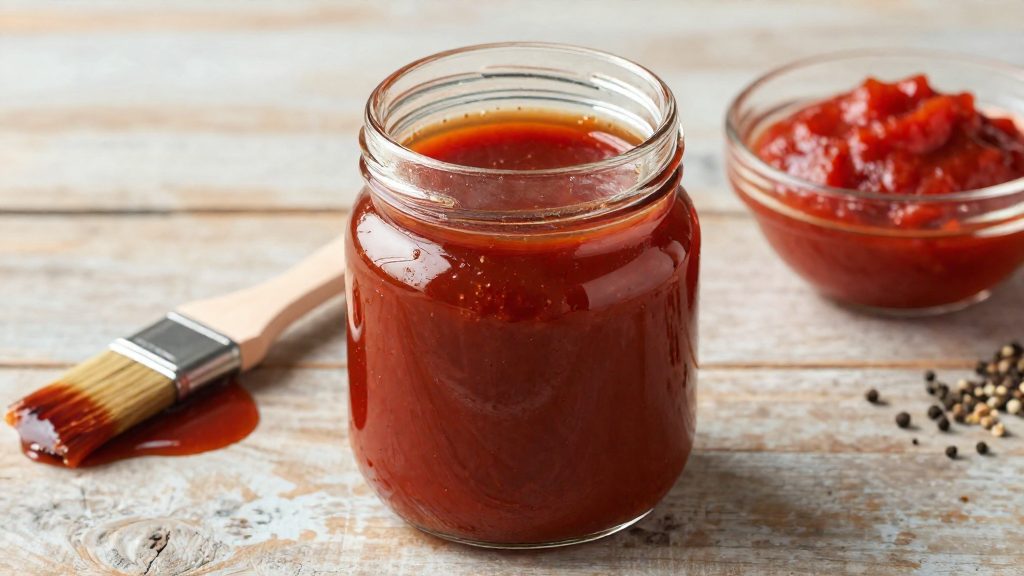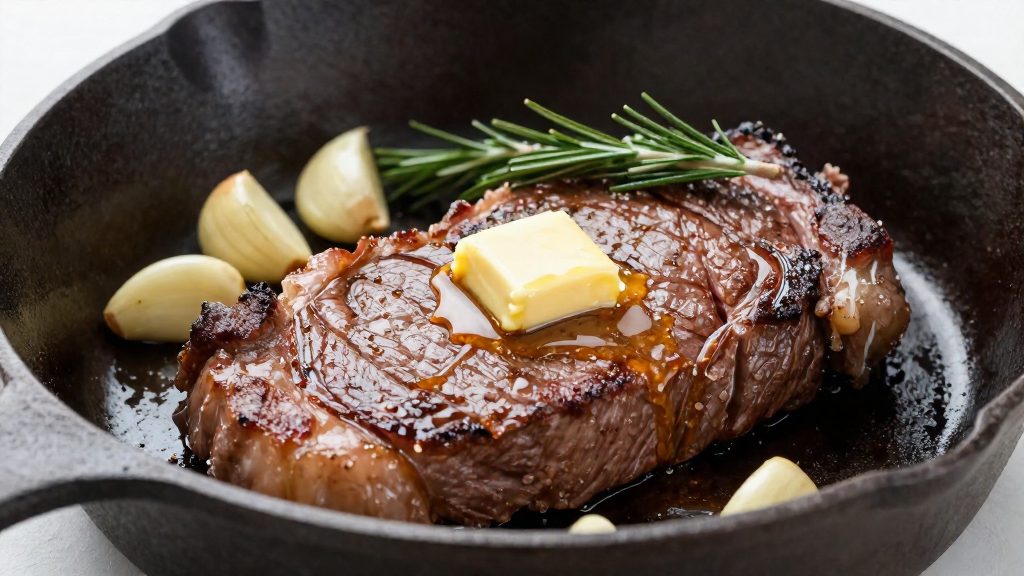
Garlic butter steak sauce rests on a short ingredient list: butter as the base, garlic for pungency, and optional aromatics such as horseradish, mustard, chili flakes, fresh herbs and lemon zest. Two published recipes show how the proportions vary. Outgrilling (2026) makes a batch for 8 servings with ½ cup of salted butter and 3 minced garlic cloves, while Lurpak (2026) uses 50 g of butter and 1 tbsp of chopped garlic for 3 cm entrecôte steaks. The amounts below come from those recipes and can be scaled to the number of steaks.
Ingredients for garlic butter steak sauce
Butter and garlic base
| Ingredient | Outgrilling (8 servings) | Lurpak (3 cm entrecôte) |
|---|---|---|
| Butter | ½ cup salted butter | 50 g butter |
| Garlic | 3 cloves, minced | 1 tbsp, chopped |
Both recipes use fresh garlic, so the choice between minced cloves and chopped garlic depends on the texture you want in the finished sauce.
Flavour additions
- Horseradish and mustard: listed in the Outgrilling recipe only, with no amounts given in the source. They add sharpness to the sauce.
- Chili flakes: Outgrilling only. Omit them for a sauce without heat.
- Fresh herbs: Outgrilling specifies chives and thyme. Lurpak calls for “herbs” without naming them, so chives, thyme or another soft herb can be used in that version.
- Lemon zest: Lurpak only, with no quantity stated. Add it to taste.
Substitutions
Use salted butter if you want the seasoning from the Outgrilling recipe. If you switch to unsalted butter, taste the sauce before serving and adjust the salt. Keep the garlic-to-butter ratio close to the recipe you follow so the garlic does not overpower the fat.
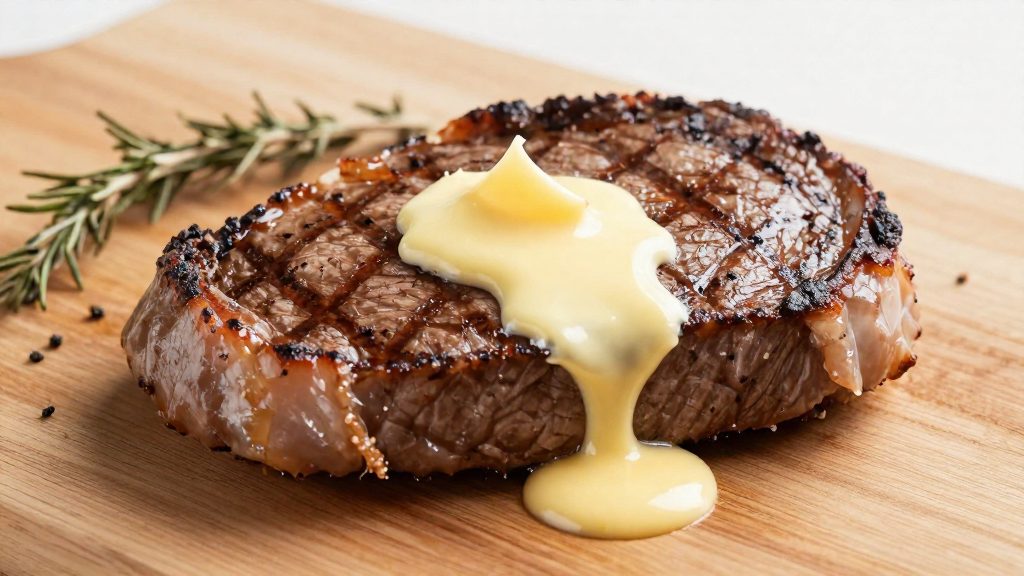
How do you make garlic butter sauce for steak?
The method is a three-stage stovetop sequence: melt the butter over low heat, cook the garlic briefly, then stir in the herbs and horseradish away from the heat. According to Outgrilling (2026), this is the order used in its steak butter recipe, and each stage has a specific job. Keeping the heat controlled at each step prevents the garlic from scorching and lets the flavours combine into a smooth sauce.
Melt the butter slowly over low heat
Place the butter in a small saucepan and set the heat to low. Lurpak (2026) advises melting the butter slowly and stirring often, which helps prevent it from burning or separating. Wait until the butter is fully liquid before adding anything else.
Cook the minced garlic for about one minute
Add the minced garlic to the melted butter and cook it for about one minute, stirring so the pieces cook evenly. One minute is the time specified for the garlic in the Outgrilling (2026) method. Once the garlic is fragrant and softened, the butter is ready for the final step.
Stir in the herbs and horseradish off the heat
Remove the pan from the heat before adding the remaining ingredients. Stir in the chopped herbs along with the horseradish. Combining them off the heat lets the residual warmth of the butter blend the flavours without cooking the herbs.
| Stage | Heat | Action | Duration |
|---|---|---|---|
| 1. Melt butter | Low | Melt slowly, stirring often | Until fully liquid |
| 2. Cook garlic | Low | Cook minced garlic, stirring | About 1 minute |
| 3. Add flavourings | Off | Stir in herbs and horseradish | Until evenly combined |
Use the sauce promptly while the steaks finish, and refrigerate any leftovers.
Melted sauce or compound butter?
Garlic butter reaches the steak in two forms: a melted sauce that is poured or spooned over the meat, or a compound butter that is shaped, chilled and placed on the steak. Both start from butter, garlic and herbs, but the format changes how the fat spreads, how it sits on the surface and how the plate looks when served. The Lurpak barbecue recipe (2026) uses the melted route: 50 g of butter is melted with 1 tbsp chopped garlic, herbs, lemon zest and pepper, then spooned over 3 cm entrecôte steaks.
| Feature | Melted garlic butter | Chilled compound butter |
|---|---|---|
| Starting state | Liquid, warm, after melting | Solid, shaped and chilled before serving |
| Application | Spooned over the steak | Set on the steak as a pat |
| Coverage | Spreads across the whole surface, with even distribution | Concentrated in one spot, spreading as it melts |
| Texture on the meat | Thin, glossy film that soaks into the crust | Thick, slowly melting layer that forms a pool |
| Presentation | Even sheen across the plate | Visible pat of butter, a distinct finishing touch |
Melted sauce suits situations where even coverage matters, such as several steaks cooked at once or a finish that needs to reach every part of the surface. Because the butter is already liquid, it can be spooned on quickly as the steaks come off the heat.
Compound butter suits a single steak or a plated presentation where a visible topping is wanted. Its solid form holds its shape until the hot meat softens it, so the butter releases gradually over the surface rather than spreading all at once. This format also keeps the garlic and herbs in a concentrated area, which gives each portion its own flavour point.
The choice mainly depends on the desired coverage and the presentation. Melted sauce gives an even, glossy finish across the steak, while compound butter gives a concentrated topping that melts into the meat.
When should you add garlic butter to grilled steak?
Add garlic butter after the steak has been seared, not before it goes on the grill. The Lurpak barbecue recipe (2026) sears 3 cm entrecôte steaks for about 1 minute per side on the hottest part of the grill, then cooks them 2–3 more minutes for medium-rare. The garlic butter is spooned over the steaks during this sequence. Butter placed on the grill before the sear is complete will burn before the meat develops its crust.
| Stage | Action | Duration (3 cm entrecôte) |
|---|---|---|
| 1 | Sear, first side, hottest part of the grill | About 1 minute |
| 2 | Sear, second side | About 1 minute |
| 3 | Finish over heat, spoon butter over the steak | 2–3 minutes |
Prepare the butter before the steaks go on the grill. Having the sauce ready means it can be spooned over the steak at stage 3 without delay.
Timing for mechanically tenderized steak
Health Canada (2026) advises turning mechanically tenderized steak over at least twice during cooking, which is more turns than the single flip in the Lurpak sequence above. For this reason, the butter should go on only after the final turn, so the sauce is not disturbed by repeated flipping. Apply the finish phase once the steak has been turned to its final side, and keep the sequence in the order above.
Do not treat the sear and finish times as universal. The 1-minute and 2–3-minute durations come from the Lurpak recipe for 3 cm entrecôte. Adjust the times for thicker or thinner cuts.
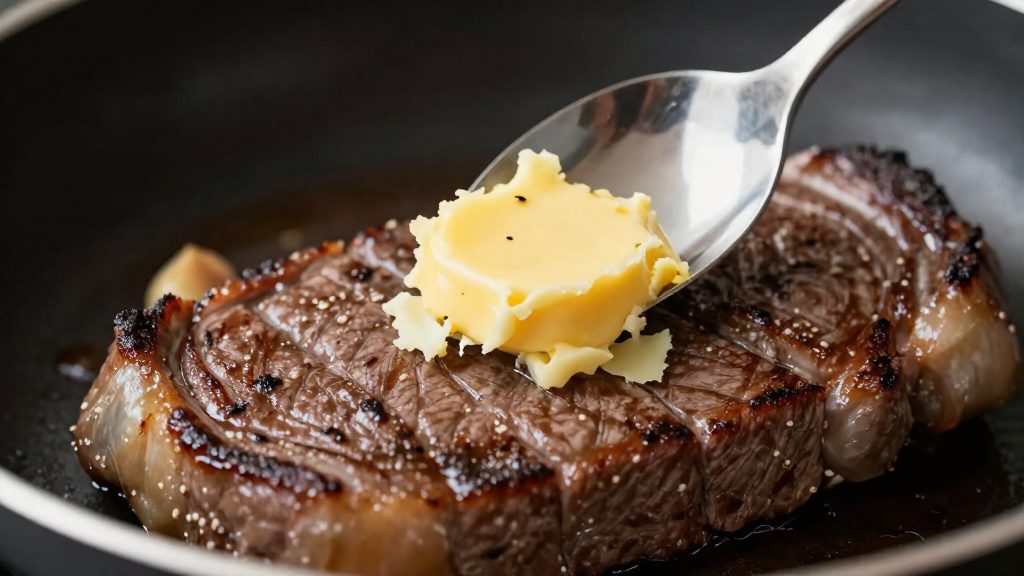
Steak doneness temperatures in Canada
Health Canada (Government of Canada, 2026) lists safe internal temperatures for beef steaks and roasts, which are whole cuts. Use these figures as the reference for doneness on the grill rather than relying on colour or cooking time alone.
| Doneness | Safe internal temperature |
|---|---|
| Medium-rare | 63°C (145°F) |
| Medium | 71°C (160°F) |
| Well done | 77°C (170°F) |
The same source states that mechanically tenderized beef should be cooked to 63°C (145°F). Health Canada also states that mechanically tenderized beef should be cooked to 63°C (145°F). Confirm it with a thermometer reading rather than by colour or cooking time.
Accurate readings depend on probe placement. Insert the thermometer into the thickest part of the meat, toward the centre, and keep the tip clear of bone, since bone conducts heat differently and gives a misleading reading. Check each steak separately, even when they are cooking side by side. Health Canada notes that a digital thermometer is more accurate than other types, so it is the better choice for thin or unevenly shaped cuts where a small error changes the result.
Is it safe to store garlic butter?
Garlic steak butter can be stored for a set period, and the time depends on where it is kept. According to Outgrilling (2026), the butter made from its 8-serving steak butter recipe keeps for 1 week in the refrigerator or 1 month in the freezer. Lurpak’s grilled entrecôte sauce, made with 50 g of butter, also recommends refrigerating leftovers for up to one week.
Refrigerator storage
Refrigerated garlic butter keeps for up to one week. Once the butter has firmed up, transfer it to a clean, sealed container so it does not pick up other food odours. Write the date on the lid so the one-week window is easy to track. Use the butter within that period, and discard any that shows mould, an off smell or an unusual colour.
Freezer storage
For longer keeping, freeze the butter for up to one month. Portioning it before freezing makes it easier to use only what you need:
- Log method: Roll the butter in cling film or parchment, twist the ends, and freeze it. Slice off rounds as needed.
- Portion method: Spoon the butter into an ice-cube tray or small silicone moulds, freeze, then move the portions into a labelled freezer bag.
Thaw frozen portions in the refrigerator rather than at room temperature. Use them within the one-month period, and do not keep them beyond it.
Flavour variations to try
The base garlic butter takes several additions. The recipes consulted use different ingredients for three effects: heat, tang and brightness. Each addition changes the flavour without altering the core method.
| Effect | Addition | Recipe |
|---|---|---|
| Heat | Chili flakes | Outgrilling (2026) |
| Tang | Mustard | Outgrilling (2026) |
| Sharp, pungent note | Horseradish | Outgrilling (2026) |
| Brightness | Lemon zest and pepper | Lurpak (2026) |
Chili flakes add heat. Outgrilling uses them alongside mustard and horseradish, so they can be added in small amounts and adjusted by taste before the butter is spooned over the steak.
Mustard provides the tang. Outgrilling combines it with horseradish, so the two together form the sharpest layer of the sauce. Use mustard if you want a savoury edge without extra heat.
Lemon zest and pepper bring brightness to the butter. Lurpak’s recipe specifies zest rather than juice, so grate the peel directly into the melted butter. Pepper is added alongside it in the same recipe, giving a sauce with both lift and bite.
Alternative herbs: Parsley, tarragon and rosemary are common choices in the grilling niche.
Frequently asked questions
How long does garlic butter sauce keep?
Refrigerated in a sealed container, the sauce keeps for 1 week, according to Outgrilling (2026). Outgrilling also says it can be frozen for up to 1 month, which suits a large batch made for several steak nights.
Why does my butter sauce separate or burn, and how do I prevent it?
The usual cause is heat that is too high. Lurpak (2026) advises melting the butter slowly and stirring it often so it does not burn or separate. Keep the pan on low heat throughout, and remove it from the heat before adding the herbs and horseradish.
What internal temperature should steak reach before I spoon on the sauce?
Health Canada (2026) gives 63°C (145°F) for medium-rare, 71°C (160°F) for medium and 77°C (170°F) for well done, for whole-cut beef steaks. Measure with a digital thermometer inserted into the thickest part of the steak, without touching the bone, and check each steak separately.