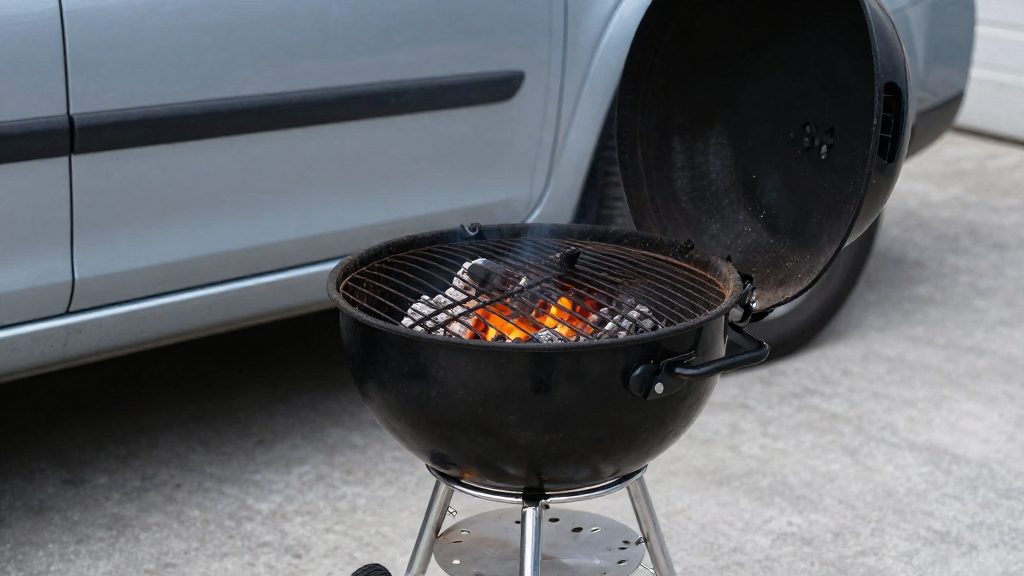
A charcoal grill produces carbon monoxide because burning charcoal releases this gas when the fuel does not get enough oxygen to burn completely. The gas is a product of how the fire burns, so any charcoal burned with limited oxygen or in a poorly ventilated place can produce it.
Why does a charcoal grill produce carbon monoxide?
Incomplete combustion of carbon
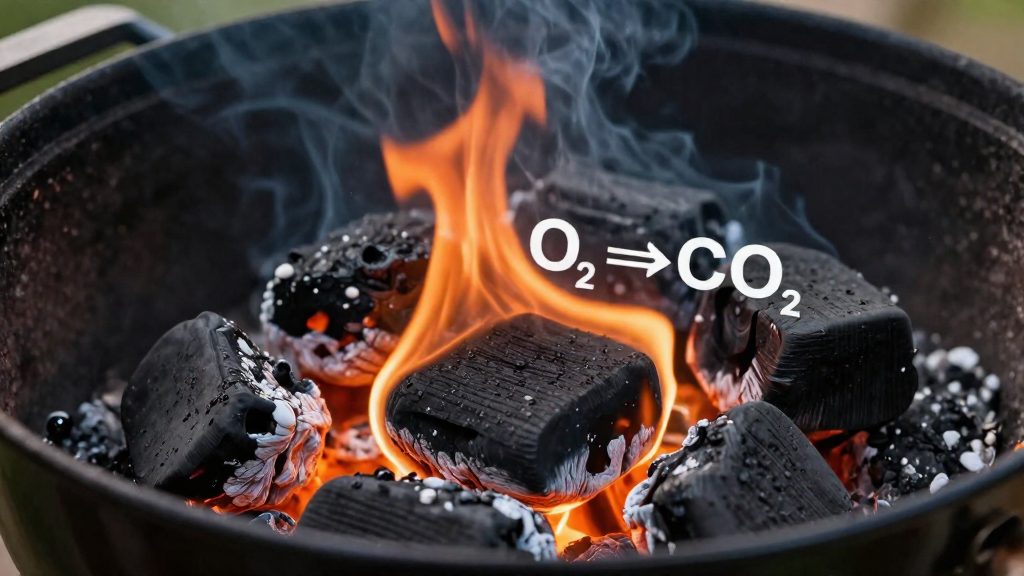
Lump charcoal and briquettes are both carbon-based fuels. When carbon has sufficient oxygen, it burns completely and forms carbon dioxide. When oxygen is limited, combustion is incomplete, and part of the carbon leaves the fire as carbon monoxide instead. The fuel is the same in both cases, so the difference comes from the air supply.
On a charcoal grill, airflow through the intake vents and the lid controls how much oxygen reaches the fire. A fire with restricted airflow, such as one with closed vents or a thick layer of ash blocking the air intake, burns less completely and produces more carbon monoxide. A fire with open vents and a steady air supply burns more completely.
Why the gas builds up in enclosed spaces
Carbon monoxide produced outdoors disperses into the surrounding air. In an enclosed space, the gas has no route out and accumulates.
What changes the amount of gas produced
The variables that govern carbon monoxide output are the air supply to the fire and the volume of the space around it. Restricted airflow raises output at the source, and a confined room raises the concentration the gas reaches. Neither factor is set by the type of charcoal alone. The Health Canada recall notice (2021-10-28) concerned both lump charcoal and briquets and states that charcoal produces carbon monoxide.
Is it safe to use a charcoal grill in the garage?
No. Brampton Fire and Emergency Services advises: “Never cook with barbecues or propane cookers inside the home or garage” (City of Brampton, Fire and Emergency Services, 2026). The advice names the garage without distinguishing between attached and detached structures.
Why charcoal counts as an indoor hazard
Health Canada’s recall notice for lump charcoal and briquets (2021-10-28) states that charcoal produces carbon monoxide (CO). It describes this gas as toxic when charcoal is burned indoors or in a poorly ventilated area, and notes that it creates a suffocation hazard. An attached or enclosed garage falls within that warning because it is an indoor space.
Fuel-burning appliances as a category
Brampton lists barbecues among common household CO sources, which places charcoal grills within the broader category of fuel-burning appliances: any device that burns fuel to produce heat is a potential CO source when used indoors. The same logic applies to every grill type, not only to charcoal models.
Propane cookers
The Brampton rule extends to propane cookers, so a propane cooker is excluded from garage use in the same way as a charcoal grill. Garage use is therefore excluded for both fuel types.
Ontario’s CO alarm requirement
An alarm only detects CO once it is already present. It does not make cooking in a garage acceptable. The Ontario alarm requirement is detailed in the alarm section below.
Practical rule
Keep charcoal and propane cooking outside the garage and the home, and limit grilling to the open air.
Does opening the garage door make it safe?
No. An open garage door does not make fuel-burning activity safe. The City of Brampton Fire and Emergency Services (2026) states that a vehicle or fuel-burning power tool should never be warmed up in a garage, even with the door open. The guidance treats the activity itself as the hazard, not the state of the door.
| Activity in or near a garage | Guidance in the sources |
|---|---|
| Running a vehicle in an attached garage | Listed as a carbon monoxide source; should never be warmed up there (Brampton, 2026) |
| Burning charcoal indoors or in a poorly ventilated area | Produces carbon monoxide; toxic and a suffocation hazard (Health Canada, 2021) |
Vehicles and power tools in attached garages
An attached garage shares a wall or structure with the living space, so exhaust produced inside it can reach the home. Brampton names a vehicle running in an attached garage as a carbon monoxide source, which is why the advice is to keep engines out of that space altogether rather than rely on airflow.
Move the vehicle or fuel-burning power tool outside the garage before starting it, as the Brampton guidance advises.
Warning signs of CO poisoning
Carbon monoxide is hard to detect without equipment because it has no colour, smell or taste, so physical symptoms are often the first warning. The early signs of exposure include:
- Headache
- Dizziness or light-headedness
- Nausea
- Confusion or difficulty concentrating
- Vomiting, shortness of breath or chest pain
- Fainting or loss of consciousness
Any of these signs while using a fuel-burning appliance means leaving the area at once and calling 911.
Symptoms that appear while the grill is in use, or that ease once you step outside, may indicate CO exposure, but other sources are possible, so leave the area and get help regardless. If one person shows symptoms, everyone in the space should leave.
Pets and other household members can show the same signs. Dogs, cats and young children may not describe how they feel, so watch them closely. If several people or animals become unwell together in the same place, treat it as a possible carbon monoxide exposure rather than a shared illness.
Immediate actions:
- Move everyone, including pets, into fresh air outdoors, away from the grill and away from any door or window leading back inside.
- Call your local emergency number from outside the building. State that you suspect carbon monoxide exposure and describe the symptoms.
- Do not go back inside to switch off the grill or retrieve belongings. Leave the assessment of the building to emergency responders.
- Seek medical attention for anyone affected, even if symptoms seem mild or have started to fade.
Where to place a charcoal grill outdoors
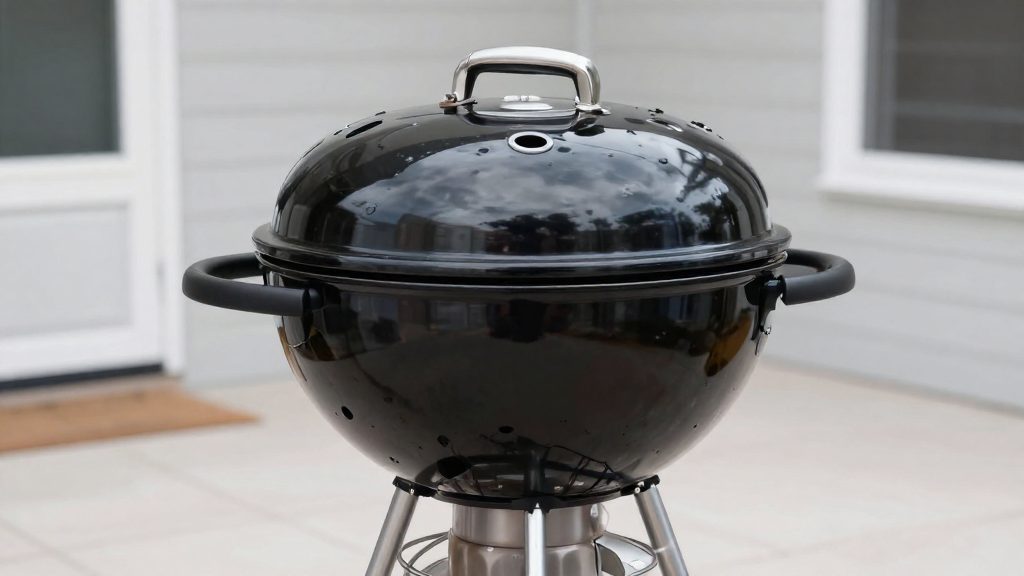
Set up a charcoal grill in an open outdoor area where air moves freely around the whole unit, so that smoke and gases disperse instead of collecting. The spot you choose is the first safety decision, made before you light anything.
Open-air airflow
Look for a position with unobstructed airflow on all sides. Walls, fences, overhanging roofs, awnings and dense hedges trap smoke and heat against the grill and against nearby structures. Avoid corners and recesses where air stagnates.
Distance from doors, windows and vent openings
Keep the grill clear of doors, windows and vent openings, both your own and those of neighbouring buildings where possible. Do not place it under an eave, beside a window, or next to a vent that could draw smoke inside. Check the wind direction before setting up and orient the grill so that smoke drifts away from openings and seating areas. For the minimum clearance specified for your model, follow the manufacturer’s manual.
Level, stable surface away from combustibles
Place the grill on a level, stable surface such as concrete, paving or compacted earth. A stable base prevents tipping when the coals are loaded or the lid is lifted. Keep combustible materials, including dry leaves, paper, firewood, cushions, textiles and wooden decking boards, well away from the grill’s sides and underside, and make sure the base will not sink or shift under its weight.
Do you need a CO alarm if your home has an attached garage?
In Ontario, Canada, a CO alarm is required from 1 January 2026 in homes with a fuel-burning appliance, a fireplace or an attached garage, according to City of Brampton Fire and Emergency Services (2026). Each of these three features is a separate trigger, so a home needs an alarm if it has any one of them, even if it has no gas or wood-burning equipment.
The rule therefore depends on the building itself, not on how the garage is used. A house with an attached garage falls under the requirement whether or not a grill, vehicle or power tool is stored or operated there.
The requirement is stated for Ontario only. Readers in other provinces or countries should check their own local fire and building rules rather than assume the same obligation applies.
How to check your home
- Confirm whether the house has an attached garage that shares a wall, ceiling or door with living space.
- Check for any fuel-burning appliance, such as a gas furnace, water heater or stove, and for any fireplace.
- If any of these is present in an Ontario home, make sure a CO alarm is installed.
How to put out and store charcoal safely
Extinguishing, cooling and storing the fuel are part of the same safety routine as cooking.
Extinguishing hot charcoal
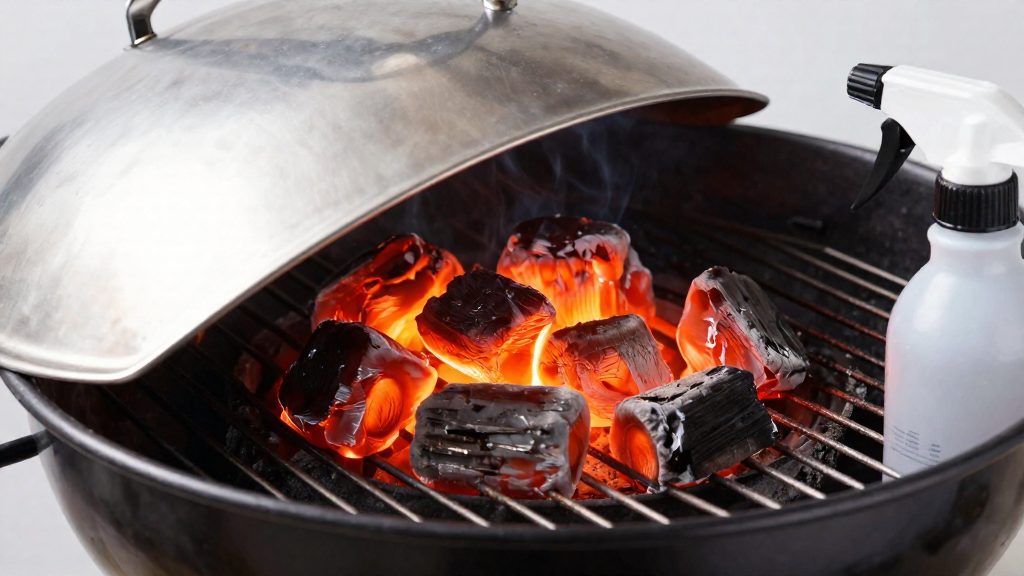
- Close all vents to starve the fire of oxygen, then close the lid to smother the remaining embers.
- Leave the grill in its outdoor position until the charcoal is fully cold. Do not carry glowing charcoal to a bin, a shed, or any other enclosed space.
- Do not rely on touch to judge whether the grill is safe to handle. Ash can hold live embers that give off little felt heat, even after the flames are gone. Keep the grill closed and outdoors, and treat the ash as hot until it has had ample time to cool completely. Only then transfer it to a metal container.
Storing unused charcoal
- Keep unlit lump charcoal and briquettes in their original sealed bags, or in a closed container, in a dry place.
- Store bags outdoors or in a space that is not a living area, and keep them away from vehicles.
- Do not store charcoal near heat sources or fuel containers.
Disposing of ash
- Once the charcoal is cold, transfer the ash into a noncombustible container with a tight-fitting lid, such as a metal bin.
- Keep the closed container on a noncombustible surface, away from the house, wooden structures, and dry vegetation, until it is taken for disposal.
- Never place ash in a plastic bag or a combustible bin, even when it appears cold.
Frequently asked questions
Can I use a charcoal grill in an attached garage if the door is open?
No. Brampton Fire and Emergency Services (2026) advises against cooking with barbecues inside the home or garage, and it states that an open garage door does not make warming up a vehicle or fuel-burning power tool safe. Treat an attached garage as an enclosed space for any charcoal fire.
Are CO alarms required in my home?
In Ontario, CO alarms become mandatory from 1 January 2026 in homes with a fuel-burning appliance, a fireplace or an attached garage, according to City of Brampton Fire and Emergency Services (2026). Check your local regulations for rules in other provinces or countries.
What should I do with charcoal ash after grilling?
Keep the grill closed and outdoors, and treat the ash as hot until it has had ample time to cool completely. Do not judge temperature by touch, because residual embers can give off little felt heat. Only transfer the ash to a metal container once it is fully cold.