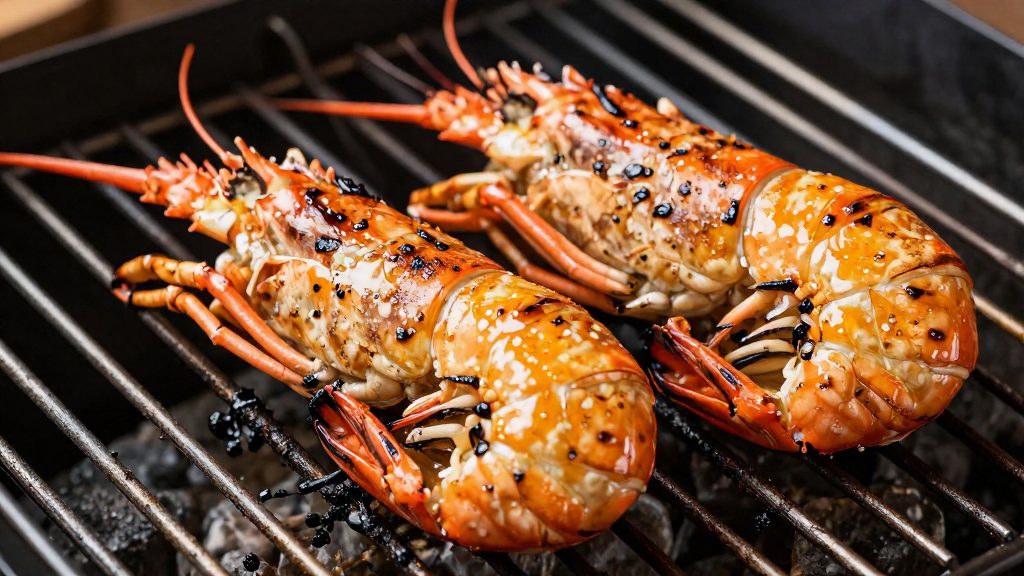
What size lobster tails should you buy?
The tail size you choose sets how long the grill needs to run, so buy for the portion you plan to serve before you think about the price.
Matching tail weight to portion size
As a general suggestion, count one tail per person when lobster is the main dish, and plan for a smaller tail per person when it is one of several dishes. Heavier tails hold more meat under the same shell, so they need the later part of the cooking window. Broil King’s method runs 10 to 15 minutes total at 400°F (204°C) (Broil King, 2025), and BBQ Outfitters’ method takes about 11 minutes on medium heat (BBQ Outfitters, 2025). These times are only a guide: a large tail will need the upper end or more, so confirm doneness with a thermometer at 74°C (165°F).
Fresh versus frozen tails
Check the package to see whether the tails are sold fresh or frozen, and choose the format that matches your cooking date. Whichever you buy, the shell should be intact and the meat should look even in colour and texture, without dull or dry patches.
Reading the label
Look for three details on the pack:
- Tail weight or count: Some packs list the count per pound. Others may give only the total weight.
- Origin: Check whether the country or region of origin is printed on the pack.
- Storage state: Confirm whether the product is labelled fresh or frozen.
If the label shows only the total weight, calculate the average weight per tail with this formula: total weight ÷ number of tails = average weight per tail. Use the result to decide whether one tail is enough for each guest.
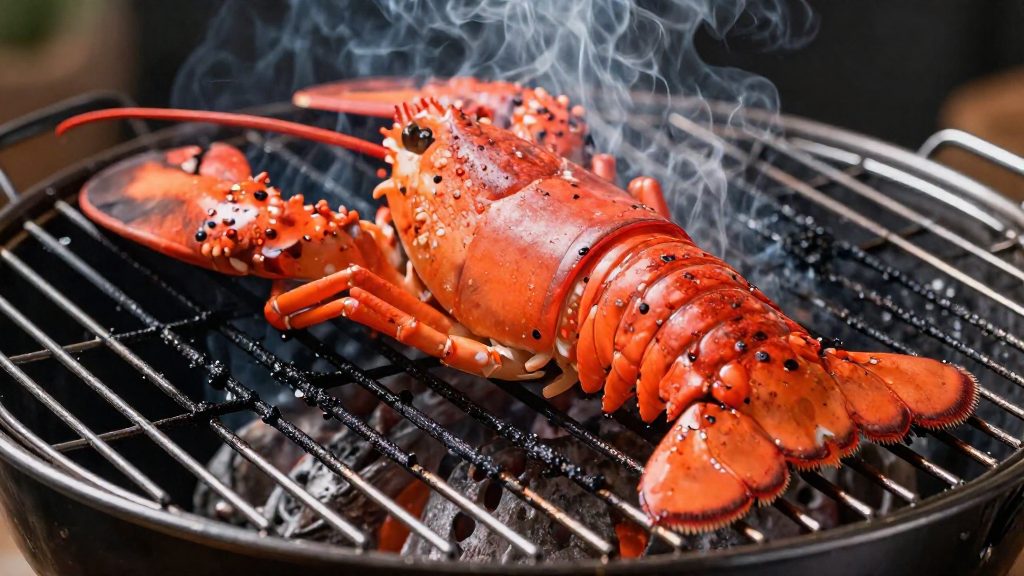
How do you thaw lobster tails safely?
Frozen tails should thaw before they reach the grill. A frozen shell cannot be split cleanly, and frozen flesh cooks unevenly, with a cold centre under a charred surface. The two practical routes are refrigerator thawing, the gentlest option, and cold-water thawing in a sealed bag, which is faster.
Refrigerator thawing
Keep the tails in their packaging or a sealed bag, placed on a plate or tray on the lowest shelf. This stops drips from reaching other food. Plan the thaw a day ahead rather than the same morning, because tails thaw from the outside inward and a partly frozen centre will cook unevenly on the grill.
Cold-water thawing in a sealed bag
Seal the tails in a leak-proof bag, press out the air, and submerge the bag in a bowl or sink of cold tap water. Water conducts heat far faster than air, so this route takes less time than refrigerator thawing. Change the water regularly to keep it cold. Keep the tails sealed so the meat does not take on water and turn spongy. Do not use warm water.
Drying the tails before seasoning
Once thawed, remove the tails from the bag and pat the shell and meat dry with kitchen paper. Surface moisture steams the meat instead of letting it brown, and it stops butter or oil from clinging. Season only after drying, then move the tails to the grill promptly so the seasoning does not draw out moisture again.
Equipment and grill setup (gas or charcoal)
A lobster tail setup depends on two things: a two-zone heat layout that lets you sear and finish gently, and a way to keep the shell flat on the grate. Preheat the grill fully before the tails go on.
Two-zone heat setup
A two-zone setup gives you a hot side for searing the meat and a cooler side for finishing without scorching the shell.
| Element | Gas grill | Charcoal grill |
|---|---|---|
| Hot zone | Burners lit on one side only | Lit coals piled on one half of the grate |
| Cool zone | Opposite burners turned off | Empty half of the grate |
| Lid | Kept closed so the cool side cooks by indirect heat | Kept closed, with vents adjusted to control temperature |
| Starting point | Sear meat-side down over the hot zone, then move to the cool side | Same sequence, moving the tails away from the coals if flare-ups occur |
Skewers to keep tails flat
A metal skewer pushed lengthwise through each tail stops it from curling when heat reaches the shell. BBQ Outfitters (2025) uses this method. Skewer each tail before it goes on the grate so the shell rests flat.
Tools and protection
- Long-handled tongs for turning tails and moving them between zones.
- A basting brush for applying garlic-lemon butter, as in the Broil King (2025) method.
- Heatproof gloves when adjusting skewers, lid handles, or coals near the hot zone.
How do you prepare and butterfly a lobster tail?
Butterflying a lobster tail means opening the raw tail along its back so the meat can be lifted out through the cut and rested on top of the shell. According to Broil King (2025), this beginner method splits the raw tail down the back, loosens the meat from the shell, and lifts the meat through the cut so it sits on the shell. The work is done before any heat is applied.
Cutting the shell lengthwise
Place the tail shell-side down on a cutting board. Using sturdy kitchen shears, cut straight along the top centre of the shell, following the natural line of the back from the body end toward the tail fan. Cut only through the shell, not into the flesh beneath it. Work slowly so the shell splits in one clean line instead of cracking into pieces.
Loosening the meat without tearing
Slide your fingers, or a thin, flexible tool, between the meat and the inner wall of the shell. Work gently along both sides of the cut first, then around the tail end. Pull the meat away in short, controlled movements rather than yanking. Raw lobster flesh is soft, so if it resists, loosen the area further before pulling again. Keep the tail fan intact, since it helps the finished tail hold its shape.
Lifting the meat through the cut
Once the meat is free from the shell, lift it up through the opening, keeping the end attached. Lay the meat back over the top of the shell so the flesh is exposed and the shell supports it. Handle the tail by the shell rather than the meat, so the flesh stays intact while you move it to the grill.
Step-by-step grilling and timing
Two beginner routes for grilling lobster tails differ mainly in preheat temperature and in when basting starts. Broil King (2025) preheats to 400°F (204°C), grills the tails for 3–4 minutes, then begins basting. BBQ Outfitters (2025) uses a medium setting and a fixed first pass with the meat side down. The table compares the two schedules.
| Stage | Broil King (400°F / 204°C) | BBQ Outfitters (medium heat) |
|---|---|---|
| Preheat | 400°F (204°C) | Medium |
| Initial grilling | 3–4 minutes, then basting starts | 6 minutes, meat side down |
| Remaining grilling | Basting continues | Flip, then 5 minutes |
| Total cook time | 10–15 minutes | About 11 minutes |
Preheat and first pass
Preheat the grill before the tails go on, so that the first contact with the grate is at a stable heat. The 400°F route gives a hotter sear over a shorter period. The medium route gives a longer, gentler first pass and is less likely to scorch the exposed meat.
Flip timing
In the medium-heat method, grill the tails meat side down for 6 minutes, flip them, and cook for 5 more minutes.
Basting schedule with butter
In the 400°F method, the tails grill for 3–4 minutes before the first application of butter. Basting then continues for the rest of the cook, which runs 10–15 minutes in total. Baste steadily and repeatedly rather than with a single brush of butter.
For beginners, the 400°F route is the more practical choice, because it builds in a defined basting window. Use the medium-heat timing if your grill cannot hold a high setting easily.
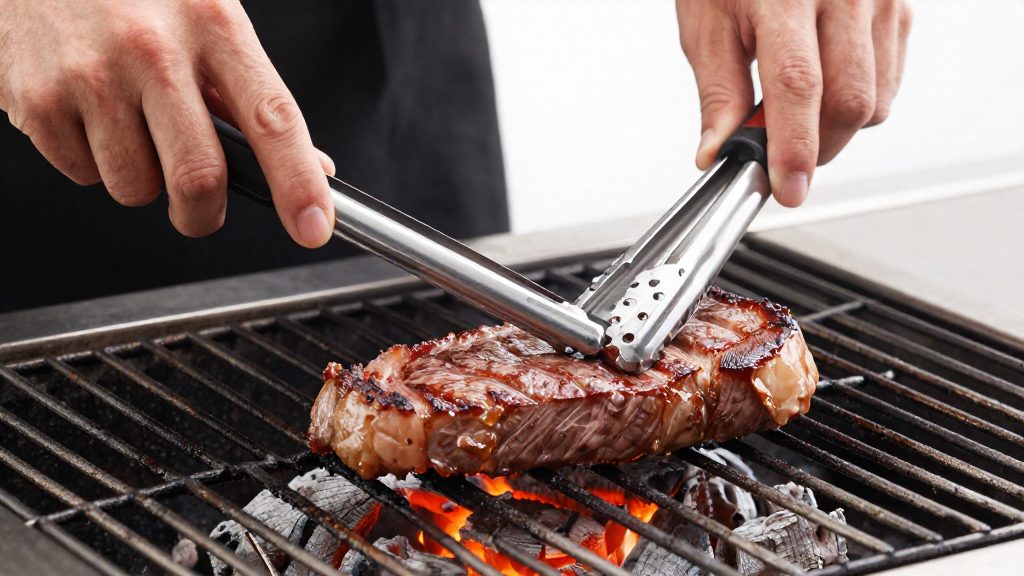
What internal temperature is lobster done?
Health Canada (2024) gives 74°C (165°F) as the safe internal cooking temperature for shellfish and crustaceans, including lobster. For fish, the same source lists 70°C (158°F), so the threshold for lobster is higher. Measure the thickest part of the tail meat to confirm this figure.
Recipe sources give lower targets. Broil King (2025) keeps basting the tail until it reaches 140°F (60°C), and recommends an instant-read thermometer to check it.
| Source | Target | Basis |
|---|---|---|
| Health Canada (2024) | 74°C (165°F) | Safe internal temperature for shellfish and crustaceans |
| Broil King (2025) | 140°F (60°C) | Recipe endpoint, checked with an instant-read thermometer |
| BBQ Outfitters (2025) | Pearly-white, opaque flesh | Visual check, no temperature given |
The two targets conflict. The recipe’s 140°F endpoint is 25°F below the Health Canada threshold, so use 165°F as the finish point. If the tail reads 140°F, keep cooking until it reaches 165°F.
Colour is a secondary check. BBQ Outfitters (2025) describes the flesh as pearly-white and opaque when cooked. Those cues show that the meat has set, but they cannot confirm that the centre has reached 165°F, so use a thermometer as the main test.
Garlic butter and simple flavours
Broil King’s beginner method uses garlic-lemon butter as its only flavouring. In Broil King’s method the butter is brushed on after the initial grilling and continues until the tail reaches its target temperature.
Because the shell is split and the meat is lifted out onto it, the exposed flesh is easy to reach with a brush or spoon. Work the butter into the cut so it runs between the meat and the shell.
A simple batch needs three elements:
- Melted butter as the carrier, warmed in a small heatproof dish or pan at the side of the grill so it stays liquid.
- Finely minced garlic, which distributes evenly in the butter and is less likely to scorch on the grate than larger pieces.
- Fresh lemon juice added to the butter, which brightens the rich fat and gives the flavour a clear edge.
Keep the seasoning to these three ingredients for a first attempt. Adding more aromatics makes it harder to judge whether the butter is working, and the lobster flavour is the main point of the dish.
Use a small brush for basting and return it to the butter between passes, so the lemon and garlic stay in the mix rather than separating on the surface. Apply a thin coat each time, rather than one heavy layer, so the butter remains on the meat instead of dripping into the fire.
Common beginner mistakes and cleanup
Most beginner errors with grilled lobster tails come from cooking too long, overcrowding the grate, or leaving the grill dirty after use. The main doneness check is a thermometer reading of 74°C (165°F). Flesh that turns firm and chalky has gone past that point, and it will be dry and rubbery when served.
Overcooking the tails
Lobster meat is lean and cooks quickly, so the window between done and overdone is narrow. Beginners often leave tails on the grill to be sure they are cooked through, but this drives out moisture and produces a tough, stringy texture. Check the tails early with an instant-read thermometer, and pull them as soon as the thickest part reads 74°C (165°F). Carryover heat continues cooking the meat briefly after it leaves the grill, but do not pull a tail that looks underdone: remove it only once a thermometer reads 74°C (165°F) in the thickest part of the meat.
Crowding the grill
Placing too many tails on the grate at once is a common error. Crowded tails release moisture and steam, which lowers the surface temperature and prevents browning. The result is pale, soft meat rather than a lightly charred exterior. Leave a gap between each tail so hot air reaches every surface. If the grill is small, cook in batches rather than packing the grate.
Cleaning grates and utensils after cooking
Cleaning is simplest when the grate is still warm, because residue loosens more easily before it hardens. Once the tails are removed:
- Scrape the grates with a stiff grill brush while they are still hot, removing butter, garlic and shell fragments that would otherwise char onto the next cook.
- Clear the drip tray or grease collector so fats do not build up or ignite during the next session.
- Wash tongs, skewers and basting brushes immediately, since butter-based marinades set quickly on metal and bristles.
- Dispose of shell pieces and drippings rather than leaving them in the grill firebox or on the cooking surface.
Regular cleaning also protects the flavour of the next cook, because burnt residue transfers to delicate seafood.
Frequently asked questions
Do I need to split the shell before grilling lobster tails?
Broil King (2025) splits the raw tail down the back, loosens the meat from the shell, and lifts it through the cut so it rests on top. This exposes the flesh to direct heat, which suits beginners who want the meat to cook quickly and evenly.
How can I tell when lobster is done without relying only on a thermometer?
The flesh should turn pearly-white and opaque, as BBQ Outfitters (2025) describes. Use that as a visual check, then confirm by probing the thickest part of the meat, since colour alone can mislead with larger tails.
Why do the two recipes give different finishing temperatures?
Broil King’s recipe stops basting at 140°F (60°C), which is below the safe internal temperature of 165°F (74°C) that Health Canada (2024) lists for lobster. Aim for the higher figure, because it is the one that matches the official safety guidance.