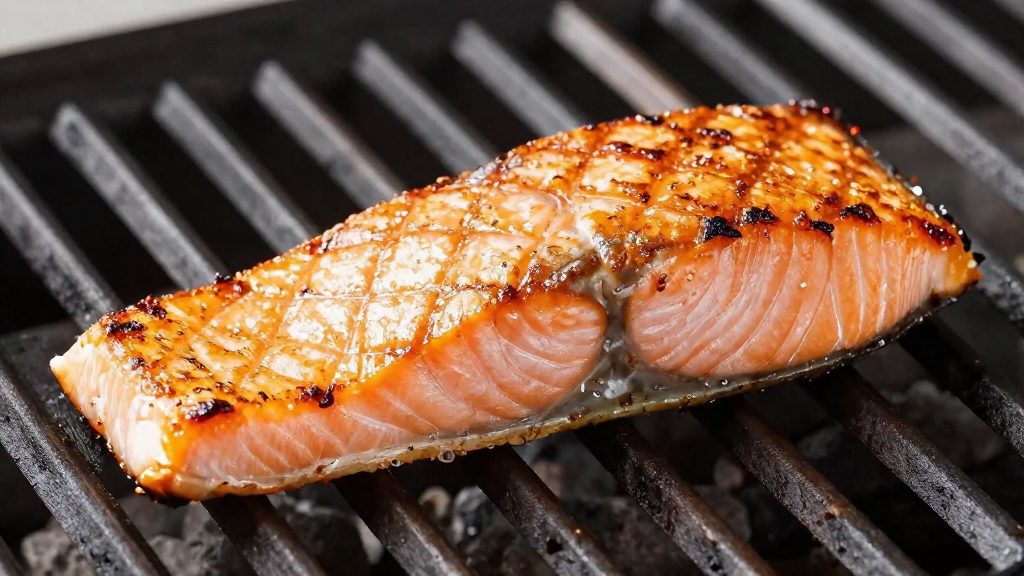
Grilling salmon skin-on protects the flesh and keeps the fillet intact. The skin also gives the fillet a crisp, edible layer that contrasts with the moist flesh.
Why grill salmon with the skin on?
The skin shields the flesh from direct heat
The grate heats the underside of the fillet first. The skin sits between the grate and the flesh, so the meat receives less direct contact with the hot metal. Placing the fillet skin-side down means the skin takes the first contact, and the flesh cooks more gently as heat passes up through the fillet. This is why the skin acts as a protective barrier rather than a decorative layer.
The skin acts as a structural layer
Salmon flesh is soft and separates easily when heated. The skin holds the pieces together, so the fillet stays in one piece when you move it with a spatula. A fillet that remains intact is easier to lift, turn and serve. Barbecue Bible notes that larger skin-on fillets can often cook skin-side down with the lid closed, so the skin supports the fish without requiring a flip.
Crisp skin as an eating benefit
When the skin is cooked long enough on the grill, it becomes crisp, which contrasts with the tender flesh beneath. Many cooks eat the skin, while others remove it after cooking. Because the skin is left on during cooking, you retain the option to serve it crisp or to peel it off the cooked fillet.
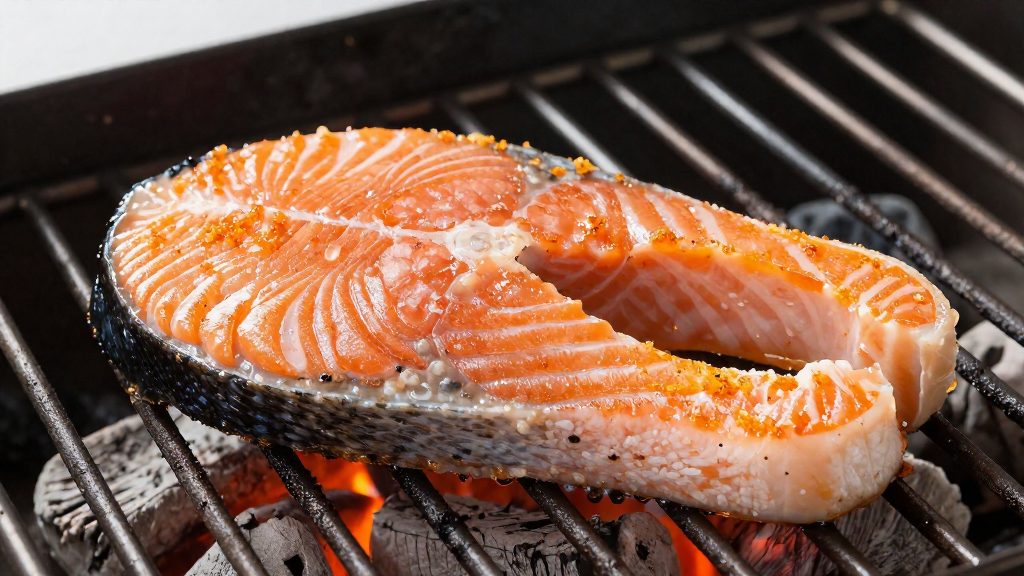
Choosing and prepping the fillet
Choose a fillet of even thickness from end to end. A thin tail cooks faster than a thick centre, so an uneven cut leaves some parts overcooked while others are still underdone. Pick a piece that fits flat on the grate with some room to spare, so you can lift and turn it without tearing. Buy the fillet with the skin on, because the skin is the part the grilling method depends on.
Size matters less than shape. A compact, rectangular fillet is easier to handle and turn than an irregular cut with a narrow end that curls up when heated. If the piece is much longer than the grate, cut it into portions before it goes on the grill, so each piece has a similar thickness and cooks at the same rate.
Once the fish is on the cutting board, pat the salmon dry with paper towel, covering both the flesh and the skin. According to Barbecue Bible (Steven Raichlen, 2026-05-27), pat the salmon dry and brush it lightly with oil before seasoning. Surface moisture slows browning and prevents the oil from spreading evenly, so this step comes first.
Next, apply a light oil coat by brushing a thin film over the flesh and skin. You only need enough oil to make the surface glisten. Heavy oiling pools on the fish and drips into the fire, causing flare-ups. Season the fillet only after the oil is on, so the salt and pepper adhere to the oiled surface rather than the bare, damp fish.
Best grill temperature for salmon
For grilled salmon fillet with skin on, use medium-high heat of about 190–220°C (375–425°F), with 400°F (about 204°C) as the target setting. According to Barbecue Bible (Steven Raichlen, 2026), this range suits salmon because it browns the skin and firms the surface without the intensity of high-heat searing, which can dry out a thin fillet before the centre is ready. Setting the grill at 400°F gives a consistent starting point, and you can adjust within the range if your grill runs hot or cool. Let the grill reach temperature with the lid closed before placing the fish, so the target setting is reached across the whole cooking surface.
| Reference point | Temperature |
|---|---|
| Grill setting, low end of range | 375°F (about 190°C) |
| Grill setting, target | 400°F (about 204°C) |
| Grill setting, high end of range | 425°F (about 218°C) |
Converting Fahrenheit to Celsius is useful if your grill displays Celsius or if you follow a recipe written in the other unit. Subtract 32 from the Fahrenheit value, multiply the result by 5, then divide by 9. For 400°F, the calculation is (400 − 32) × 5 ÷ 9, which gives 204.4°C. Round to the nearest 5°C if your dial uses those increments.
How do you keep skin-on salmon from sticking?
Grate preparation does most of the work in keeping skin-on salmon from adhering to the grill. Clean bars, a light film of oil and full preheating give the skin a surface it can release from as it sets. These steps cover the grate only, so the fillet itself is handled separately.
Clean the grates before every cook
Scrape the cooking grates with a grill brush before each session, not only after the previous cook. Any residue left on the bars gives the skin something to grip. Cleaning comes first in the sequence, so the oil in the next step lands on bare metal.
Oil the grates with a folded paper towel held in tongs
Fold a paper towel, grip it with tongs, dip it in a neutral cooking oil and wipe the bars. Holding the towel in tongs keeps your hand away from the hot grate. The Barbecue Bible (Steven Raichlen, 2026-05-27) describes this method, which applies a thin, even layer rather than pouring oil onto the grate.
Preheat the grates before placing the fish
Preheat the grill to medium-high, then oil the grates once they are at temperature, just before the fish goes on.
Set the burners or charcoal to reach the target before the fish is ready to cook. A grate that is only warm allows the skin to bond more readily, so the wait is worth it. Place the fish on the grate promptly after oiling, so the film stays fresh and effective.
Grilling step by step
With the fillet prepped as described above, the cooking itself follows four stages: first contact, lid position, timing, and lifting the fillet off the grate.
-
Start skin-side down. Place the fillet on the grate skin side down.
-
Use the lid for larger fillets. According to Barbecue Bible (Steven Raichlen, 2026-05-27), larger skin-on fillets can often cook skin-side down with the lid closed. Keep the lid closed for these pieces and leave the fillet undisturbed on the grate while it cooks. Moving it repeatedly works against the stable contact the skin provides.
-
Time the cook from first contact. Start a timer as soon as the fillet touches the grate. Barbecue Bible gives a window of about 10–12 minutes for a skin-on piece at 400°F, so the timer should be set to the lower end of that range and extended only if the fillet has not reached the expected stage.
-
Lift the fillet off the grate. Slide a thin, wide spatula between the skin and the grate, then lift the fillet off. Because the skin holds the fillet together, the piece should come off as one piece rather than breaking apart.
The timing above assumes the fillet is dried and oiled beforehand. A wet surface or uneven oil coating can change how the fillet sits on the grate, so the preparation steps matter as much as the cooking window.
What internal temperature is safe in Canada?
According to Health Canada (2026), the safe minimum internal cooking temperature for fish is 70°C (158°F). This is the food-safety threshold for grilled salmon fillets with skin on, and the value this article uses to decide when a fillet is ready to serve.
Health Canada’s guidance on checking the temperature is:
- Insert a digital thermometer into the thickest part of the fillet.
- Check each piece separately, because fillets of different sizes can finish at different points.
- Clean the thermometer between uses.
The Barbecue Bible (Steven Raichlen, 2026-05-27) gives lower pull temperatures for salmon, which are doneness targets rather than safety minimums:
| Reference | Internal temperature |
|---|---|
| Health Canada safe minimum, fish | 70°C (158°F) |
| Barbecue Bible, medium pull | 125–130°F (about 52–54°C) |
| Barbecue Bible, more fully cooked pull | 135–140°F (about 57–60°C) |
The Barbecue Bible’s pull range sits 10 to 18°C below the Health Canada minimum. Because it relies on carryover heat to finish cooking after the fillet leaves the grill, the two sources cannot both serve as a safety threshold. This article follows Health Canada: the Barbecue Bible figures describe texture, while the fillet is confirmed safe only when the thickest part reads 70°C (158°F) or higher.
Common mistakes and tips
Three common errors can cause problems with skin-on salmon on the grill. Each has a simple fix.
Pressing the fillet with a spatula
Pressing the fillet down with a spatula disturbs the stable contact between the skin and the grate. The fillet is then more likely to tear or stick. Leave the fillet alone after placing it. Slide the spatula under it only when the skin releases cleanly from the grate.
Overcrowding the grate
Packing several fillets tightly leaves no room to check each piece. Leave gaps between fillets so every one can be probed. A crowded load also lowers the surface temperature, so the fish steams instead of searing.
Cooking fillets straight from the fridge
Placing cold fillets directly on the grate makes the outside cook before the centre warms, which produces uneven doneness. Take the fillets out of the refrigerator shortly before grilling so they lose some of their chill, then check the thickest point before placing them on the heat.
Cleaning the grill after fish
Salmon leaves a different residue than red meat: skin fragments, flakes of flesh and a thin film of oil that bakes onto the bars as the grate cools. Clean while the grill is still warm, because the residue loosens more easily than it does once it has hardened.
| Surface | When to clean | Method |
|---|---|---|
| Cooking grates | While still hot | Stiff grill brush, short strokes across the bars |
| Removable grates | After cooling | Warm water and dish soap, then rinse and dry |
| Drip tray | After cooling | Spatula to lift the film, then hot soapy water |
Scraping residue from hot grates
Once the salmon is off the grill, close the lid and let the grates heat until the remaining residue turns dark and brittle. Use a stiff brush to scrape across the bars, working from one end to the other to lift loose skin and flakes. Keep your hands and face clear of the brush, since burnt debris can flick off. Check the bristles before each use. A brush with loose or frayed wires can leave fragments on the grate, and those can end up on the next food cooked there.
Removing fish odour and oil build-up
Oil build-up contributes to lingering fish smell. Once the grates have cooled enough to handle, lift them out and wash them in warm water with dish soap. Use a non-abrasive sponge on coated or enamelled surfaces, and a brush on bare cast iron or steel. Degrease the bars fully, rinse, and dry them before returning them to the grill. Moisture left on bare metal encourages rust, so drying matters as much as washing. Do not pour cold water onto a grate that is still hot, because the sudden temperature change can crack cast iron.
Cleaning drip trays and grates after fish
The drip tray catches the fat and juices that run off a fillet, and it is where fish residue most often builds up unnoticed. Remove the tray once the grill is cool and scrape out the film with a spatula into a disposable container. Wash it with hot soapy water and check that the drain hole or channel is clear, so grease cannot pool and overflow. Wipe the inside of the firebox or grill body below the grate with a damp cloth to remove drips, then dry the surface before the next cook.