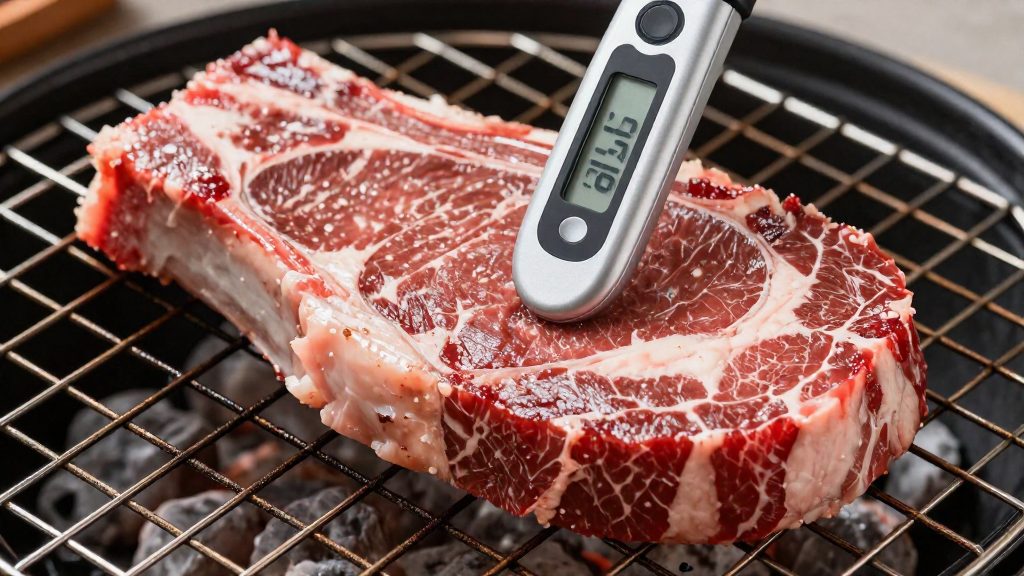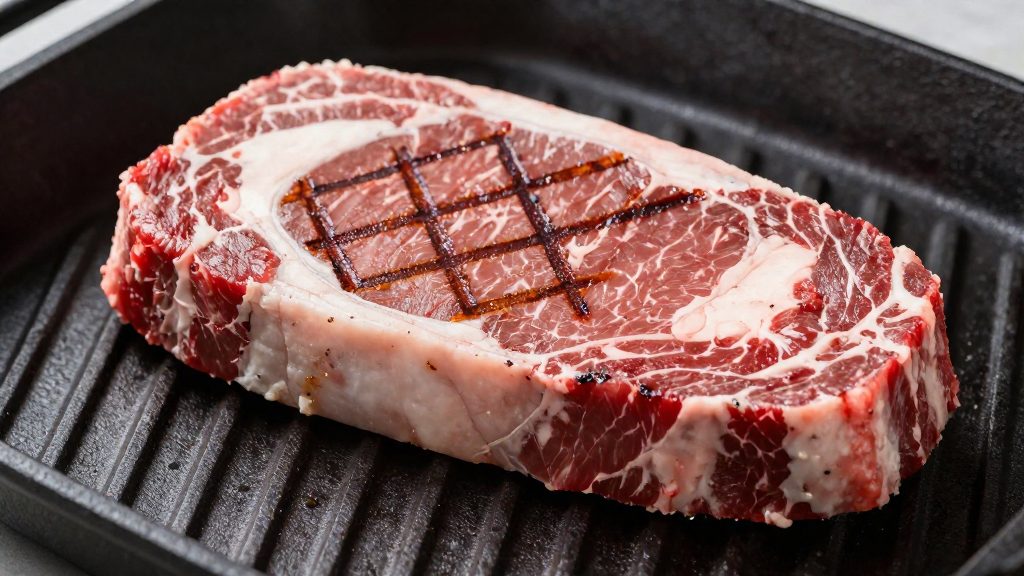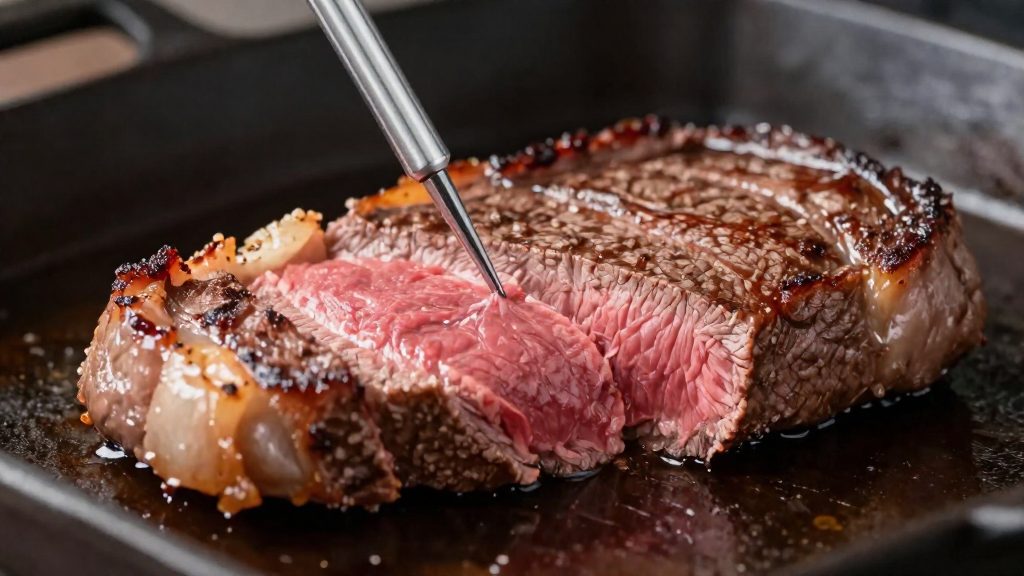
For a denver (zabuton) steak on a plancha set to high, the benchmark is 3 minutes per side, according to Barbecue Bible (Steven Raichlen). That is a starting point for timing, not a finish line. Thin-cut steaks follow a much shorter schedule: a plancha manufacturer, Gardiné, gives about 1 minute on the first side and 30 to 45 seconds on the second, with the plancha at maximum temperature.
Plancha steak medium rare: quick timing guide
Timing a denver steak on the plancha
Start the clock when the steak touches the oiled surface. Set one timer for 3 minutes, turn the steak once, then set a second 3-minute timer for the other side. Two intervals of 3 minutes total about 6 minutes of contact before you check doneness.
Turn the steak only at the end of each interval. Flipping early makes it harder to track the schedule and gives the first side less uninterrupted contact with the hot surface.
Why a fast-searing cut suits plancha timing
A plancha transfers heat mainly through direct contact, so the time needed depends on how much of the meat sits in contact with the surface and how thick it is. The Barbecue Bible gives 3 minutes per side for a denver steak as a starting point, and the result still has to be confirmed with a thermometer. The thin-cut schedule applies the same principle further: less thickness allows much shorter exposure per side.
Surface contact, cut thickness, and interval timing are the three variables to control. Keep the thickness consistent across steaks so the same timing produces repeatable results.
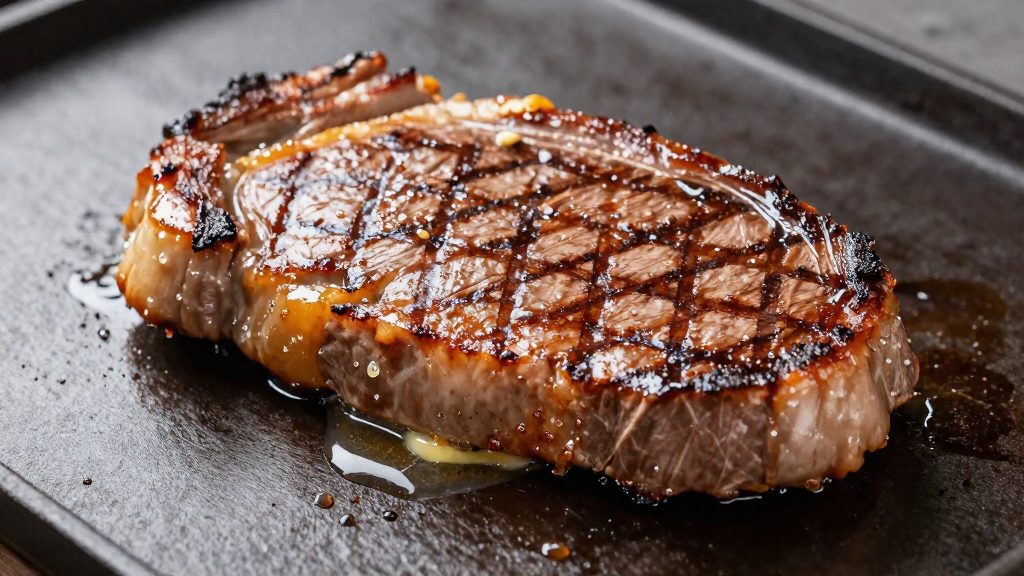
How long to cook steak medium rare on a plancha?
A clock time sets a starting window, not a finished result. Two steaks given the same number of minutes can reach different doneness, so each timed check should be converted into a temperature check. After the second 3-minute side, lift the steak and read its internal temperature. Health Canada (Government of Canada) (2024-06-04) gives 63°C (145°F) as the safe internal temperature for whole cuts of beef at medium-rare, and that is the reading to aim for.
The Barbecue Bible (Steven Raichlen) uses pull points, the temperature at which the steak leaves the heat. Its figures for a denver steak are:
| Doneness | Pull temperature | Reference |
|---|---|---|
| Rare | 125°F (about 52°C) | Barbecue Bible |
| Medium | 135°F (about 57°C) | Barbecue Bible |
The Barbecue Bible gives no pull point for medium-rare. Its two figures are for rare and medium only. The two sources serve different purposes: Health Canada sets a safety minimum, while the Barbecue Bible sets the point to remove the meat. Check the temperature in the thickest part of the steak and keep cooking until it reaches Health Canada’s 63°C (145°F). The Barbecue Bible’s lower pull points are not a substitute for that safety figure.
Why identical clock times give different results
- Starting temperature: meat taken straight from the refrigerator reaches target more slowly than meat left out briefly.
- Surface heat: the plancha’s temperature falls when a cold steak lands on it, and it recovers at different rates depending on the appliance and how often the surface is reheated.
- Moisture: surface moisture leaving the steak slows browning and can extend the cook.
What internal temperature is medium rare?
Two published charts give different numbers for medium-rare beef, and the difference comes from what each figure measures. Health Canada (2024) lists a safe internal temperature for whole cuts such as steaks and roasts. The Barbecue Bible by Steven Raichlen gives a pull temperature for plancha-cooked denver (zabuton) steak, which is the point at which you remove the meat from the heat.
According to Health Canada (2024), whole cuts reach these safe internal temperatures:
| Doneness | Internal temperature |
|---|---|
| Medium-rare | 63°C (145°F) |
| Medium | 71°C (160°F) |
| Well done | 77°C (170°F) |
The Barbecue Bible’s plancha method sets lower removal points for denver steak:
- Rare: pull at 125°F (about 52°C)
- Medium: pull at 135°F (about 57°C)
These figures do not agree. The 145°F medium-rare target is higher than the 135°F medium pull, so a steak removed at the Barbecue Bible’s points will read below Health Canada’s medium-rare value. The two charts also apply to different cooking goals: one sets a food-safety threshold, the other sets a removal point for the plancha.
For a plancha steak aimed at medium-rare, follow Health Canada’s 63°C (145°F) as the safe internal temperature, and check it with a digital thermometer. The Barbecue Bible’s 125°F (rare) and 135°F (medium) pull points are that recipe’s own removal points. They fall below the Health Canada figure, so do not treat them as a safe medium-rare target. Health Canada advises inserting the probe into the thickest part of the meat, without touching bone, and checking each steak separately. The Barbecue Bible method then calls for a 5-minute rest on a rack before slicing, so the steak can settle before you cut into it.
Is medium rare safe in Canada?
According to Health Canada (Government of Canada, 2024-06-04), whole cuts such as steaks and roasts have a medium-rare safe temperature of 63°C (145°F). Ground beef and burgers must reach 71°C (160°F). Mechanically tenderized beef must reach 63°C (145°F) and be turned at least twice. Ground beef, burgers and mechanically tenderized beef follow separate rules, so a plancha steak cooked to medium-rare is covered only when it is a single whole cut.
| Beef form | Medium-rare allowed? | Required handling |
|---|---|---|
| Whole cuts (steaks, roasts) | Yes | Cooked as a single intact piece |
| Ground beef and burgers | No | Must reach 71°C (160°F) throughout |
| Mechanically tenderized beef | Yes, at 63°C (145°F) | Turn the steak at least twice during cooking |
Ground beef and burgers require a higher minimum. Health Canada sets 71°C (160°F) for ground beef, including burger patties, so a burger cooked to a pink centre on the plancha does not meet the guidance. Patties should be cooked fully before they are served.
Mechanically tenderized beef is the exception that is still treated like a steak. It reaches the same 63°C (145°F) target, but Health Canada adds a handling step: the piece must be turned over at least twice during cooking. On a plancha, this means flipping the meat at least twice rather than leaving it to cook on one side.
Whole cuts are the standard case for medium-rare in Health Canada’s chart, at 63°C (145°F). A steak that has not been mechanically tenderized or ground can therefore be cooked to medium-rare, and it is the form that most plancha recipes for medium-rare are written for, such as the denver steak method from Steven Raichlen’s Barbecue Bible.
Preheating and oiling the plancha
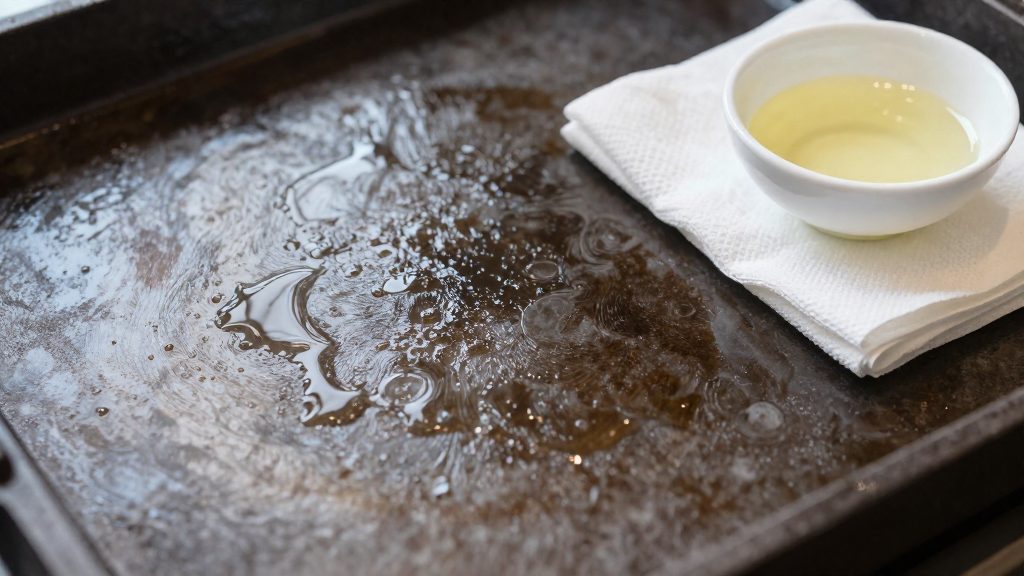
Preheating brings the cooking surface to temperature before the steak touches it, so the meat sears on contact instead of stewing in its own juices. The Barbecue Bible by Steven Raichlen gives the basic method for a denver (zabuton) steak: heat the plancha on the grill set to high, then oil the surface. The oil goes on once the plate is already hot, not while it is still cold.
Preheating is also the stage where the surface is set up for even contact. Heat the plancha on the grill set to high so the whole plate comes up to temperature, not just the area nearest the burners. A plate that is hot only in the centre leaves the edges of the steak cooking more slowly.
| Step | Action | Purpose |
|---|---|---|
| 1 | Set the grill to high and close the lid | Brings the plancha to its maximum working temperature |
| 2 | Wait until the whole plate is hot before oiling | Ensures an even cooking surface edge to edge |
| 3 | Spread a thin layer of oil with a folded paper towel held in tongs | Coats the surface evenly without pooling |
| 4 | Place the steak on the plate within moments of oiling | Keeps the oil layer intact at first contact |
Oil the surface lightly. A thin, even film is enough to prevent sticking and to conduct heat evenly. Pools of oil smoke heavily and create uneven patches where the meat fries rather than sears. Use an oil that tolerates high heat, and keep the oil in a small dish or bottle near the grill so you can reapply it quickly if the surface looks dry before the steak goes down.
Thin cuts vs thick cuts: adjusting time
The thin-cut recipe is the reference point. With the plancha at maximum temperature, a thin-cut reference steak needs about one minute on the first side and 30 to 45 seconds on the second, according to Gardiné (plancha manufacturer). The shorter second side works because the first side has already formed a crust, and a thin slice carries heat through quickly.
Thicker steaks need more time, because heat must travel further from the surface to the centre. Do not apply the thin-cut timings unchanged. Instead, extend the sear time per side progressively as thickness increases, keeping the plancha surface hot throughout. Judge the timing by the steak itself rather than by a clock alone.
Use the surface colour and the steak’s behaviour as cues. A steak that releases easily from the plancha and shows a well-browned crust is ready to turn. Once the crust has formed, a thicker cut needs a longer stay on each side than the thin-cut reference to bring the centre up to temperature.
Because a surface sear can mislead on a thick steak, confirm doneness at the centre.
Adjust the time on each side in small steps, testing at the centre, rather than repeating the thin-cut sequence on a thick piece.
Resting and slicing the steak
Resting lets the meat settle after it leaves the plancha, so the juices spread back through the muscle fibres instead of running out onto the cutting board. For a denver (zabuton) steak, Steven Raichlen’s Barbecue Bible specifies rack resting for 5 minutes before slicing. Set the steak on a rack rather than directly on a plate, so the cooked surface is not sitting in the juice it has just released.
Gardiné, a plancha manufacturer, gives a second option for thin-cut medium-rare steak: holding it under foil in a 60°C oven. This works when the steak has to wait a few minutes, for example while the rest of the meal is finished. The two methods are compared below.
| Holding method | Setting | Duration | Source |
|---|---|---|---|
| Rack resting | Off the heat, uncovered | 5 minutes | Barbecue Bible (Steven Raichlen) |
| Foil holding | 60°C oven, covered with foil | 5 minutes | Gardiné (plancha manufacturer) |
Rack resting is the default for steaks served straight after cooking. The foil and oven method keeps the steak warm for service and is intended as a short holding step, not a longer rest. Keep the foil loose over the meat so it does not trap steam against the surface.
Slicing
Once the rest is complete, slice the steak across the grain. Cutting across the muscle fibres shortens them, which makes each bite easier to chew. Use a long, sharp knife and make smooth, single strokes rather than sawing, which squeezes out more juice. Serve the slices immediately on warmed plates so the interior stays at the temperature you cooked it to.
Cleaning the plancha after searing
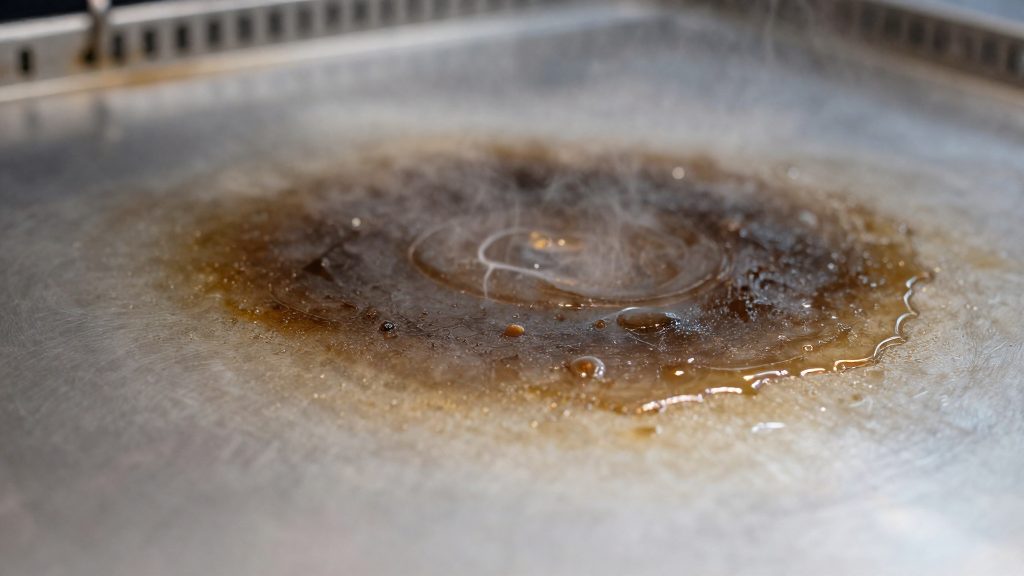
Scraping the cooking residue off the plate while it is still warm is the easiest way to clean up after searing. Once the steak is removed, meat juices and fat that have caramelised on the surface soften as the plate cools slightly, so they lift more easily with a metal scraper held flat against the plate. Work in short, firm strokes from the back of the plate toward the front, and push the debris into the drip tray rather than letting it spread across the cooking surface.
Keep the scraper at a shallow angle so you lift the burnt particles without gouging the surface. Use a scraper with a rigid edge, and avoid abrasive pads on the plate, which can remove the seasoning layer that builds up through regular use.
Once the scraper has removed most of the residue, wipe the plate with a folded paper towel or a clean cloth to pick up loose particles and grease. Empty the drip tray at the same time, since leftover fat there can smoke or spoil the next cook.
When the plate has cooled completely, store the plancha in a dry place and cover it if you have a fitted cover. Moisture left on the metal between sessions encourages rust, so do not leave the plate damp after wiping. Before the next use, check the surface for any remaining residue, because burnt particles left from a previous session can transfer flavour onto fresh food.
Frequently asked questions
What internal temperature should a medium-rare steak reach on the plancha?
According to Health Canada (2024), whole cuts of beef such as steaks reach medium-rare at 63°C (145°F). Check the thickest part with a digital thermometer, keeping the probe away from bone.
Why are the Barbecue Bible’s pull points lower than that?
The Barbecue Bible’s 125°F (rare) and 135°F (medium) figures are removal points for its recipe, and both fall below the 63°C (145°F) benchmark. The recipe gives no medium-rare pull point, so for a medium-rare steak, use the Health Canada figure instead.
How long should the steak rest after leaving the plancha?
The Barbecue Bible recommends a 5-minute rest for a denver steak, placed on a rest rack before slicing. For thin cuts, Gardiné keeps the steak covered with foil in a 60°C oven for 5 minutes before serving.