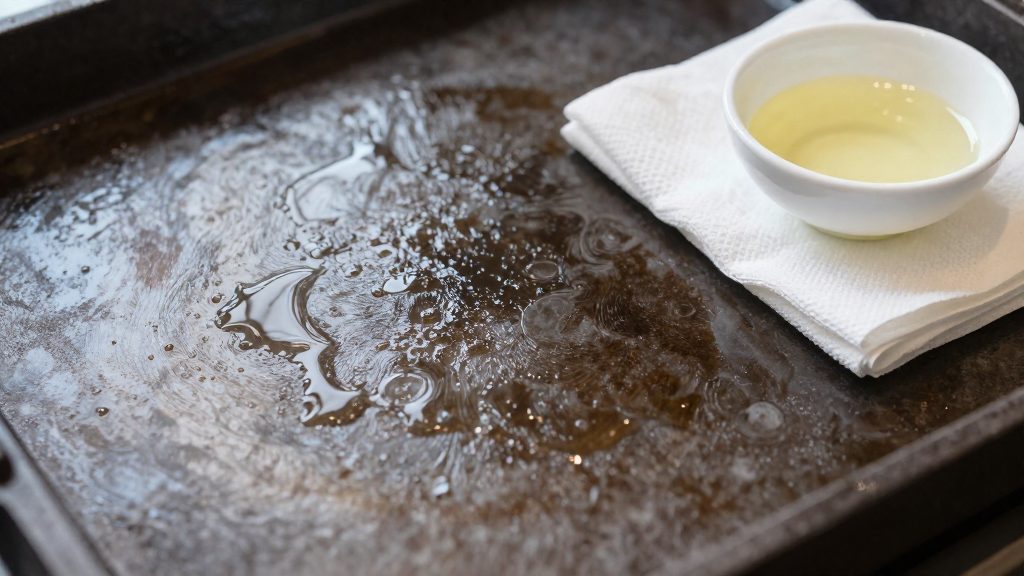
Seasoning a new plancha builds a polymerised oil layer bonded to the bare metal of the cooking surface. A properly seasoned surface helps the plate cook evenly and sear well, so it should be prepared before the first cook. Once seasoned, Le Marquier (2026) says a plate at 250–300°C is essential for even cooking and good searing.
Why season a new plancha?
A new plate has an unfinished surface, and the bare metal is what food touches on the first cook. When oil is heated on that metal until it smokes, the oil breaks down and bonds to the surface, forming a thin, hard coating. This is the polymerised oil layer, and it is what separates a seasoned plate from a raw one.
The layer matters because it gives the plate a consistent surface before any food touches it. A uniform coating supports even searing, which depends on a well-prepared plate reaching and holding the target temperature across its full width. Food placed on a raw, unevenly prepared surface is more likely to stick and brown unevenly, so seasoning first gives a more predictable baseline for the first cook.
Seasoning does not replace cleaning.
Clean off the factory residue
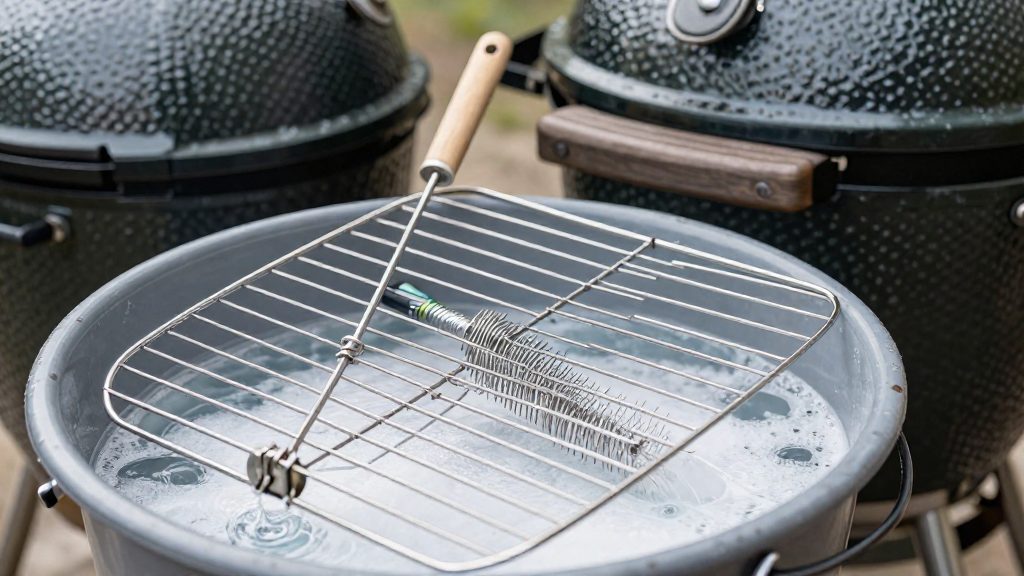
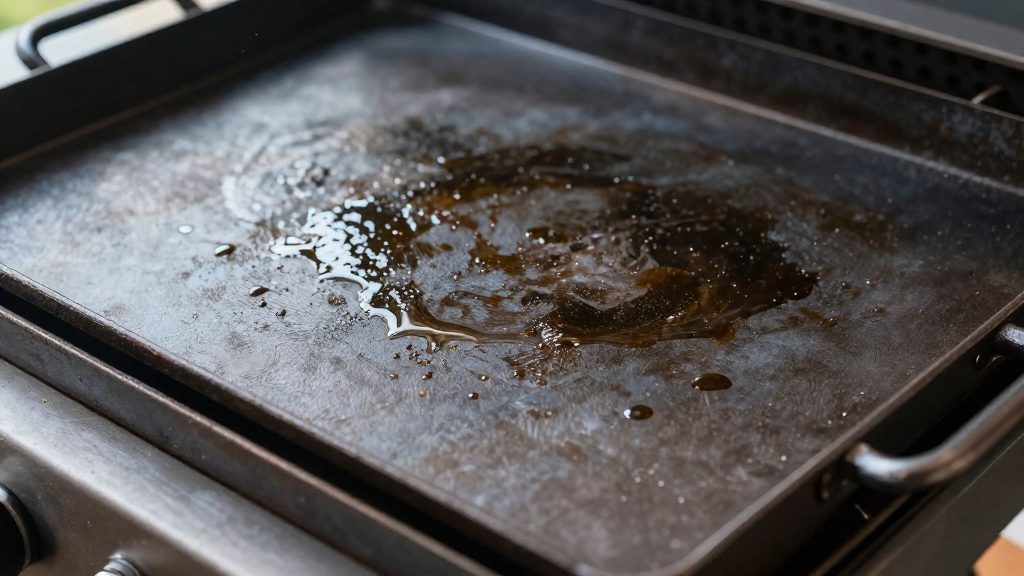
A new plancha usually leaves the factory with manufacturing residue on its cooking surface. According to Le Marquier (2026), this residue should be removed before the first use by washing the plate with warm water and mild detergent, then rinsing and drying it completely. The sequence is short, but each step has a distinct job.
| Step | Action | Purpose |
|---|---|---|
| 1 | Wash the plate with warm water and mild detergent | Lifts the manufacturing residue from the surface |
| 2 | Rinse the plate | Clears away the detergent and loosened residue |
| 3 | Dry the plate completely | Leaves no moisture on the cooking surface before it is used |
Mild detergent is the recommended cleaning agent. The source specifies a mild product rather than a harsh one, so a gentle dish soap applied with a soft cloth or sponge matches the method described. Work the solution over the whole cooking surface and the edges, then check that no greasy film or residue remains.
Complete drying is the final step of this stage. The source asks for the plate to be dried thoroughly after rinsing, so wipe the surface with a clean cloth and check it by hand before moving on. Any standing water left on the plate would go against the instruction to dry it completely.
Keep this initial wash separate from routine maintenance. The factory-residue wash is a one-time operation on a new plate, and the cleaning steps for a plate that has already been used are described in other sections of this guide.
Which oil works best?
For seasoning a new plancha, the oil choice depends on three factors: how well it tolerates high heat, whether it leaves flavour on the cooking surface, and how well it stays on the plate instead of evaporating. According to Le Marquier (2026), sunflower and grapeseed oils are the preferred options because both are high-smoke-point oils. Olive oil can also be used, but it evaporates faster than these alternatives, which makes it a less suitable choice for building the seasoning layer.
Parts Town describes suitable seasoning oils as neutral, high-smoke-point oils. This group includes vegetable, canola, avocado, peanut and grapeseed. Neutral oils are preferable because the seasoning layer should not add a distinct taste to later cooking.
| Oil | Category in the source data | Practical note |
|---|---|---|
| Sunflower | High smoke point | Preferred choice |
| Grapeseed | High smoke point, neutral | Preferred choice |
| Olive | Usable | Evaporates faster than the alternatives |
| Vegetable, canola, avocado, peanut | Neutral, high smoke point | Suitable alternatives |
Sunflower and grapeseed are the most direct recommendations, since they combine a high smoke point with the properties the seasoning process requires. Vegetable, canola, avocado and peanut oils fall into the same neutral, high-smoke-point group, so any of them can replace sunflower or grapeseed when those are unavailable. Olive oil can be used, but it evaporates faster, so less oil remains on the surface after heating. A neutral, high-smoke-point oil is the better choice for seasoning.
How do you season a plancha step by step?
Seasoning a new plancha is a heat, oil and cool sequence that bonds a thin oil layer to the cooking surface. According to Parts Town, the method has four stages, and each one depends on a specific temperature or surface condition. Work through them in order, starting with a clean, dry plate.
| Stage | Target | Action |
|---|---|---|
| 1. Heat | 150–175°C (300–350°F) | Hold for 30 minutes |
| 2. Oil | Surface still slightly warm | Spread a small amount of oil in a thin layer |
| 3. Reheat | 175°C (350°F) | Heat until the oil smokes |
| 4. Cool | Plate cooled completely | Wipe off any excess oil |
Step 1: Heat the plate for 30 minutes
Bring the cooking surface to about 150–175°C (300–350°F) and hold it there for 30 minutes. This slow, moderate heat lets the iron or steel reach an even temperature before any oil is added. Do not rush this stage to higher temperatures, because the target range is the one specified for seasoning.
Step 2: Apply the oil while the plate is still warm
After the 30 minutes, turn the heat off or lower it, then spread a small amount of oil across the surface. Timing matters: the plate should be still slightly warm, not hot enough to smoke and not fully cold. Work the oil into a thin, even film with a brush or a paper towel. A thick layer will not bond as well and will leave a sticky residue, so use less oil than seems necessary.
Step 3: Reheat until the oil smokes
Raise the temperature again to about 175°C (350°F). Keep the plate at this heat until the oil begins to smoke. The smoke is the visual endpoint of this stage: it shows that the oil has reached the temperature at which it polymerises onto the surface. Watch the plate closely at this point and keep the cooking area ventilated.
Step 4: Cool completely and wipe off excess
Turn off the heat and let the plancha cool completely before handling it further. Once cool, wipe off any oil that has not bonded to the surface. The remaining film is the seasoning layer that protects the plate for the first cooks.
How many coats are enough?
The documented method describes one single cycle of heating, oiling and cooling, not a fixed number of layers. Each application therefore produces one thin layer.
Single versus repeated cycles
| Approach | What it involves | Result on the cooled plate |
|---|---|---|
| Single cycle | One full heat, oil, reheat and cool sequence | One thin oiled layer |
| Repeated cycle | The same sequence run again after the plate has fully cooled | A second layer applied over the first |
Repeating the cycle does not change the steps, only the number of times they are performed. Applying more oil in one pass tends to leave excess that must be wiped away. The sources do not cover repeated cycles, so treat a second cycle as optional and keep each coat thin.
Deciding whether a second pass is needed
The method does not tie a second pass to a specific visual test, so the decision rests on the state of the surface after the first cycle. A plate that still looks uneven or dry in patches can be given a second cycle using the same temperatures and timings. Once the wiped surface shows a uniform, thin film, further passes add little, and the plate can move on to ordinary use.
Protection from a second pass is not quantified in the method, so treat repeated cycles as a practical way to even out the surface rather than a guaranteed increase in durability.
Daily cleaning and upkeep
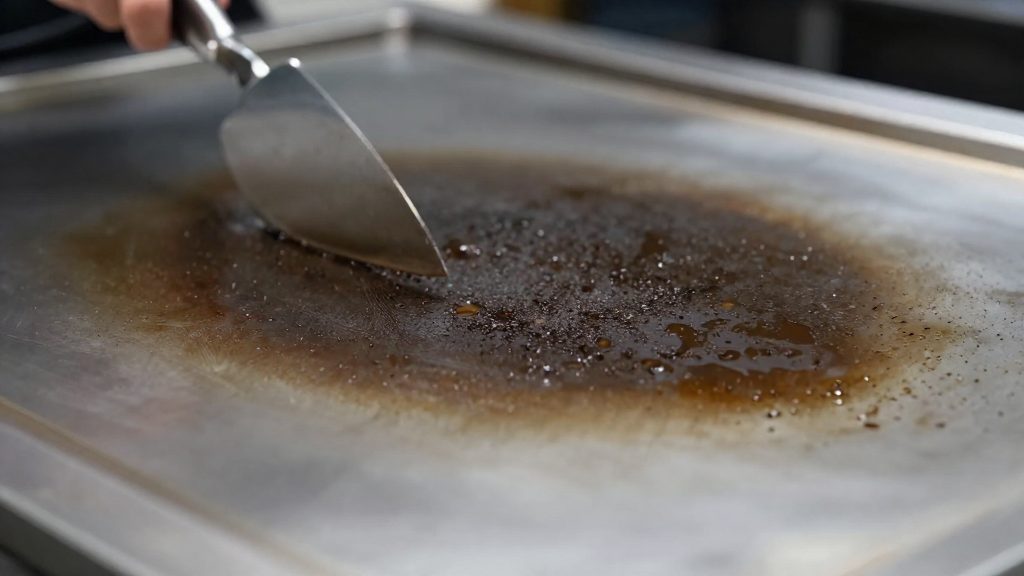
Clean the plancha while it is still hot. Residue lifts more easily from a warm surface, so the cleaning step belongs immediately after the cook, once the food is off. Use a metal spatula or scraper to scrape off food debris and burnt fragments, working toward the grease channel. Then deglaze the surface by pouring a little water or white vinegar onto the hot plate. The liquid steams and loosens what remains. Stand back and keep your hands and face away from the hot steam. Wipe the plate with a cloth or paper towel, and repeat the scrape and wipe on any sticky patches. According to Le Marquier (2026), this routine is the standard approach for flat-top plates after each use.
Deglazing with a small volume of liquid is enough for routine upkeep. Use only the quantity needed to lift the residue, since excess liquid must then be wiped away and the plate dried before storage.
Once the plate is clean and dry, cover it. A cover keeps the cooking surface protected between sessions, and it should only go on after the plate has been fully dried, not while moisture remains. Check the surface before each cook: if residue has built up, scrape and wipe again while the plate is warm before the next use.
Common mistakes to avoid
Two errors compromise the seasoning and the cooking surface of a new plancha more often than others: skipping the preheat and seasoning with the wrong oil.
Skipping the preheat
Oiling a plate that has skipped the initial 30-minute heat, or one that is fully cold or already hot, is a common shortcut. Parts Town’s method heats the plate to 150–175°C for 30 minutes first, then applies a thin layer of oil while the surface is still slightly warm. Skipping this heat stage leaves the oil layer less even. The 10 to 15 minute preheat to 250–300°C recommended by Le Marquier (2026) applies later, when you start cooking, to get even cooking and good searing. Check that the surface is hot across its width rather than only at the centre.
Follow the order of the method: the oil goes on only after the 30-minute heat stage and once the plate has cooled to slightly warm, never while the plate is still heating.
Seasoning with corn oil
Corn oil is often reached for in the kitchen, but it is a poor choice for seasoning. According to Parts Town, corn oil should be avoided because of its sugar content, which means it can caramelise and burn on a hot surface. Burnt residue forms a sticky, uneven film instead of a smooth, cooked-in layer, and that film must be scraped off before the next session.
Avoid the mistake of using whatever oil is nearest to hand, and check the label of any oil you pick to confirm it is neutral in flavour before applying it to the plate.
Frequently asked questions
Which oil should I use to season a new plancha?
Choose a neutral high-smoke-point oil such as sunflower, grapeseed, vegetable, canola, avocado or peanut oil. Avoid corn oil, because its sugar content can caramelise and burn on the hot plate (Parts Town). Olive oil also works, but it evaporates faster on the hot surface, according to Le Marquier (2026).
Can I clean my plancha with cold water while it is still hot?
No. Scrape off residue while the plate is hot, then deglaze with a little water or white vinegar and wipe. Avoid ice or very cold water on enamelled cast iron plates, as it could damage the enamel (Le Marquier, 2026). Cover the plancha once it is clean and dry.
What temperature do I need for seasoning compared with cooking?
Seasoning uses a lower heat than cooking: about 150–175°C (300–350°F) for 30 minutes, followed by a thin oil layer reheated until it smokes (Parts Town). The 250–300°C plate range is for cooking, not for seasoning, according to Le Marquier (2026). Let the plate cool completely and wipe off any excess oil before the first cook.