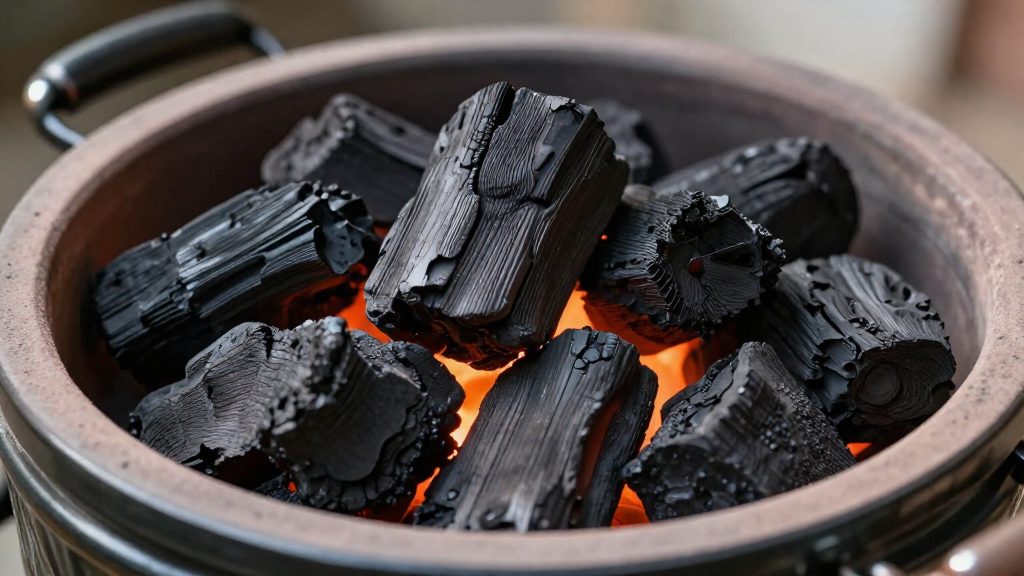
What is lump charcoal, and why use it in a kamado?
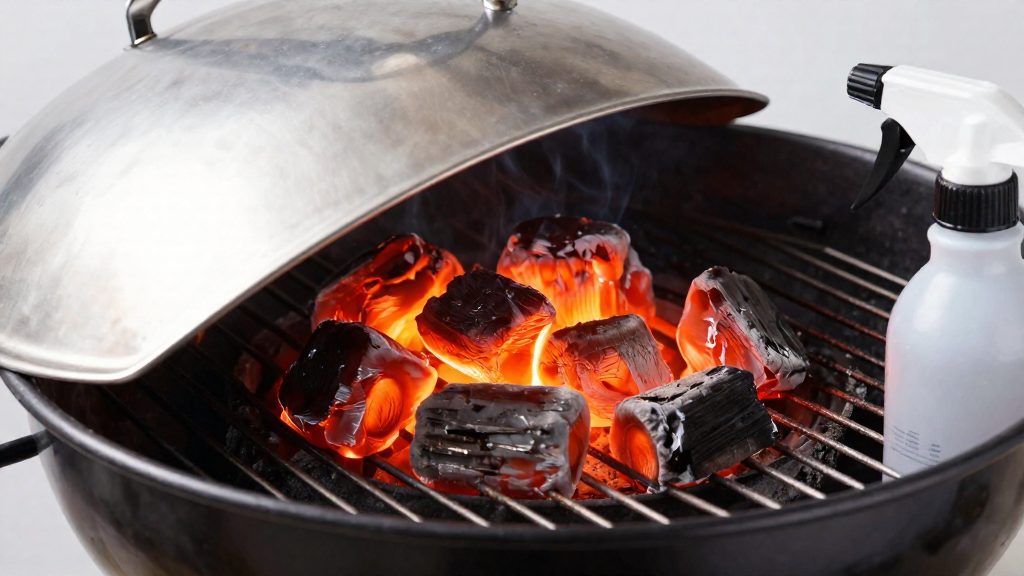
Lump charcoal is fuel made from natural hardwood pieces with no additives. According to Barbecues Galore Canada (2025), it is 100% hardwood and burns hotter and faster than briquettes, which suits steaks, chops and burgers. In a kamado, the irregular pieces leave air channels through the fuel bed, and the ceramic body holds heat after the fire has built up. These properties explain why lump charcoal is a common fuel choice for ceramic grills.
Composition: natural hardwood only
Lump is made from pieces of natural hardwood, and the product contains no additives. Because the fuel is the wood itself, the contents of the bag determine what burns in the firebox. Check the packaging for a hardwood-only statement before buying, and avoid bags that list fillers or other ingredients.
Piece size and airflow
Lump is sold as irregular pieces rather than uniform shapes, so sizes vary between bags and within the same bag. Gaps between pieces let air move through the fuel bed. Larger pieces leave wider channels, while dust and small fragments fill those gaps and restrict airflow, so a bag with many fines will burn less evenly than one with mostly intact pieces.
Ceramic retention with lump fuel
A kamado’s ceramic body behaves differently from thin metal. Blaze Grills (2025) notes that the ceramic cools slowly. Lump supplies heat quickly, and the ceramic then retains much of that heat, so the grill holds temperature steadily once the fire has built up. Because the body changes temperature slowly, adjustments to the fuel take effect gradually rather than instantly.
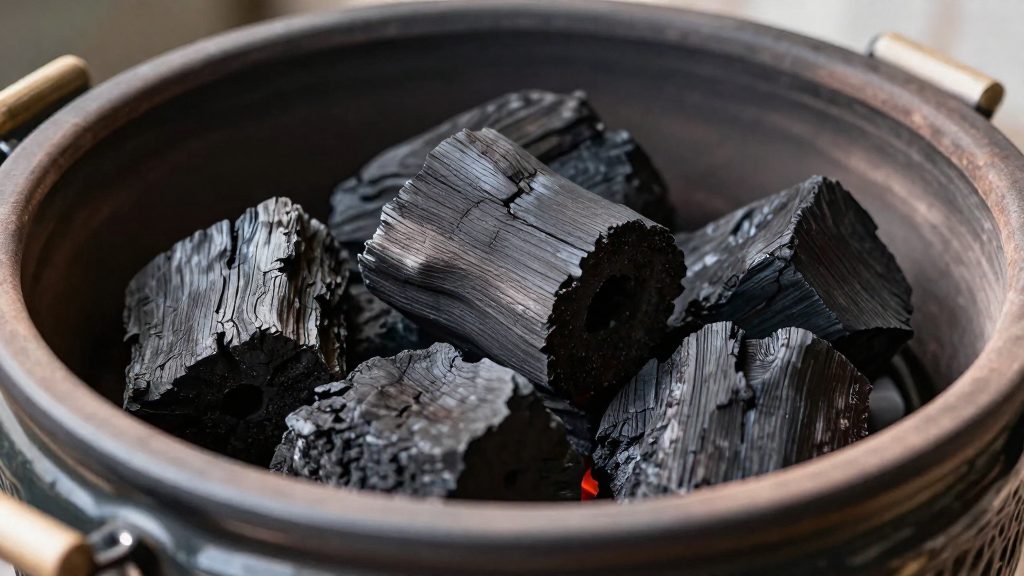
Lump charcoal or briquettes: which is better for beginners?
For a kamado, lump charcoal is the fuel the consulted sources point to for beginners. Blaze (2025) describes natural hardwood lump as lighting faster, burning hotter and leaving less ash than briquettes, while Barbecues Galore Canada (2025) describes briquettes as burning lower and steadier over a longer period.
| Factor | Lump charcoal | Briquettes |
|---|---|---|
| Lighting | Lights faster | Lights more slowly |
| Heat output | Burns hotter | Burns lower |
| Ash | Leaves less | Leaves more |
| Burn pattern | Quicker, faster rise in temperature | Steadier and longer-lasting |
Why briquettes and lighter fluid are not recommended in kamados
All Things Barbecue (2022) advises against using briquettes or lighter fluid in a kamado. For lighting, the same guidance is built around lump alone, which keeps the fuel and the ignition method consistent with the grill’s design. Lighter fluid also carries a flavour risk: it can leave a chemical taste on the food.
Beginner choice: consistency and predictability of burn
For a first kamado, the practical question is how predictable the fire is. Lump lights and heats quickly, so the temperature can climb fast after lighting. Because the ceramic body changes temperature slowly, damper changes take time to show. A beginner should make small adjustments and wait between them. Briquettes, by contrast, hold a lower and steadier output for longer, which makes them easier to hold at a fixed temperature once it is reached. Because the two fuels behave so differently, beginners should pick one fuel and learn its response. For a kamado, the cited guidance points to lump. For a kamado, lump charcoal is the fuel the sources support, and a predictable burn comes from keeping that fuel consistent from one cook to the next.
What you need before your first cook
Before lighting a kamado, settle three things: how the charcoal will catch, how much you load, and which tools you will use to handle heat.
Starter options
- Chimney starter: a metal cylinder that holds charcoal while it catches, then you pour the glowing coals into the firebox.
- Electric starter: an electric element that ignites the charcoal in place. Barbecues Galore Canada (2025-11-03) describes electric starters as reliable.
- Looftlighter: a hot-air starter that Blaze Grills (2025) lists among its lighting options.
- Paraffin cubes: solid fire starters placed in a gap in the charcoal. Blaze Grills (2025) includes them among its recommended methods.
Barbecues Galore Canada (2025-11-03) describes fire starters as reliable options in general. Choose one method and use it for your first session, so you can learn its behaviour before comparing others.
Fill levels
Two sources give different fill guidance. The table shows the figures as published.
| Fill level | Source | Stated use |
|---|---|---|
| About 40% of the fire basket | All Things Barbecue (2022-04-21), citing Kamado Joe guidance | Maximum load when lighting |
| Halfway | Blaze Grills (2025) | Smaller or lower-temperature cooks |
| Within 4 inches (about 10 cm) of the top | Blaze Grills (2025) | Large cooks or searing |
The two sources differ on the halfway fill for lighting. For a first cook, load to about 40% and light from that level, since it is the more conservative figure. Fill higher only once you have lit the charcoal successfully and know how your kamado responds.
Tools for handling heat
- Heat-resistant gloves for opening the lid and draft door and for handling the grate once the kamado is hot.
- Probe thermometer so you can check the meat without repeatedly lifting the lid.
- Ash removal tool to clear spent ash from the firebox before the next session.
How do you light a kamado with lump charcoal?
Open the lid and the draft door fully, place two fire starters in a gap in the charcoal, and light them. Leave the lid and draft door open until the charcoal begins to ash and ember, then rake the coals. According to All Things Barbecue (2022), this sequence takes about 10 minutes before raking at roughly 10 to 12 minutes.
Step-by-step lighting sequence
- Open all airflow. Open the lid and the draft door. Following Blaze (2025), fully open the top and bottom dampers before lighting, which gives the fire maximum airflow while it establishes itself.
- Load the starters. Place two fire starters into a gap in the lump charcoal, not on top of the pile. The gap lets the flame reach the surrounding charcoal.
- Light the starters. Ignite them using the method for your starter type (see the table below).
- Wait for ash and ember. Keep the lid and draft door open for about 10 minutes, until the lump begins to show grey ash and orange ember.
- Rake the coals. At about 10 to 12 minutes, rake the glowing lump so the fire spreads evenly across the bed of charcoal.
- Close the lid to build heat. Once the fire is established, set the vents for the cook. Temperature management is covered in the next section.
Starter ignition times
Blaze (2025) gives the following lighting times for each starter type:
| Starter | Ignition time (Blaze, 2025) |
|---|---|
| Paraffin cubes | About 10–12 minutes |
| Chimney starter | About 10–15 minutes |
| Electric starter | About 10–12 minutes, then removed after 5–8 minutes |
| Looftlighter | About 5–8 minutes |
Blaze’s electric starter figure means the starter should be taken out once the lump has caught, not left in the fire for the full ignition window.
Chimney starter timing
Barbecues Galore Canada (2025) puts a chimney starter at about 15 to 20 minutes to bring coals to a glowing and ashy state. The two sources give different timings, so use the ash-and-ember signal, not the clock alone, to decide when to rake. Use the ash-and-ember signal, rather than the clock alone, to decide when to rake.
How to set the vents and hold your temperature
On a kamado, the bottom damper (the draft door) controls how much air reaches the fire, and the top damper (the vent in the lid) controls how quickly hot air and smoke leave the dome. More incoming air feeds the fire and raises the temperature. Less air slows it down. The top damper governs how much heat the dome retains and how fast air moves through it, so it works alongside the bottom damper rather than replacing it.
Once the charcoal is burning and the lid is closed, the adjustment phase begins.
Stepwise adjustments to reach and hold target temperature
- Close the lid and let the dome settle before judging the reading.
- If the temperature is below target, open the bottom damper slightly. If it is above target, close it.
- Make one change at a time and wait for the reading to stabilise before making another.
- Use the top damper for fine trimming. Partly closing it helps the grill hold heat, and opening it releases heat.
- Once you are near target, hold it by leaving both dampers where they are. Small corrections are usually enough.
| Observed trend | First adjustment | Second adjustment |
|---|---|---|
| Temperature climbing past target | Close the bottom damper slightly | Partly close the top damper |
| Temperature falling below target | Open the bottom damper slightly | Open the top damper slightly |
| Temperature swinging up and down | Stop adjusting and wait | Make only one change at a time |
Reading temperature: dome gauge versus grate probe
The dome gauge in the lid reports the air temperature near the top of the chamber. It responds quickly to damper changes, which makes it useful for tracking the grill’s overall state. A probe placed at grate level measures conditions closer to where food sits, so it is the better reference for the actual cooking environment.
The two readings often differ. During your first cook, note the grate reading when the dome shows your target, then use that gap as a working offset for later sessions. Opening the lid repeatedly to check the temperature releases heat and restarts the settling period, so read the gauge from the outside whenever possible.
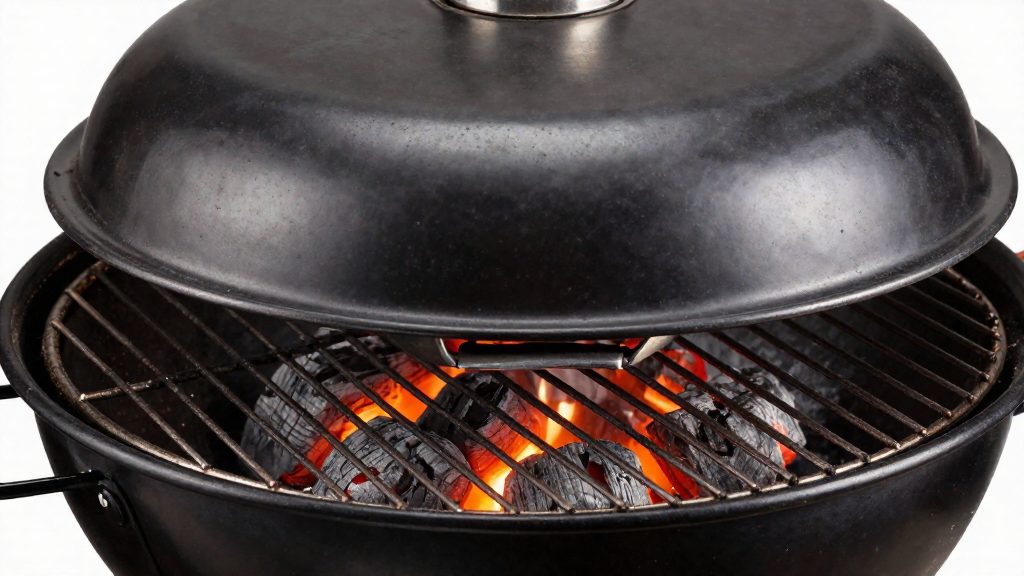
Direct grilling or indirect smoking: which setup to use
Choosing between direct grilling and indirect smoking depends on how close the food sits to the fire and how long it cooks. Direct grilling places the food over the hot coals for fast searing. Indirect smoking keeps the food off the main fire and flavours it with wood smoke over a longer cook. Both use the same lump charcoal bed, with the food and wood placed differently.
Direct grilling over hot coals for searing steaks
Once the lump is lit and the coals are glowing and ashy, spread them to form the hot zone and set the steaks directly above it. The high heat forms a crust quickly, so the steak is seared before the interior overcooks. Keep the steak over the coals only long enough to sear, then move it off the direct heat to finish.
Indirect smoking with a wood chunk in the hottest coals
For smoking, the food is not placed over the fire at all. The smoke comes from the wood, and the method follows this sequence:
- Light the lump and let the coals reach their hottest part.
- Bury a wood chunk in the hottest part of the coals.
- Wait for thin blue smoke before closing the lid.
- Close the lid, then partly close the vents toward the target temperature.
The cue to close the lid is visual. Watch for thin blue smoke rather than a set time.
Choosing the fuel for each method
Sources differ on fuel for long cooks. Barbecues Galore Canada (2025-11-03) says briquettes burn lower and steadier for low-and-slow cooking, while All Things Barbecue (2022-04-21) warns against briquettes in a kamado. For a kamado, the cited lighting guidance is built around lump and warns against briquettes, so lump is the fuel to use for both searing and smoking.
| Setup | Food position | Cue to proceed | Typical use |
|---|---|---|---|
| Direct grilling | Over the hot lump coals | Coals glowing and ashy | Searing steaks, chops, burgers |
| Indirect smoking | Away from the main fire, wood chunk buried in hottest coals | Thin blue smoke | Smoked cooks |
Common beginner mistakes and safety tips
Two common errors to avoid with a kamado are leaving the grill unattended during preheat and lighting damp charcoal. Blaze Grills (2025) addresses both. Blaze Grills (2025) addresses both, and each is straightforward to avoid once you know what to watch for.
Unattended preheating is the main safety risk. Once the lump catches, the temperature can rise quickly. An overshoot takes a long time to correct, so the adjustment you make is slow to take effect. Stay with the grill from lighting until it reaches your target temperature, and check the dome thermometer at short intervals rather than after long gaps.
Damp charcoal is a likely cause when the grill will not climb above roughly 300–350°F (about 150–175°C) even though the charcoal has lit. Lump charcoal that has absorbed moisture can light, yet the grill still fails to climb past a certain point. Adding more fuel or adjusting the fire will not solve this. Empty the firebox, replace the damp lump with dry charcoal, and relight.
Use the table below as a quick diagnostic before you start the fire.
| Symptom | Cause | Action |
|---|---|---|
| Temperature rises quickly after lighting | Unattended preheat | Stay near the grill and monitor the thermometer |
| Temperature stalls below roughly 300–350°F (about 150–175°C) after the charcoal lights | Damp charcoal | Replace with dry lump and relight |
Treat the cool-down as part of the cook. A kamado that has run hot retains heat for a long time, so plan for that period before you handle the grill or move it.
How do you clean and shut down a kamado?
A kamado is shut down by cutting off airflow, not by removing fuel. Closing the top and bottom dampers fully starves the fire of oxygen, so the lump stops burning and the ceramic body holds its heat. Once the unit is cold, the remaining ash and grate residue can be cleared.
Closing the dampers to extinguish the fire
- Close the bottom damper (draft door) fully, which removes the main source of incoming air.
- Close the top damper fully to stop air leaving the dome and drawing fresh air through the firebox.
- Keep the lid closed until the unit is cold. Opening it re-admits oxygen and can reignite embers.
Burning lump has no separate “off” switch, so the dampers are the only control you need. Plan the shutdown before the cook ends, so the fire is not left running on a high setting while you finish the food.
Removing ash and cleaning the grates
Wait until the ceramic is fully cool before touching the firebox.
- Remove the cooking grates and set them aside.
- Clear the ash from the firebox and the ash pan using a dedicated ash tool or a metal scoop. Blaze (2025) states that natural hardwood lump leaves less ash than briquettes, so the volume to remove is usually modest.
- Brush the grates with a stiff, non-metal-bristle brush to remove grease and food residue, then dry them.
Dispose of ash only once it is cold, and place it in a metal container, never a plastic bag. Ash can hold embers for a long time.
Storing leftover lump between sessions
Unburned lump should be kept dry, because damp charcoal can stop the kamado from climbing above roughly 300–350°F (about 150–175°C). Blaze (2025) reports that charcoal which will not climb above roughly 300–350°F is likely damp and should be replaced with dry charcoal.
Frequently asked questions
How much lump charcoal should I load into a kamado?
Blaze Grills (2025) advises filling the firebox about halfway for smaller or lower-temperature cooks. For large cooks or searing, fill it to within 4 inches (about 10 cm) of the top, which gives you a fuel bed deep enough to hold heat for longer.
Why won’t my kamado climb above 300°F?
If the charcoal lights but the grill stalls at roughly 300–350°F (about 150–175°C), the fuel is probably damp charcoal. Replace it with dry lump before trying again, since moisture absorbs heat that should go into raising the grill’s temperature.
Can I start a kamado fire with lighter fluid?
All Things Barbecue (2022) warns against using lighter fluid or briquettes in a kamado. Lighter fluid can also leave a chemical taste on food, according to Barbecues Galore Canada (2025), so a chimney starter or electric starter is the safer choice for beginners.