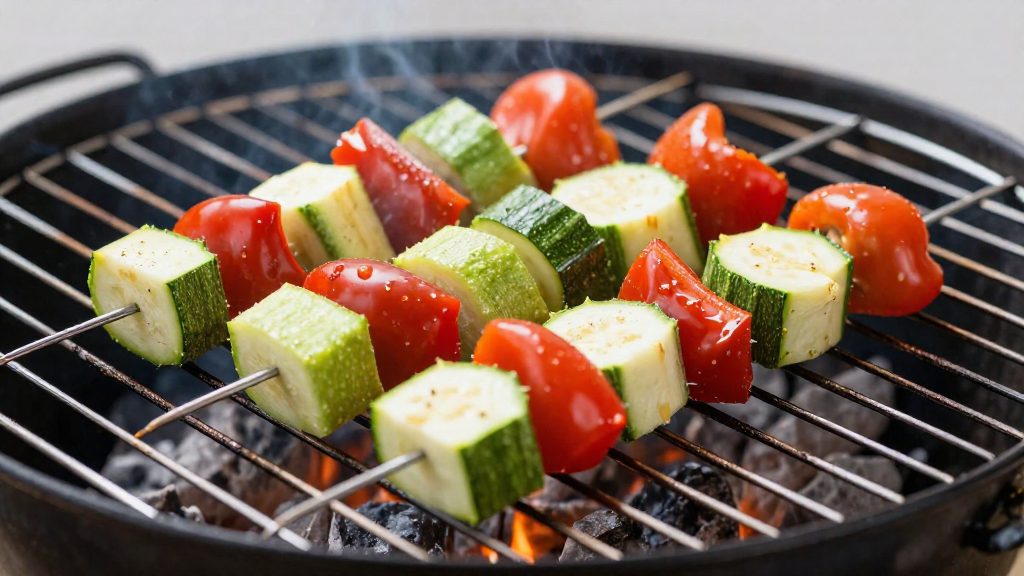
Why zucchini and pepper skewers work on the grill
Zucchini and bell pepper suit the grill because of their water content, their natural sugars and their soft texture. Zucchini releases steam as it heats, which keeps the flesh moist while the surface colours. Bell pepper browns on direct heat and develops a charred, sweet flavour. Both vegetables cook through in about 10 to 12 minutes over medium heat. They can share a skewer with similarly sized pieces of meat, or cook on their own.
Water content and steam from zucchini
Zucchini flesh holds a high proportion of water. On a hot grate, the moisture near the surface turns to steam, which keeps the interior from drying out while the skin blisters and takes on grill marks. Steam is the reason the pieces should have room on the grate.
Natural sugars on bell pepper skin
Bell pepper contains natural sugars, and these caramelise when the skin contacts direct heat. The skin darkens and blisters, producing the smoky, sweet notes typical of grilled peppers. The blistered skin also loosens, which makes it easier to remove if you prefer a softer texture. Turning the skewers ensures each face of the pepper meets the grate, so colour develops evenly.
Why softer vegetables cook faster than meat
Meat is judged by internal temperature. Vegetables have no equivalent threshold in this guidance. The Northfield Hospital skewer recipe instead judges them by texture, cooking until tender.
| Food | Doneness marker |
|---|---|
| Poultry pieces | 74°C (165°F) internal |
| Pork cuts | 71°C (160°F) internal |
| Mixed vegetable skewers | Tender |
How do you cut vegetables for even skewers?
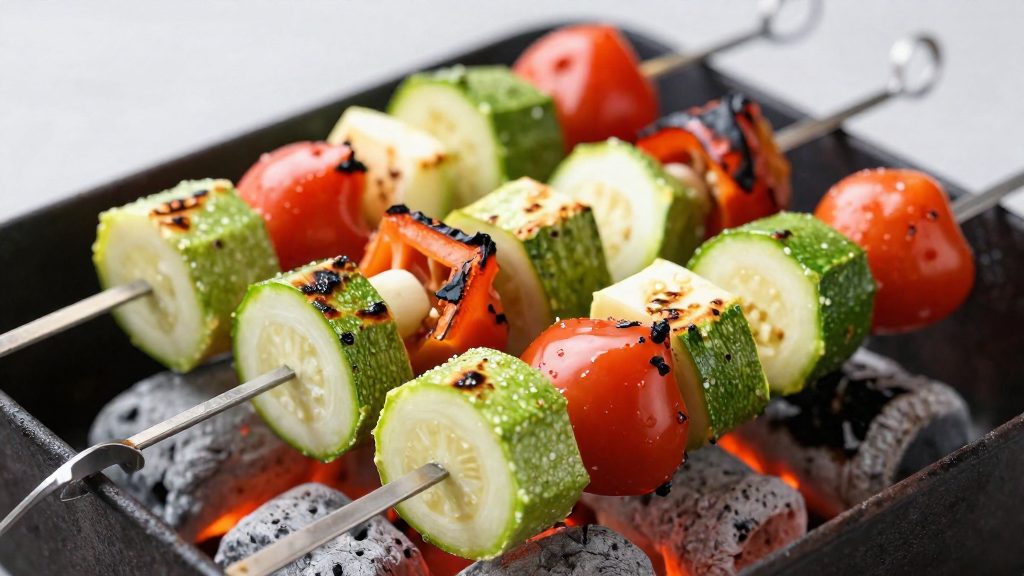
Even skewers depend on giving every piece the same thickness and footprint, so heat reaches each one at the same rate. A mixed vegetable skewer built from square bell pepper pieces and 1-inch thick zucchini rounds (about 2.5 cm) is a useful reference. Northfield Hospital uses this combination in a health-education recipe, which makes it an indicative starting point rather than a specialist standard.
Square bell pepper pieces
Cut off the stem, remove the seeds and white ribs, then open the pepper flat on the board. Slice the panels into strips, then cut the strips across at the same spacing to form squares of roughly 1 inch per side. Keep all pieces the same size. Mixing wide and narrow squares on one skewer means the small pieces char while the large ones are still firm inside.
Thick zucchini rounds
Trim both ends, then cut straight rounds of consistent thickness, aiming for 1 inch. Thin rounds dry out and blacken before the centre heats, while thicker ones stay raw in the middle. Cut from a single zucchini at a steady pace, keeping the blade perpendicular to the board so each round has flat faces that sit flush against its neighbour on the skewer.
Keeping each skewer uniform
Cut one test piece of each vegetable first and compare it with the rest of the batch. Pieces that differ visibly in thickness should be re-cut before threading. Alternate the two vegetables so every skewer carries the same mix, and leave a small gap between pieces. Packed pieces trap moisture and steam rather than char, which uneven spacing makes worse.
Marinade and seasoning
The marinade for grilled zucchini and bell pepper skewers is simple: olive oil and herbs, applied for a short window before the vegetables go on the grill. In the Northfield Hospital health-education recipe, the vegetables are marinated for 10–15 minutes. The source is a general health-education recipe rather than a specialist grilling publication, so treat these timings as a starting point and adjust them to your grill.
Olive oil and browning
Olive oil does two jobs on the grate. It carries the herbs and seasoning onto the surface, and it creates a thin film that helps the cut faces of the bell pepper and zucchini make direct contact with the bars and brown rather than dry out. The film also reduces sticking, which matters for zucchini because its moisture release can cause pieces to cling to the grate.
Measure the oil by coverage rather than by volume. Add it gradually and toss until each piece looks lightly glossy. Pooled oil at the bottom of the bowl means uneven coating, which produces pale patches on one side and greasy, flare-prone spots on the other.
Herbs and seasoning
Herbs add aroma during the short marinating window, so their flavour is mainly surface-level. Common choices for vegetable skewers include thyme, oregano and rosemary. Rosemary is woody, so chop it finely to avoid tough pieces on the skewer.
| Component | Role during grilling | Practical approach |
|---|---|---|
| Olive oil | Carries seasoning, aids browning, reduces sticking | Coat by hand or brush until lightly glossy |
| Thyme, oregano, rosemary | Aroma during the 10–15 minute soak | Chop rosemary finely |
| Salt and black pepper | Seasoning | Add shortly before grilling |
Add salt shortly before the skewers go on the grill rather than early in the soak. Salt draws moisture out of zucchini, which can make the surface wetter and slow browning. Keep the marinating time within the 10–15 minute window so the vegetables retain their texture and their outer surfaces stay firm enough to brown well.
Should you soak wooden skewers?
Yes, soak wooden skewers for 15 to 20 minutes before threading zucchini and bell pepper onto them. A mixed-vegetable skewer recipe from Northfield Hospital uses this soak, and it is a health-education recipe rather than a specialist barbecue publication, so treat the timing as a practical guideline. Soaking saturates the wood so that it resists scorching while it sits over the heat.
Soak the skewers fully submerged so that the exposed wood absorbs water along its whole length. Drain them briefly before threading. Surface water left on the wood can make the vegetable pieces slide and steam instead of taking on a grilled surface.
Protecting the exposed ends
Vegetables cover only the middle of a skewer, so the bare ends are the parts most likely to char. Wrap each exposed end in a small square of aluminum foil before placing the skewers on the grate. The foil keeps the wood out of direct flame and reduces the risk of blackened, bitter tips. Keep the foil tight so that it does not slip onto the vegetables.
When metal skewers are the better choice
Metal skewers need no soaking, so they remove the 15 to 20 minute wait entirely. Choose flat or square-profile metal skewers rather than round ones, because the flat faces hold the pieces in place when you turn the skewers. Metal skewers also avoid the charred-end problem, since there is no wood to protect. After grilling, wash them and reuse them for the next batch.
Choose wooden skewers when you need disposable skewers for a large group, and metal skewers when you grill regularly and want to skip preparation. Either option works for zucchini and bell pepper, provided you match the skewer type to how often you grill.
Grill heat and timing: charcoal, gas, pellet
For grilled zucchini and bell pepper skewers, aim for medium heat and a cooking window of 10 to 12 minutes. Northfield Hospital’s health-education recipe for mixed vegetable skewers grills them over medium heat for 10 to 12 minutes, turning them occasionally until tender. That source is a hospital publication rather than a grilling specialist, so treat these timings as a starting point and check the vegetables by feel as well as by the clock.
Turning frequency during the grilling window
Turn the skewers occasionally rather than constantly. Turning once the vegetables have coloured on the side facing the heat lets them release from the grate and develop some char. Rotate each skewer so that all of its faces meet the grate during the 10 to 12 minute window. Zucchini rounds and bell pepper squares cook at different rates, so a skewer that looks even may still need a final turn to finish the pepper pieces.
Fuel-specific heat adjustments
The points below describe method only.
- Charcoal: Spread the lit coals in an even layer, then set the skewers over the part of the grate that feels medium rather than directly over the hottest coals. Charcoal heat falls as the fuel burns down, so check the fire near the end of the window.
- Gas: Set the burners to medium before placing the skewers. If the grill has a lid, keep it closed between turns so the heat stays even, and reduce the flame if the vegetables darken before they soften.
- Pellet: Set the controller to a medium setpoint and let the grill reach it before loading the skewers. Pellet grills hold temperature through the controller, so adjust the setpoint rather than the fire itself if the vegetables cook too fast or too slowly.
Keep the grill lid closed during the grilling window where the design allows, and avoid opening it repeatedly, since each opening lowers the cooking temperature.
How do you know when the skewers are done?
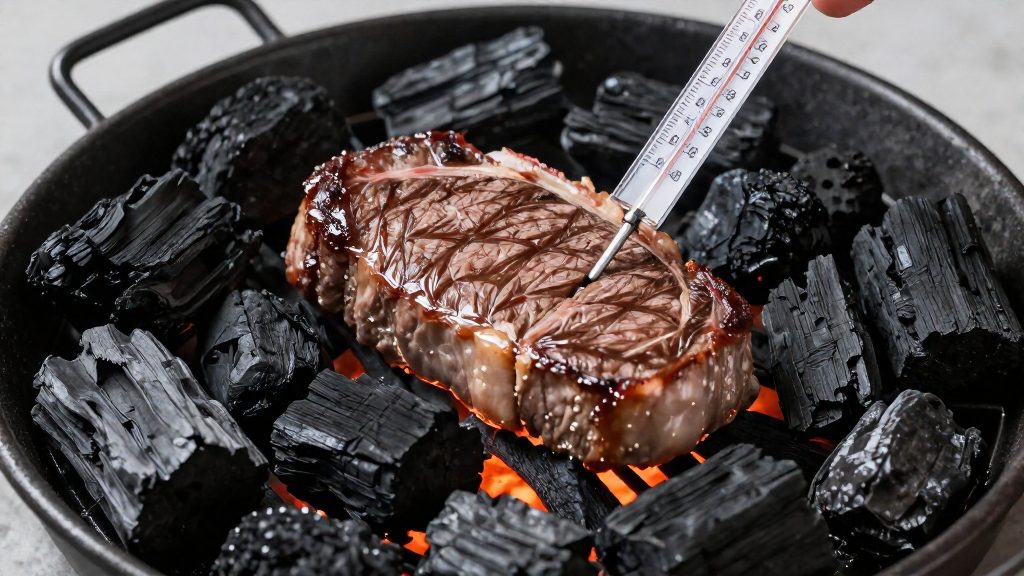
For a mixed skewer, check the vegetables and the meat separately. The vegetables are judged by touch and sight. The meat needs a thermometer reading.
For the vegetables, push a fork into the thickest part of a zucchini round and into a bell pepper piece. Tender zucchini should give with little resistance, and the fork should slide in without the flesh tearing or staying firm at the centre. Pepper pieces should be soft enough that the fork passes through the flesh easily, with the skin slightly wrinkled.
Colour and char are the second check. Zucchini should show golden to light brown marks on the cut faces, and the surface should look glossy rather than raw and pale. Pepper pieces should show blistered, darker skin in places, with char marks that are uneven rather than burnt black. Heavy blackening on the outside while the centre remains firm usually means the heat is too high for the pieces to cook through, so move the skewers to a cooler part of the grill.
For the meat, insert a digital thermometer into the thickest part of each piece, keeping the probe away from bone. Health Canada (Government of Canada) recommends checking each piece separately, because grill temperatures vary across the surface. Use the following minimum internal temperatures:
| Food | Minimum internal temperature |
|---|---|
| Poultry pieces | 74°C (165°F) |
| Whole poultry | 85°C (185°F) |
| Fish and seafood | 70°C (158°F) |
| Ground beef, veal, lamb or pork | 71°C (160°F) |
| Ground poultry | 74°C (165°F) |
| Pork cuts | 71°C (160°F) |
| Beef, veal or lamb cuts, medium-rare | 63°C (145°F) |
| Beef, veal or lamb cuts, medium | 71°C (160°F) |
| Beef, veal or lamb cuts, well done | 77°C (170°F) |
Pull the skewer once the meat reaches its target and the vegetables pass the fork test. If one ingredient is ready before the other, remove it from the heat and keep it on the grill’s cooler edge while the rest finishes. Pieces cut very small will cook faster than the thickest pieces, so the fork test is the more reliable guide for vegetables.
Food safety for mixed grills
Skewers that combine raw meat, poultry or fish with zucchini and bell pepper need the same hygiene and temperature controls as any raw-protein grill.
Hygiene after raw contact
Wash your hands before cooking. Clean every utensil and surface that touched raw meat, poultry, fish or shellfish, including the boards and knives used to cut the protein and then the vegetables. Never place cooked skewers back on the plate or tray that held the raw ones. On a mixed skewer, raw contact can happen at the cutting board, the threading step and the serving stage, so each of these needs its own clean surface or a thorough wash in between.
Safe internal temperatures
Beef, veal and lamb cuts are listed in the doneness section above:
| Food | Safe internal temperature |
|---|---|
| Poultry pieces | 74°C (165°F) |
| Whole poultry | 85°C (185°F) |
| Fish and seafood | 70°C (158°F) |
| Pork cuts | 71°C (160°F) |
| Ground pork, beef, veal or lamb | 71°C (160°F) |
| Ground poultry | 74°C (165°F) |
A skewer that looks cooked on the outside may still be below the target inside, so test the protein on each skewer rather than relying on a single reading.
Holding cooked skewers
Keep hot food at 60°C or higher until it is served. Cold food should stay at 4°C or lower. If skewers are cooked ahead of a gathering, keep them warm above 60°C rather than letting them cool on the counter.
Serving and variations
Once the skewers are off the grill, serve them while the vegetables are still warm. Tenderness is the cue for doneness, so check for it with a fork or a knife before you pull the skewers.
Resting and plating
- Let skewers rest briefly on a rack or a clean board so surface moisture can evaporate. This keeps the grill marks visible.
- Slide the pieces off the stick before serving. Wooden skewers are awkward to eat from and leave splinters on the plate.
- Alternate the pepper and zucchini colours on a platter. The contrast reads well and makes portions easy to share.
Vegetable and protein swaps
- Keep vegetable pieces at about 1 inch (2.5 cm), as in the recipe, so they cook at a similar rate.
- Replace zucchini with other firm, grillable vegetables, such as onion or mushrooms, and keep the cut size consistent.
- Chicken, beef, pork, fish or seafood can replace part of the vegetables. Cut proteins to a size close to the vegetable pieces so the skewer cooks evenly.
- Proteins cook at different rates from vegetables. If the timing differs, skewer them separately and serve them together.
Dipping sauces and side dishes
- A yogurt and herb dip or a light vinaigrette pairs well with charred peppers and zucchini, adding acidity and freshness.
- Serve the skewers with bread, rice or a green salad so the meal does not rely on the skewers alone.
- Keep sauces in individual bowls rather than one shared dish, so guests can dip without repeatedly touching a common container.