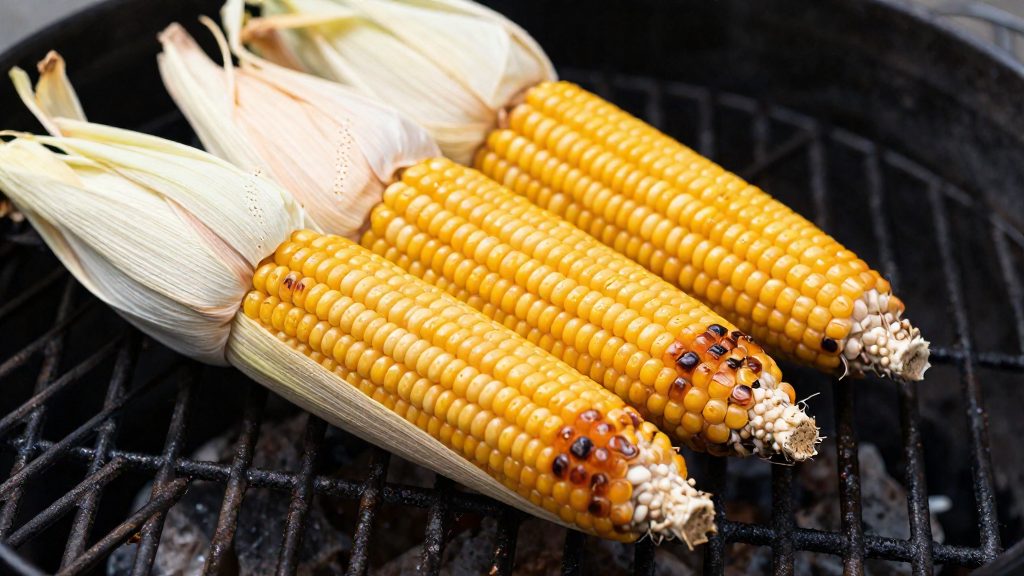
For most cooks, the best default is husk-on grilling over medium heat with the grill covered. The kernels cook in their own husks. A foil-wrapped maple version on high heat is the alternative when you want a sweet, glazed finish. The two methods differ mainly in heat level, in whether the husk stays on or is wrapped in foil, and in how the cob is coated.
What is the best way to grill corn on the cob?
Husk-on grilling over medium heat (default)
Foodland Ontario grills the soaked cobs covered over medium heat, turning them often until the husks are charred in spots (Foodland Ontario, Government of Ontario). The husks act as a protective layer, so the corn cooks gently without extra wrapping. The finish is applied after grilling: the source serves the corn with three flavoured butters, each made with 1/2 cup softened butter, including a Mexican lime-coriander version (3 tbsp lime juice, 2 tbsp coriander), a chimichurri, and a Caribbean version with 1 tbsp jerk paste.
Foil-wrapped maple version on high heat
This method flips the approach. The glaze goes on before cooking: mix 1/4 cup pure maple syrup with 1/2 cup melted butter, salt and pepper, then brush it onto each ear. Pull the husks back around each cob, wrap it in foil, and grill on high with the lid closed (Maple from Canada, Québec Maple Syrup Producers). The foil seals the glaze against the kernels, so the sweetness is applied during cooking rather than afterwards.
Side-by-side comparison
| Factor | Husk-on, medium heat | Foil-wrapped maple, high heat |
|---|---|---|
| Heat setting | Medium, lid closed | High, lid closed |
| Husk | Left on and charred in spots | Pulled back, then wrapped in foil |
| Coating | Flavoured butter served after grilling | Maple-butter brushed on before wrapping |
| Recipe yield | Serves 6 | Glaze quantity given for 12 ears |
Choose husk-on grilling when you want plain, smoky cobs with a choice of flavoured butters. Choose the foil method when the goal is a maple-glazed result.
Which corn should you buy?
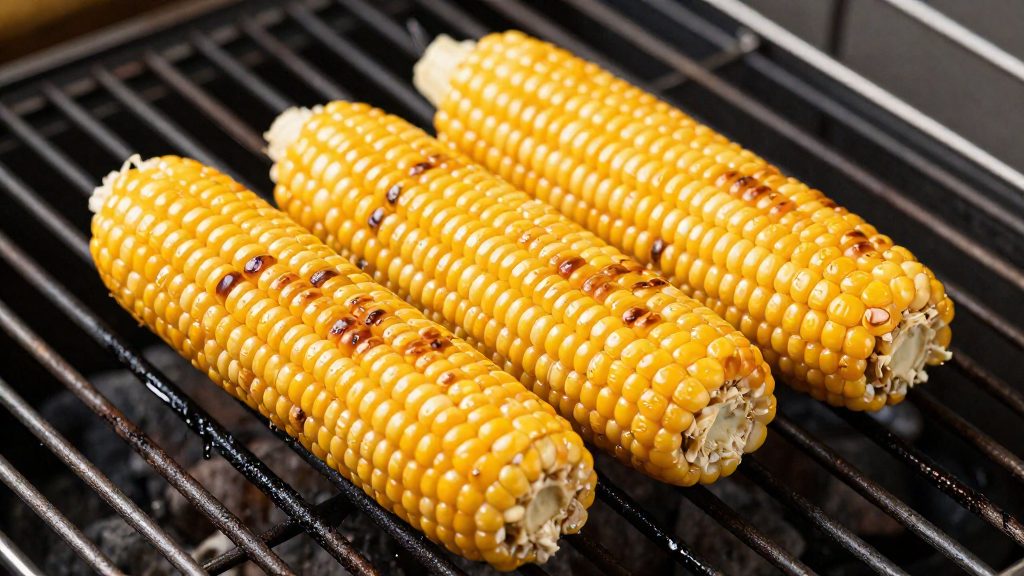
Ear selection decides how well the grilling method works. Corn that is fresh and fully developed cooks evenly over medium heat and keeps its sweetness through the soak and the grill.
Husk condition is the first check. Choose ears whose husks are tight against the cob and bright green. Husks that are dry, papery, yellowing, or pulling away from the tip suggest the ear has been sitting too long. The husks also protect the kernels during grilling, so they need to be intact enough to char in spots without drying out the ear.
Kernel fill comes next. Squeeze the ear gently through the husk. You want firm, plump rows that reach the tip. Gaps or soft, shrunken areas near the top mean the kernels will cook unevenly and taste thinner.
Ear size matters for even cooking. Pick ears of similar length and girth so they finish at the same time on the grill. Very large ears with thick husks need more time to heat through, while small ears can char before the centre is tender. Buying a batch of matching ears makes the turning routine much easier to follow.
Freshness on the day is the most important habit. Buy the corn on the day you plan to grill it, or as close to that as possible. Fresh ears have the best sweetness and moisture, which is what the method is designed to preserve. If you must buy ahead, choose the ears with the greenest husks and the fullest kernels.
Should you soak or husk the corn first?
Both happen, but in a fixed order: the husks are opened and the silk is cleared first, then the cob is tied and soaked. Foodland Ontario (Government of Ontario) gives this sequence:
- Peel the husks back without detaching them. Grip the leaves at the stalk end and fold them down the length of the cob, leaving them joined at the base. The husks stay connected to the cob throughout.
- Remove the silk. With the husks folded back, pull out the pale silk threads from the exposed kernels by hand.
- Pull the husks up and tie them with string. Fold the leaves back over the kernels so the cob is fully covered again, then secure them with kitchen string.
- Soak in cold water for 20 minutes. Submerge the tied cobs in cold water for a 20-minute cold water soak before grilling.
The order matters. Removing the silk while the husks are still folded back gives access to the kernels, and tying the husks closed afterwards means the silk-free cob is re-covered before it is wetted. Skipping the tie leaves the husks loose, so they cannot hold their shape on the grate.
Keep the cobs in the water for the full 20 minutes rather than shortening the soak, since the source specifies this exact duration. Use cold water.
How long does corn take on the grill?
Corn on the cob takes about 10 to 12 minutes when grilled covered over medium heat in its husks, or about 16 minutes on high when wrapped in foil. The two published methods use different heat levels and turning schedules, so the timing depends on which one you follow.
| Method | Heat | Lid | Time | Turning and cue |
|---|---|---|---|---|
| Covered in husks (Foodland Ontario, Government of Ontario) | Medium heat | Closed | 10–12 minutes | Turn often, until husks are charred in spots |
| Foil-wrapped (Maple from Canada, Québec Maple Syrup Producers) | High | Closed | About 16 minutes | Quarter turn every 4 minutes |
Covered cooking over medium heat
Place the soaked ears on the grate, close the lid and grill over medium heat for 10–12 minutes, turning often, until the husks are charred in spots (Foodland Ontario, Government of Ontario).
Foil-wrapped cooking on high heat
Pull each husk back around its cob, wrap the ear in foil wrap, and grill on high with the lid closed for about 16 minutes. Turn each ear a quarter turn every 4 minutes, which gives roughly four turns over the full cook. Because the kernels steam inside the foil, this method relies on the timed turns rather than charring as a sign of doneness.
Gas, charcoal or pellet: how does the heat change things?
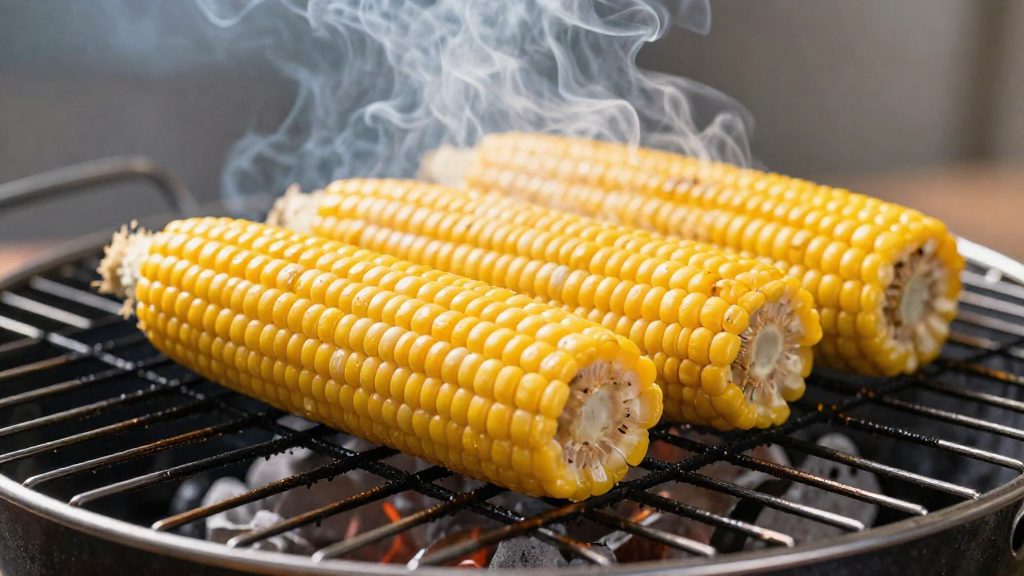
The heat source changes how evenly the corn cooks and how quickly the husks char. Foodland Ontario (Government of Ontario) grills soaked corn covered over medium heat, while the maple version from Maple from Canada (Québec Maple Syrup Producers) uses high heat with the lid closed. Matching the setting to your grill type gives the closest result to either recipe.
Gas burners: zones and lid-closed heat
On a gas grill, the closed lid keeps heat circulating around the ears, which makes the cooking more even than with the lid open. Use medium burner settings for the Foodland method, or high for the maple version. Keep the lid closed between turns, since each opening lets heat escape and slows the charring.
Charcoal: direct and indirect placement
With charcoal, placement matters more than the setting. Corn placed directly over the coals chars faster on the side facing the fire. Corn placed on the cooler side of a split fire, with the lid closed, cooks more gently. Foodland Ontario does not specify direct or indirect placement, so position the ears to keep the heat at medium.
Pellet grills: controller-set temperature and smoke flavour
A pellet grill holds the temperature set on its controller, so a recipe’s medium or high setting can be matched directly on the dial rather than judged by flame. The pellets also produce smoke during the cook, which adds a smoky flavour. Because the controller holds the heat steady, the charring stays predictable from one ear to the next.
Which butters and toppings work best?
Foodland Ontario (Government of Ontario) serves its grilled corn with three flavoured butters, each built on 1/2 cup of softened butter. Maple from Canada (Québec Maple Syrup Producers) offers a sweet alternative built on melted butter and pure maple syrup. The four options differ in their flavouring agents, so the choice depends mainly on whether you want acidity, herbs, heat or sweetness.
| Topping | Fat base | Flavouring ingredients | Application |
|---|---|---|---|
| Mexican lime-coriander butter | 1/2 cup softened butter | 3 tbsp lime juice, 2 tbsp coriander | Spread as a butter |
| Chimichurri butter | 1/2 cup softened butter | Chimichurri (amount not specified) | Spread as a butter |
| Caribbean jerk paste butter | 1/2 cup softened butter | 1 tbsp jerk paste | Spread as a butter |
| Maple syrup glaze | 1/2 cup melted butter | 1/4 cup pure maple syrup, salt and pepper (amounts not specified) | Brushed on 12 ears |
Lime-coriander and herb options
The Mexican lime-coriander butter is the only version that combines citrus juice with a fresh herb, giving a sharp, bright profile. The chimichurri butter uses a herb-and-vinegar sauce as its flavouring, so it is the most herbaceous of the set.
Jerk paste butter
The Caribbean version uses a single tablespoon of jerk paste per 1/2 cup of butter. It is the only option in the set with a spice paste as its base, which makes it the most heavily seasoned of the three savoury butters.
Maple syrup glaze
The maple version differs in two ways: the butter is melted rather than softened, and the flavouring is sweet rather than savoury. The mixture is brushed onto the corn, with the glaze quantity given for 12 ears. Because the maple recipe calls for salt and pepper without amounts, season to taste when preparing it.
How do you serve and store leftovers?
Once the ears come off the grill, you can serve them whole, strip the kernels for salads and salsas, or refrigerate them for reheating later. Decide which route you want before the cobs cool, because the choice determines how you cut, store and reheat them.
Cutting kernels off the cob for serving
Kernels are easier to remove once the cob has cooled enough to hold. Stand the ear upright on a cutting board, flat end down, and run a sharp knife downward along the cob to strip the rows. Holding the cob over a bowl catches the kernels and the milky juice released as you cut. Cut kernels suit salads, salsas, grain bowls and taco toppings, and they reheat faster than whole ears.
Cooling and refrigerating cooked ears
Cooked corn should not sit at room temperature for long. Let the ears cool only until they can be handled comfortably, then move them into a sealed container or bag and refrigerate them. Spreading the ears in a single layer in a shallow container helps them cool more evenly than a deep pile does. Cut kernels follow the same rule: transfer them out of the mixing bowl into a sealed container instead of leaving them in the bowl.
Reheating leftover corn on the grill
Reheat whole ears over indirect heat on a medium setting, so the kernels warm through without scorching. Check that the corn is steaming hot all the way through before serving, and cut into a kernel to confirm. Lightly brushing the ears with oil before reheating helps keep the surface from drying out.
Cut kernels are better reheated in a foil packet or a grill pan set over the grill. Stir them occasionally until they are hot throughout. A small amount of liquid in the packet keeps the kernels from drying out.
| Leftover form | Storage | Reheating method |
|---|---|---|
| Whole cooked ears | Sealed container, refrigerated | Indirect medium heat, turned until hot through |
| Cut kernels | Sealed container, refrigerated | Foil packet or grill pan, stirred until hot |
Frequently asked questions
Do I need to soak the corn before grilling it?
Yes, for the husk-on method. Foodland Ontario (Government of Ontario) peels the husks back without detaching them, removes the silk, ties the husks up with string, and then soaks the cobs in cold water for 20 minutes before they go on the grill.
How often should I turn the corn when using the foil method on high heat?
Turn each wrapped cob a quarter turn every 4 minutes, with the lid closed, for about 16 minutes in total. Maple from Canada (Québec Maple Syrup Producers) sets this rhythm so that the foil-wrapped kernels cook evenly on all sides.
What tells me the husk-on corn is ready?
The main visual cue is charred spots on the husks. Foodland Ontario (Government of Ontario) grills the covered cobs over medium heat for 10–12 minutes, turning them often, until this charring appears.