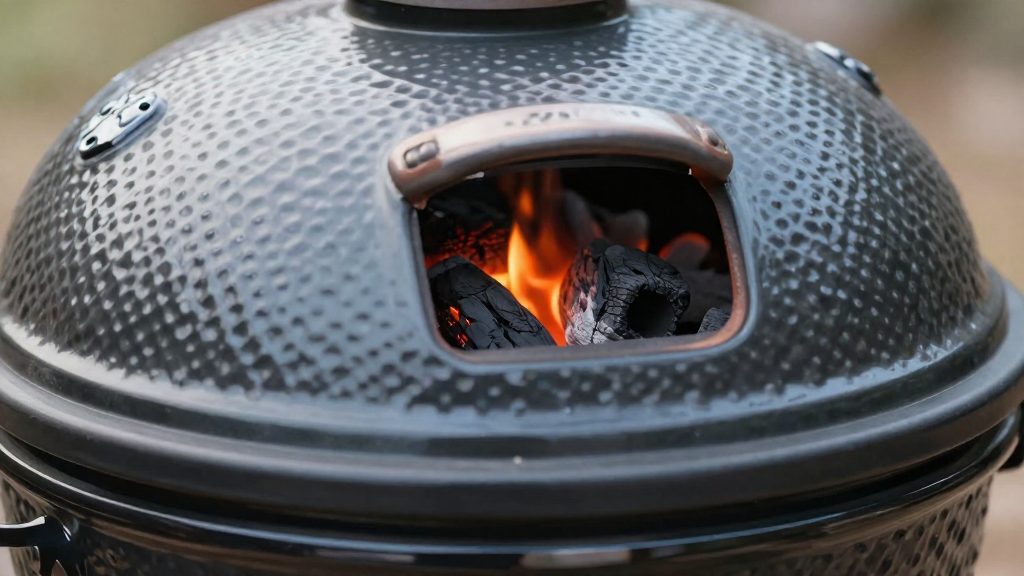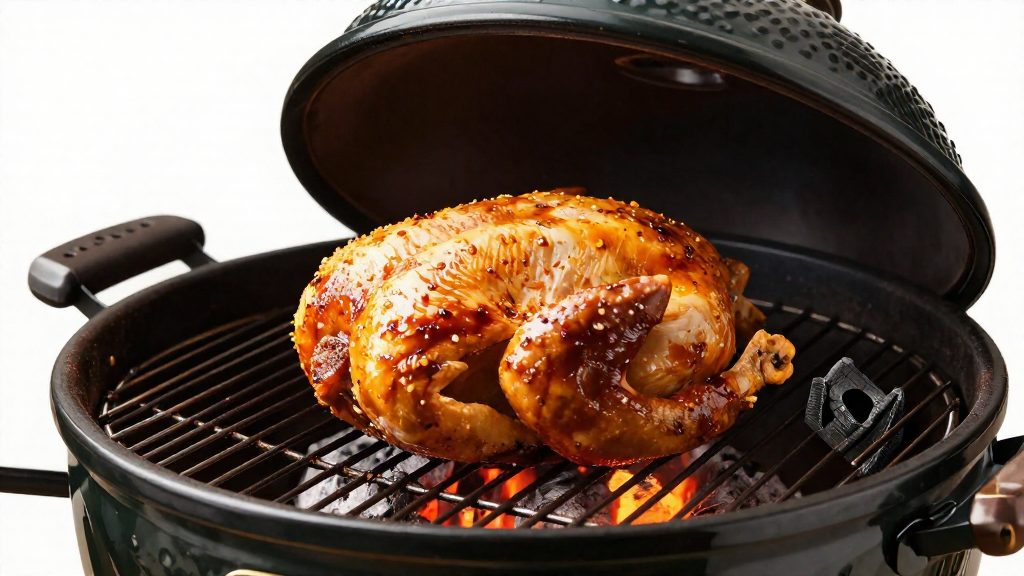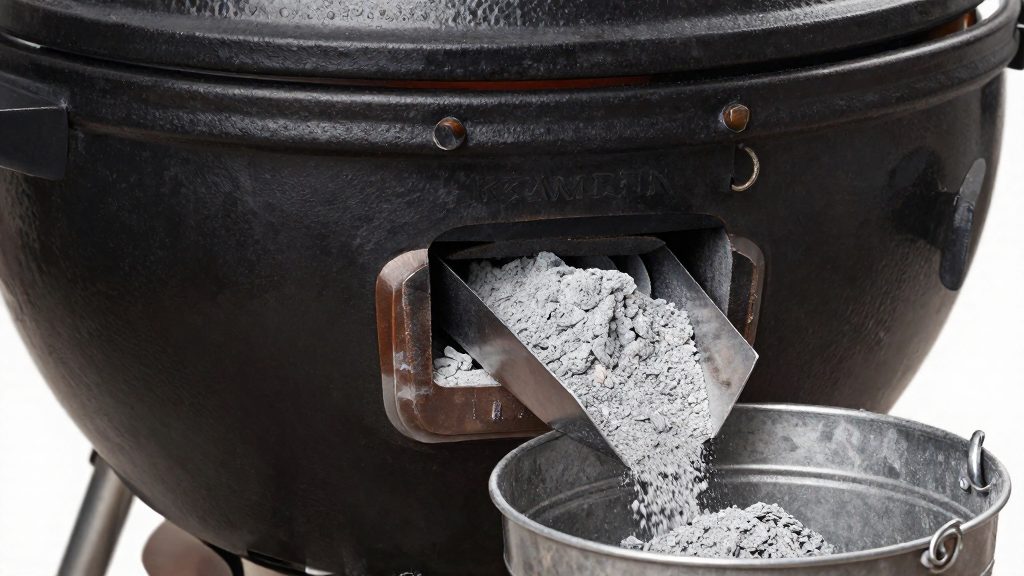
Ash left in a kamado builds up in the firebox and interferes with three things: airflow through the vents and air holes, the way the fire bed holds and releases heat, and the space available for charcoal. Kamado Joe advises clearing leftover ash and debris so that airflow stays open for the next cook (Kamado Joe, 2026).
Why should you remove ash from a kamado?
A kamado controls temperature by regulating how much air reaches the fire. Air enters through the bottom vent, passes up through the firebox, and feeds the coals. Ash that accumulates over the air holes and on the charcoal grate restricts this path, so less oxygen reaches the fuel and the fire responds more slowly when you adjust the vents.
How ash changes fire control
Ash also sits directly on the fire bed. A layer of it limits the oxygen reaching the coals beneath. The result is a fire that drifts in temperature and reacts sluggishly to vent changes.
| Ash condition | Effect on airflow | Effect on fire control |
|---|---|---|
| Blocked air holes and grate openings | Less air reaches the coals | Slower temperature rise and fall after vent changes |
| Layer of ash over the fire bed | Restricted oxygen to lower charcoal | Uneven burn and temperature drift |
| Ash filling the bottom of the firebox | Less volume for fuel | Less charcoal available for a cook |
Reduced usable charcoal space
Ash occupies the same volume in the firebox that lump charcoal needs. Each inch of ash buildup removes space for fuel, which reduces how many coals are available to sustain a long, steady cook.
Impact on internal components
Ash that stays on the charcoal grate and in the fire bowl also makes those parts harder to keep clear, so the airflow problems above tend to build from one cook to the next rather than resetting between sessions.
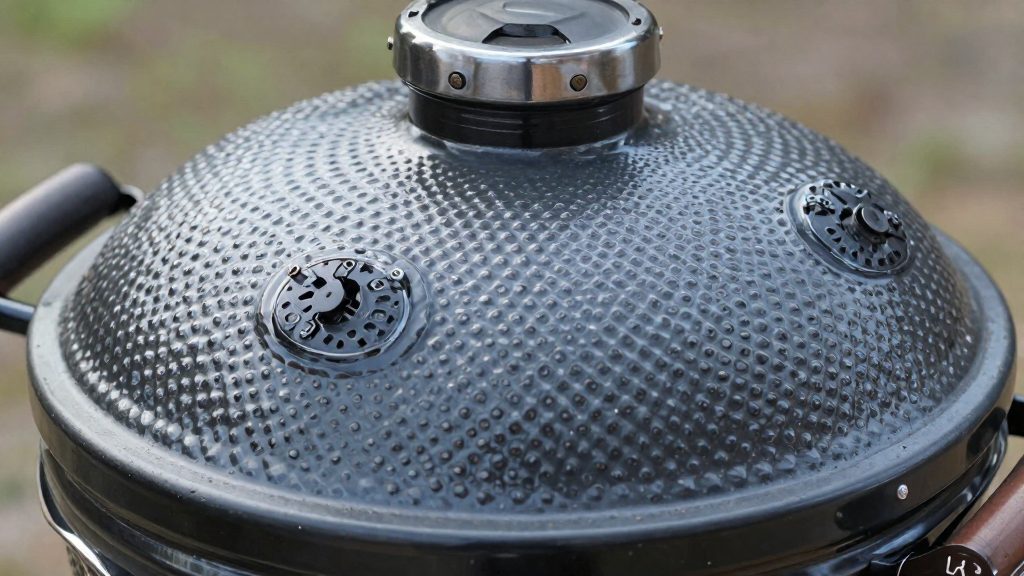
What tools do you need to clean kamado ash?
Cleaning kamado ash requires three tools: the ash tool supplied with the grill, a wire fire bowl brush, and heat-resistant gloves. Each handles a different part of the job, from clearing the firebox to protecting your hands during handling.
The ash tool supplied with the grill
Kamado Joe (2026) directs owners to use the ash tool supplied with the grill. It is the manufacturer’s named tool for this task, so use it as your primary tool rather than improvising with a household utensil. Keep this tool reserved for ash work so that grease and debris do not transfer to your cooking tools.
Wire fire bowl brush for loose debris
A wire brush suits loose material: it lifts fine ash and small fragments from the bowl surface. Its limit is compacted ash. Inspect the bristles before each use and replace the brush once they are bent or missing, since loose wire can contaminate the grill and food.
Heat-resistant gloves for handling hot ash
Gloves protect your hands when you reach into the firebox, lift the ash tool, or handle grate components. Choose a pair labelled heat-resistant and with a cuff long enough to cover the wrist. Thin kitchen oven mitts are less suitable, because they can slip off or let heat through at the fingers. Gloves also protect against ash particles, which can irritate skin.
How do you clear ash step by step?
Both manufacturers make cooling the first requirement. Kamado Joe says the grill must cool down completely after each use before cleaning, and Char-Griller’s AKORN guide says to wait until the fire is completely out and the grill is cool to the touch (Kamado Joe and Char-Griller, 2026). The sequence below therefore starts only once the grill is cold, with no glowing coals left in the firebox.
Once the grill is cold, work through the following steps in order:
| Step | Action | Purpose stated in the guidance |
|---|---|---|
| 1 | Confirm the fire is out and the grill is cool to the touch | Safe starting condition |
| 2 | Brush out the fire bowl | Removes loose ash from the bowl |
| 3 | Firmly tap the charcoal grate | Loosens ash stuck to the grate |
| 4 | Clear leftover ash and debris with the ash tool supplied with the grill | Cleans the firebox |
| 5 | Remove leftover charcoal | Removes unburnt fuel from the firebox |
The AKORN guide gives the order as brushing out the fire bowl and then firmly tapping the charcoal grate. Any ash the tapping dislodges is then cleared with the ash tool. Tapping should be firm, as the AKORN guide specifies, rather than a light knock that leaves ash clinging to the grate.
Clearing leftover charcoal is the final step before the grill is closed up. Unburnt charcoal left in place can block the air path, so removing it keeps the grill ready for the next cook.
Can you use water inside a kamado?
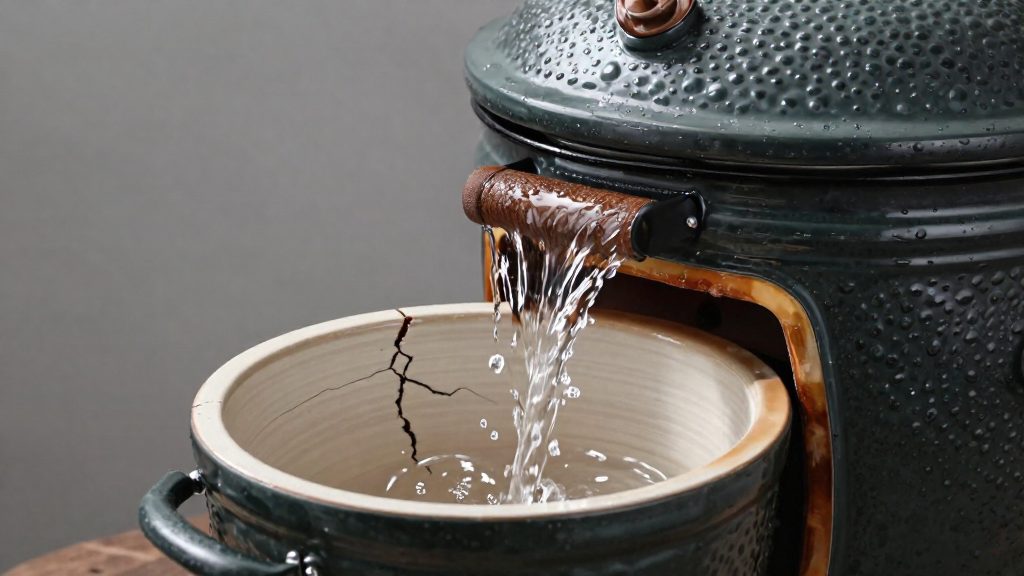
The manufacturers’ firebox routine relies on dry removal with the ash tool and a brush, and water is reserved for removable accessories and for soaking ash in a separate container. Wetting the firebox itself departs from that method and carries the risks below.
Thermal shock on ceramic walls
The body of a kamado is ceramic, and sudden temperature change is the main concern when water contacts it. Cold water on a hot surface cools one area much faster than the surrounding material, which can stress the ceramic. Ceramic also holds heat for a long time, so the risk remains well after the visible fire has gone out.
Rust on metal parts
The charcoal grate, cooking grates and other metal firebox components rust when they stay wet. Water that pools in the bowl or collects around the vents leaves metal exposed to moisture long after cleaning. Any metal part that gets wet should be dried thoroughly before the grill is closed.
Hose-down cleaning of the firebox
Hosing down the interior delivers water to the ceramic walls, the grate and the vents at once, and it is difficult to control where the water drains.
| Component | Risk with water |
|---|---|
| Ceramic firebox walls | Thermal shock when water hits hot ceramic |
| Charcoal grate | Rust, and wet ash that cakes onto the grate |
| Fire bowl | Water pooling around vents and in the bowl |
How often should you empty the ash?
Empty the ash when it builds up near the air inlet, not on a fixed schedule. The inlet draws air up through the charcoal, so ash piled beneath the fire restricts the airflow path that controls temperature.
Ash level relative to the air inlet
- Check the firebox before each session, looking at the area directly beneath the air inlet.
- If ash sits against or covers the inlet opening, clear it before lighting.
- Ash resting on the charcoal grate reduces the space air needs to pass through, so check the grate as well.
Emptying after long low-and-slow cooks
Long, low-temperature sessions burn charcoal for longer and leave more ash behind. After an extended cook, clear the firebox thoroughly rather than only removing the top layer. Ash that remains between sessions can block the next fire’s airflow.
Pre-cook airflow check
Run this check before lighting:
- Open and close the air inlet to confirm it moves freely.
- Look through the firebox for ash or charcoal fragments blocking the grate.
- Confirm the grate sits level, so the fire has an even base.
How to dispose of kamado ash safely
Safe disposal means extinguishing every remaining coal before the ash leaves the grill area. Char-Griller’s AKORN guide (2026) advises putting ashes in a metal container and covering them with water so no coals stay lit, then disposing of them. Ash that looks cold can still hold live embers, so treat every batch as hot until it is soaked.
Soaking the ash in a metal container
Use a metal bucket or can with a lid, not a plastic or paper container. Scoop the cooled ash into it, then add enough water to fully cover the ash and any charcoal pieces. Stir the mixture with a metal tool so that no coal stays buried under the surface, where water cannot reach it.
Keeping the container away from combustible materials
Set the container on a non-flammable surface such as concrete, paving or gravel. Keep it clear of wooden decks, fences, dry leaves, furniture and the grill’s cover. Do not store it in a garage or shed with flammable items, and keep it out of reach of children and pets. Never put ash in a plastic bag or cardboard box, because residual embers can ignite them.
Confirming no glowing embers remain
Before sealing the container, make sure the fire is completely out. Inspect the ash for any red or orange glow, but do not treat the absence of a glow as proof that it is safe. Keep the ash fully covered with water, stir again so nothing stays buried, and leave the container outdoors on a non-flammable surface until all of the ash is cold and wet throughout. Close the lid only after that.
Deep cleaning and maintenance tips
Periodic deep cleaning of a kamado grill focuses on its removable accessories, including the ash drawer. Routine clearing after each cook is a separate task.
Soaking removable accessories
Remove each accessory, including the ash drawer, from the grill. Place the parts in a container large enough to hold them fully submerged, then cover them with warm soapy water. Leave them to soak until residue starts to loosen. Soak time is not specified in the official guidance, so judge it by how easily the grease and ash release from the surface.
Scrubbing with a non-abrasive sponge
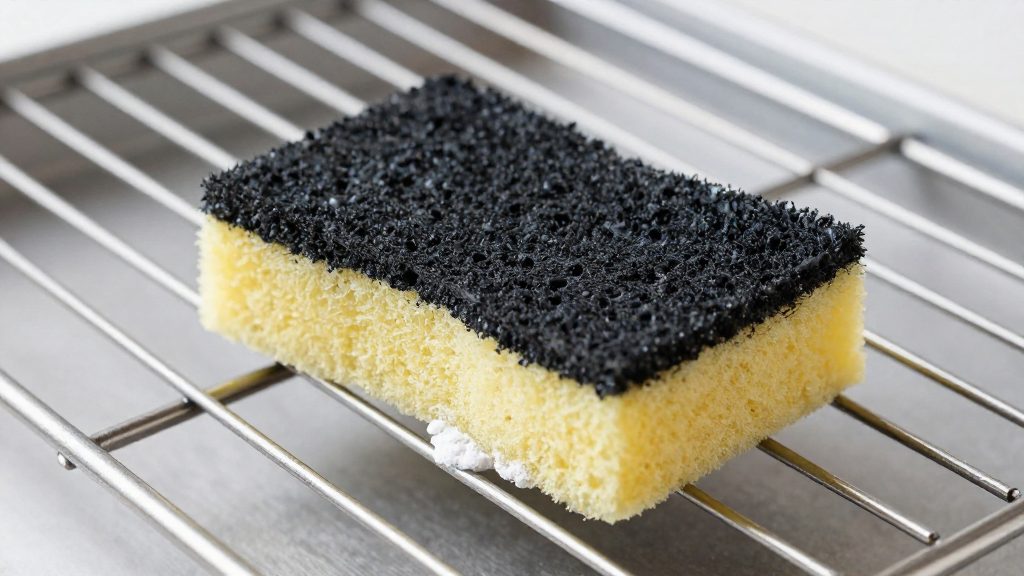
After soaking, scrub each part with a non-abrasive sponge. Work over all surfaces, including corners and edges where ash collects. Avoid abrasive scourers, since the Kamado Joe method calls for a non-abrasive sponge only. Once scrubbing is done, rinse every part thoroughly with clean water to remove all soap residue.
Air-drying before reinstalling
Dry each part completely in open air before returning it to the grill. Lay the parts on a clean, dry surface in a spot with good airflow, and turn them over so that water does not pool in hollows or along seams. When the parts are fully dry, refit the ash drawer and any other accessories. Keep the air-drying step separate from any firing, and do not light the grill until the parts are back in place and dry.
Frequently asked questions
When is it safe to start removing ash from a kamado?
Only after the grill has cooled completely. Kamado Joe specifies a full cool-down after each use before any cleaning begins, so the firebox and ash should be fully cold before you open the bottom vent area or reach for the ash tool.
What if ash is stuck to the charcoal grate?
Tap the charcoal grate firmly to loosen the stuck ash, then brush out the fire bowl. This method is recommended in Char-Griller’s guide for the AKORN.
How should you dispose of kamado ash?
Put the ash in a metal container and cover it with water so no coals stay lit. Once it is soaked, you can dispose of it. Char-Griller gives this procedure for its AKORN models.