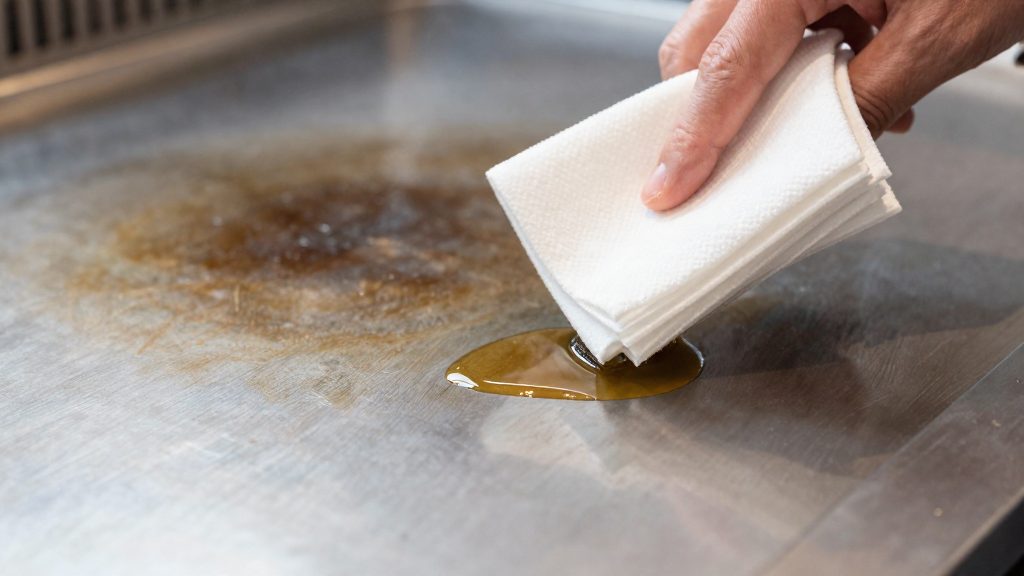
A good oil for a flat top plancha must tolerate the surface heat without breaking down, burn cleanly, and taste neutral enough not to compete with the food. Three criteria cover this: smoke point relative to the surface temperature, the refining status of the oil, and its flavor profile.
What makes a good oil for a flat top plancha?
Smoke point relative to surface heat
Compare the oil’s smoke point with the temperature of the cooking surface, not with the burner setting. Oil heated past its smoke point breaks down and can flare up, so the margin between the two matters.
| Reference point | Value | Source |
|---|---|---|
| Griddle surface temperature | 450–500°F | The Flat Top King (2026) |
| Preferred minimum smoke point | Above 450°F | The Flat Top King (2026) |
| Minimum smoke point for griddle cooking | 400°F | The Online Grill (2026) |
Refined versus unrefined processing
Refining affects how an oil behaves when hot, and the label is the reliable check. The Online Grill (2026) notes that the smoke point of refined canola oil varies by brand, so the bottle’s stated specification should be read rather than assumed from the oil’s name. Refined avocado oil, at about 520°F, is the reference point the sources use for high-heat flat top cooking.
Neutral flavor profile
A neutral oil keeps the taste of meat, fish or vegetables at the center of the sear. Strongly flavored oils carry their own taste into the food, which is why The Flat Top King (2026) advises against flavored oils and bacon grease.
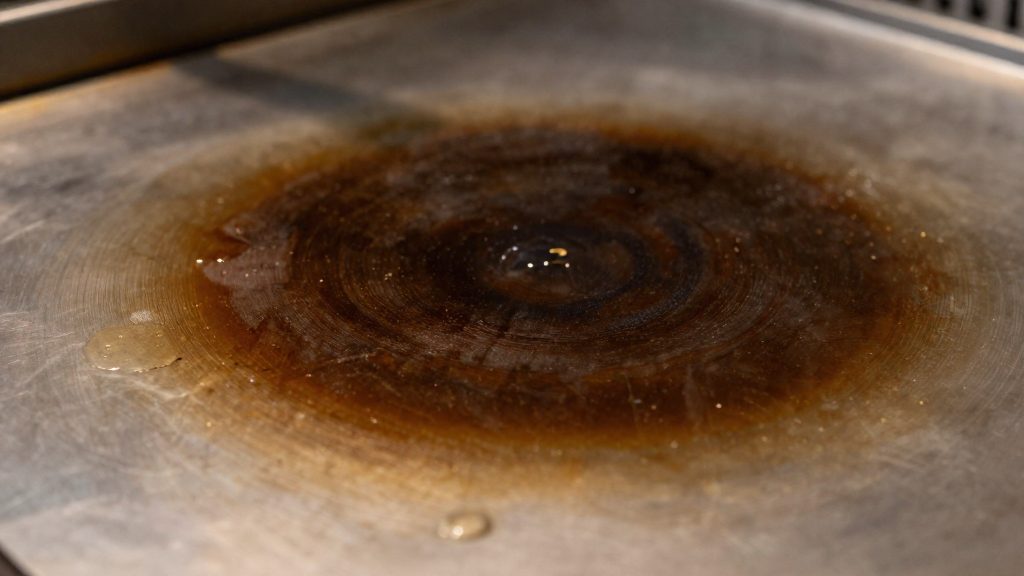
Best high-smoke-point oils compared
Smoke point is the temperature at which an oil begins to break down and smoke. The benchmark to aim for is an oil with a smoke point preferably above 450°F.
| Oil | Smoke point | Reported by |
|---|---|---|
| Refined avocado oil | 520°F | Arteflame (2026) |
| Ghee | about 480°F | Arteflame (2026) |
| Peanut oil | 450°F | The Online Grill (2026) |
| Sunflower oil | 440°F | The Online Grill (2026) |
| Grapeseed oil | 420°F | Arteflame (2026) |
| Beef tallow | 400°F | Arteflame (2026) |
Refined avocado oil has the highest figure in this group, 70°F above the 450°F benchmark. Ghee, at about 480°F, also clears it with a comfortable margin. Peanut oil sits exactly at 450°F, so it reaches the benchmark without exceeding it and leaves no headroom.
Sunflower oil (440°F), grapeseed oil (420°F) and beef tallow (400°F) all fall below the benchmark. On a surface running at the upper end of the 450–500°F range, these oils are likely to exceed their rated smoke point, so they suit moderate sears better than sustained high heat.
For searing at the top of the range, avocado oil and ghee give the widest margin. Apply a thin, even film with a paper towel rather than pouring a pool of oil, since excess oil is what smokes first.
Is olive oil okay on a plancha?
Extra virgin olive oil is a poor choice for high-heat searing on a plancha. Arteflame (2026) lists its smoke point at 375°F and advises against using olive oil for searing. The problem is the gap between that figure and the surface temperatures a flat top reaches.
Smoke point is the temperature at which an oil starts to break down. The Online Grill (2026) recommends an oil with a smoke point of at least 400°F for griddle cooking.
| Reference point | Temperature |
|---|---|
| Extra virgin olive oil smoke point | 375°F |
| Minimum recommended smoke point for griddle cooking | 400°F |
Extra virgin olive oil sits below the minimum recommended figure, so at searing temperatures it reaches its breakdown point before the surface reaches its working heat. The result is smoke and a higher risk of flare-ups during the sear.
Searing oil should therefore have a smoke point above the temperature you plan to use. Oil the flat top lightly before each cook, and choose an oil whose smoke point sits above your surface temperature.
Can you cook with butter on a griddle?
Butter can be used on a flat top, but only as a finishing fat, not as a searing oil. Its smoke point is the main limit. According to Arteflame (2026), butter’s smoke point is 302°F, while The Flat Top King (2026) gives about 350°F. Use the lower value as the safe limit.
| Source | Butter smoke point | Recommendation |
|---|---|---|
| Arteflame (2026) | 302°F | Add cold after the meat leaves direct heat |
| The Flat Top King (2026) | About 350°F | Avoid for high-heat cooking |
Butter is not pure fat. Its milk solids contain proteins and sugars that brown and burn quickly. Placed on a surface at searing temperature, the butter turns dark and bitter within seconds, which leaves an acrid taste on the protein and can produce smoke before the meat is cooked.
The method that avoids this is to separate the two steps:
- Sear first: Cook the protein in a high-smoke-point oil on the hottest part of the surface, over direct heat.
- Move the meat: Once the protein comes off direct heat, slide it onto a cooler zone or lift it off the plate.
- Add cold butter: Place cold butter on the cooler area. It melts slowly, away from the flame, and does not reach the temperature at which the milk solids burn.
- Baste: Spoon the melted butter over the protein for the last minutes of cooking.
Keeping butter away from direct heat gives you its flavor without exposing the milk solids to the temperatures that cause burning.

How to oil and season a flat top
A new Blackstone griddle needs a build-up of seasoning layers before its first serious cook. According to The Flat Top King (2026), a new Blackstone typically needs about 5–6 thin layers of oil to season. Each layer should be a thin film, applied one at a time, with each coat set before the next is added.
Building the initial seasoning
Use a high-smoke-point oil. The Flat Top King lists refined avocado oil at about 520°F, and Arteflame (2026) recommends grapeseed or avocado oil for high-heat flat-top cooking. Work through the following sequence:
- Apply one thin coat across the cooking surface and wipe off any excess.
- Heat the griddle so the coat sets into a dry, even film.
- Let the surface cool, then repeat until five to six layers are built up.
Routine oiling between cooks
Once seasoned, the surface needs only light maintenance. Arteflame (2026) advises oiling the flat top lightly before each cook, then again after it has cooled slightly, which protects against rust. Keep the coats thin in both cases.
| Stage | Oiling | Number of coats |
|---|---|---|
| New griddle | Thin layers, applied one at a time | 5–6 |
| Before each cook | Light coat | 1 |
| After slight cooling | Light coat for rust protection | 1 |
Rust protection depends on the post-cook coat, which Arteflame (2026) advises applying once the surface has cooled slightly.
Oils and fats to avoid
Some fats and cooking products leave residue on a flat top or contain ingredients that can damage the cooking surface. The Flat Top King (2026) advises avoiding six products: extra virgin olive oil, unrefined coconut oil, butter, aerosol cooking sprays, flavored oils and bacon grease. Some leave residue on the surface, and others are simply poorly suited to high heat or contain additives.
Unrefined coconut oil
Unrefined coconut oil is advised against because it produces a sticky seasoning layer instead of a smooth, even one. A tacky film on the cooking surface can pick up food residue and make the surface harder to keep clean between cooks. Refined oils with higher smoke points, such as those compared earlier, avoid this problem.
Aerosol cooking sprays
Aerosol sprays are a poor choice because their additives can harm the surface. The sources say the additives in these products can harm the surface, so a plain oil is the better choice. For even coverage without spray products, pour a small amount of oil onto a folded paper towel and wipe it across the surface in a thin layer. This gives direct control over the quantity applied.
Flavoured oils and bacon grease
Flavored oils and bacon grease are also on the avoid list. They carry strong flavors of their own into the food, which is why The Flat Top King (2026) advises against them. Reserve these products for finishing food on the plate, and use a plain, refined oil for seasoning the surface and searing.
Oil mistakes that cause smoke and sticking
Most smoke and sticking on a flat top come from two preparation and heat-control errors: applying oil at the wrong stage, and heating oil past its smoke point.
Oiling protein before salting
Arteflame (2026) states that rubbing high-smoke-point oil on the protein before salting can reduce flare-ups. Apply a thin, even film of oil to the meat, fish or vegetables first, then season. Oil on the surface helps the cook start with a protected layer rather than dry protein meeting hot steel.
Heating oil past its smoke point
Use the smoke point as a ceiling for each oil:
| Oil | Smoke point | Suitability for high-heat flat-top cooking |
|---|---|---|
| Avocado oil (refined) | 520°F | Suitable; the top figure in both sources |
| Ghee | About 480°F | Listed by Arteflame |
| Peanut oil | 450°F | Suitable per The Online Grill (2026) |
| Sunflower oil | 440°F | Meets The Online Grill’s 400°F minimum but is below the 450°F benchmark; moderate sears only |
| Grapeseed oil | 420°F | Recommended by Arteflame for high-heat cooking, but below the 450°F benchmark |
| Refined canola | About 400°F | Suitable per The Online Grill (2026) |
| Beef tallow | 400°F | Listed by Arteflame |
| Extra virgin olive oil | 375°F | Avoid for searing |
| Butter | 302°F (Arteflame) / About 350°F (The Flat Top King) | Low tolerance for high heat |
The two sources disagree on butter’s smoke point. Use the lower Arteflame figure of 302°F as the working limit, because it leaves a wider safety margin.
Frequently asked questions
Which oil should a beginner buy first for a plancha?
Refined avocado oil is the most forgiving choice, with a smoke point of 520°F according to Arteflame (2026). That gives a wide margin above the 450°F minimum that The Flat Top King (2026) recommends for surface temperatures of 450–500°F. Its refined processing also keeps the flavor close to neutral.
Can I sear on a plancha with extra virgin olive oil or butter?
Arteflame (2026) lists extra virgin olive oil at 375°F and advises against using olive oil for searing. Butter has a lower threshold at 302°F, and its milk solids burn quickly, so it is better added after the meat comes off direct heat.
How often should I oil the cooking surface?
Arteflame (2026) recommends a light coat before each cook and another after the surface has cooled slightly, which protects against rust. When seasoning a new flat top, The Flat Top King (2026) estimates that about 5–6 thin layers are needed.