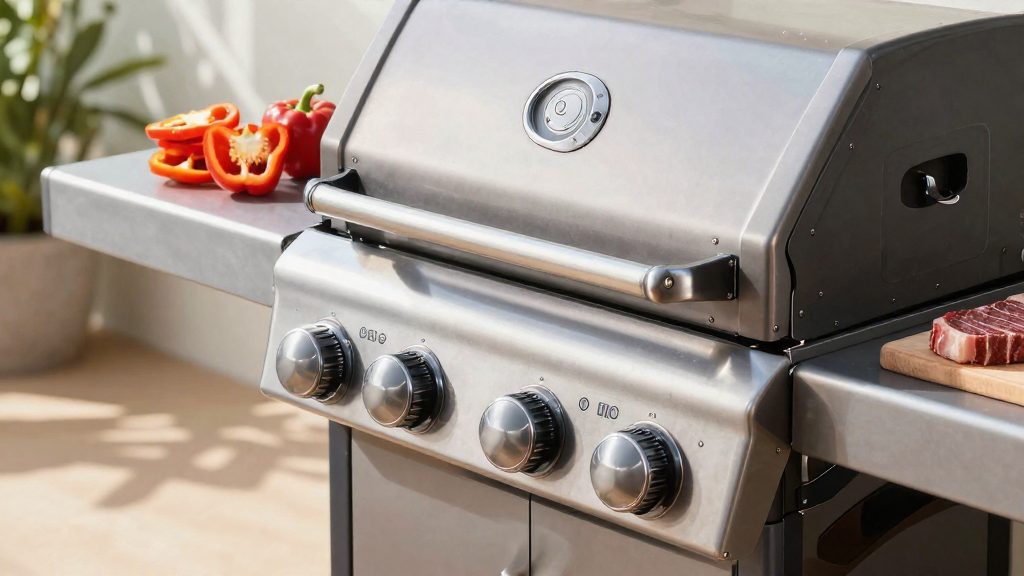
A family-size gas grill is a freestanding or built-in unit that can cook for a household of four at the same time and be placed with safe clearance from the house and overhead hazards. According to NBC News Select (2026), buying advice for families is built around a family of four, so that household is the baseline used here. Household size alone does not settle the choice, though. How often you cook and where the grill will sit matter just as much.
What counts as a family-size gas grill?
Household size and cooking frequency
Start with the number of people you cook for on a typical evening. If you regularly feed more than four, or host often, look for a unit with more cooking capacity. If you cook for two most evenings and entertain rarely, a smaller grill is easier to store and move.
Weekly frequency also affects which build features deserve attention. A grill used most days places more demand on its igniter, burners and lid, so those components should be checked more carefully than they would be for occasional use.
Freestanding carts versus built-in units
Freestanding carts are the most common format for family use. They can be repositioned, which makes them easier to move away from a railing or branch when the layout changes.
A built-in unit is fixed into an outdoor counter. Its location is decided before installation and is difficult to change later. Either format still needs the clearance described below.
Placement and clearance
NFPA advice, reported by the Jamaica Plain Gazette (2025-05-21), is to keep gas grills away from the house, railings, eaves and low branches, and to keep children and pets at least 3 feet from the grill. Gas grill fires are common, so placement is a real safety factor.
Before first use:
- Set the grill on a flat, stable surface.
- Check the area above and beside it for eaves and low branches.
- Confirm that the propane connection is positioned where it can be inspected for leaks.
Features to check
NBC News Select (2026) lists the following features for family-size models:
| Feature | What to check |
|---|---|
| Igniter | Reliable ignition; weak ignition is a safety concern |
| Handle heat shields | Protection for the hands during use |
| Lockable wheels | The cart stays in place once positioned |
| Ignition shutoff | Easy to reach without reaching over the cooking surface |
| Body material | Stainless steel resists rust; cast iron sears better but needs more care |
Why a side burner matters
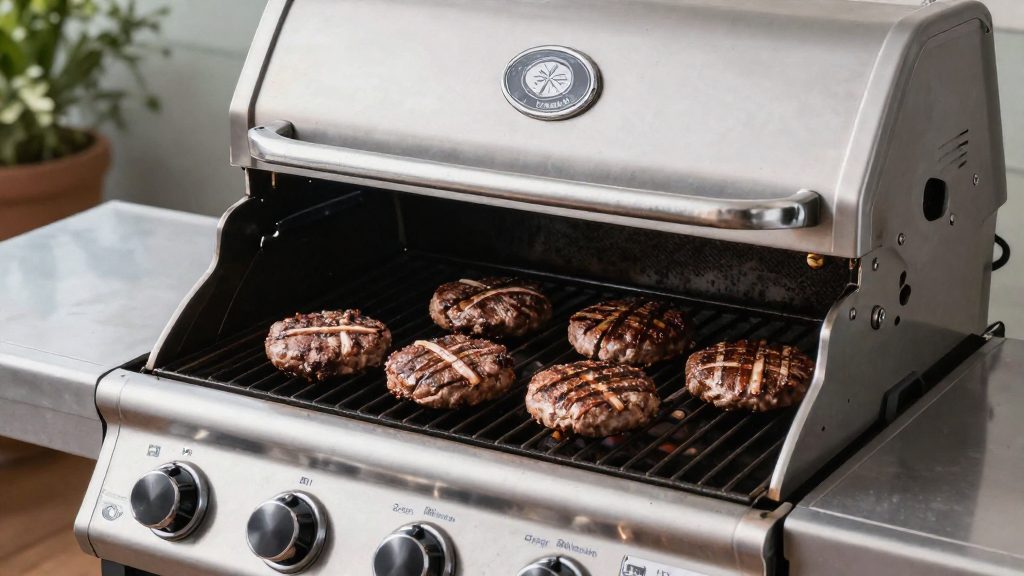
A side burner gives a family cook a second, separate heat source. On a gas grill with a side burner, the main burners can handle meat over the grate while a pan or pot sits on the side burner for sauces, sides or vegetables. Without it, those tasks have to wait until the meat comes off, or be cooked indoors.
Simultaneous cooking is the main advantage. A typical sequence looks like this:
- Sear the meat on the main burners at high heat, then move it to a cooler zone to finish.
- Warm a sauce, such as a butter or barbecue glaze, in a small pan on the side burner.
- Cook corn, potatoes or sliced vegetables in a pot or pan on the side burner while the meat rests.
Start the side burner pan a few minutes before the meat finishes, so both are ready together.
Heat level is the key difference from the main burners. The side burner is smaller, so it typically provides a more concentrated, lower-volume heat source suited to simmering and reducing rather than searing large cuts. Before relying on it for a particular task, check its flame on your specific model at low and high settings, and watch the pan during the first few uses to learn how quickly your sauce or vegetables heat through.
Pan and pot choice matters. Use cookware whose base is no wider than the side burner’s grate, so the flame reaches the base evenly. A small, heavy-bottomed saucepan works well for sauces, and a shallow pan suits sliced vegetables. Keep handles turned inward and away from the edge of the grill, and never leave a pan on the burner unattended.
How many burners and how much cooking space?
For a family gas grill, two figures matter most: the burner count and the cooking area. According to NBC News Select (2026), a family grill should have at least two burners so you can cook at different heat levels at the same time. With a single burner, the whole grate runs at one temperature, so a steak that needs a hard sear and fish that needs gentle heat cannot be cooked properly side by side.
Burner count
- Minimum: two burners, giving you two separate heat zones.
- Family of four: two to four burners, per the same guidance.
- Practical use: set one burner high for searing, one at medium for the main cooking, and keep the third (if present) low or off as a resting and warming area.
Cooking area
- Family of four: at least 500 sq in of cooking space, which leaves room for several items to cook at once without crowding.
- Overlap check: a grill can have enough burners but a grate too small for the group, so check both figures.
Which features make a grill safer for kids?
Child-relevant safety on a family gas grill depends mainly on hardware: an igniter that lights reliably, handle heat shields, lockable wheels, and an ignition shutoff that an adult can reach quickly. NBC News Select (2026) lists these as features to check when buying, and it flags weak ignition as a safety concern.
Reliable igniter
A reliable igniter is the most safety-relevant feature in this group. Weak ignition is a safety concern. If a burner fails to light on the first attempt, turn off the gas control and wait for any gas to clear before trying again. Test every burner’s igniter before the first cook of the season, and check that the lid closes and seals properly. If a burner does not light promptly, turn its control off, wait before retrying, and check the cause rather than repeating the attempt.
Handle heat shields
Handle heat shields limit how much heat reaches the handle, which matters when a child is nearby and an adult is moving or adjusting the grill. Check that each shield is fixed firmly, fully covers the handle, and is not loose or missing. A shield that has come off provides no protection.
Lockable wheels
Lockable wheels keep the cart from rolling when a child leans against it or when the grill is bumped. Engage the locks before lighting, and check after every move that the locks hold the cart in place.
Ignition shutoff placement
An easy-to-reach ignition shutoff lets an adult stop gas flow without reaching across the cooking surface. Confirm that the control sits at the front of the cabinet and that it can be turned off in one motion.
| Feature | What to verify | Purpose |
|---|---|---|
| Reliable igniter | Lights on the first attempt on every burner | Avoids repeated ignition attempts |
| Handle heat shields | Fixed, with full handle coverage | Limits heat reaching the handle |
| Lockable wheels | Locks engage and hold the cart | Prevents unintended movement |
| Ignition shutoff | Front-mounted, operable in one motion | Fast shutoff by an adult |
When comparing models, check each listing against these features, since the source does not confirm them for specific models.
Are cast iron or stainless grates better?
According to NBC News Select (2026), stainless steel resists rust, while cast iron sears better but needs more care. Neither material is better in every case. For families, the choice depends on how much searing matters for the meals you cook and how much upkeep you can manage between uses.
| Factor | Cast iron grates | Stainless steel grates |
|---|---|---|
| Searing | Better sear quality | Less strong for searing |
| Rust | Needs seasoning and oiling to resist rust | Resists rust |
| Upkeep | More care required | Less demanding |
Sear quality and heat retention
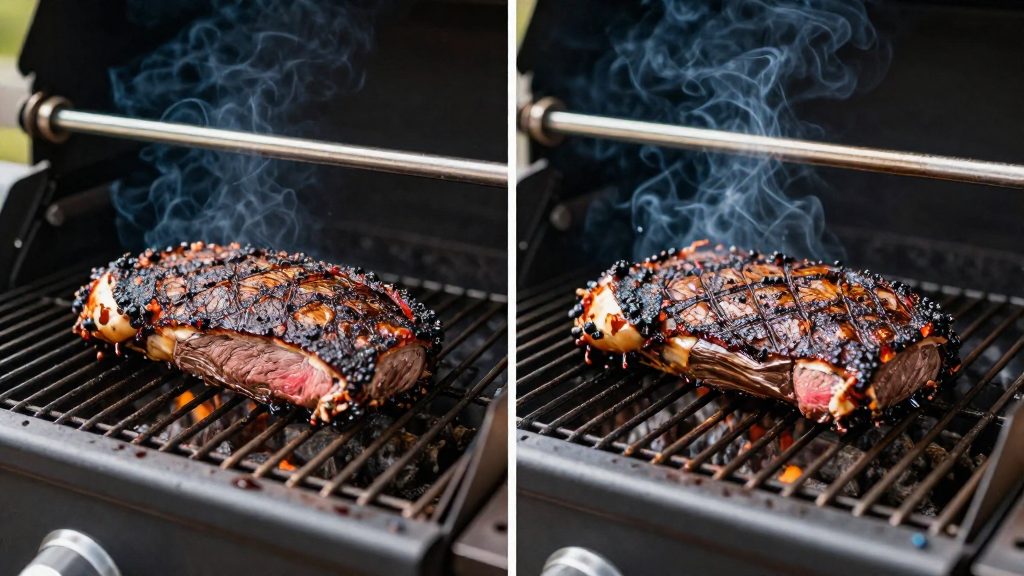
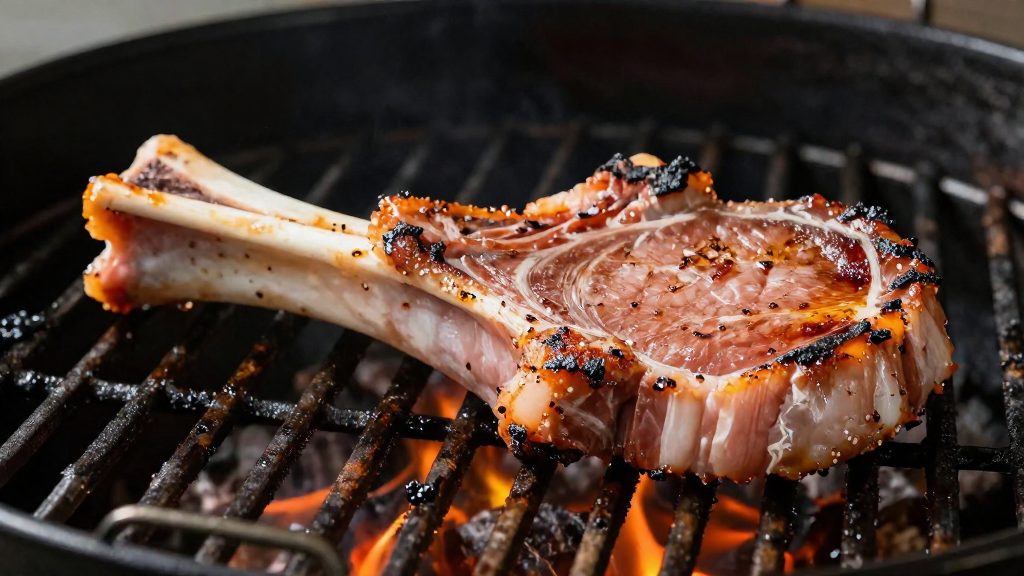
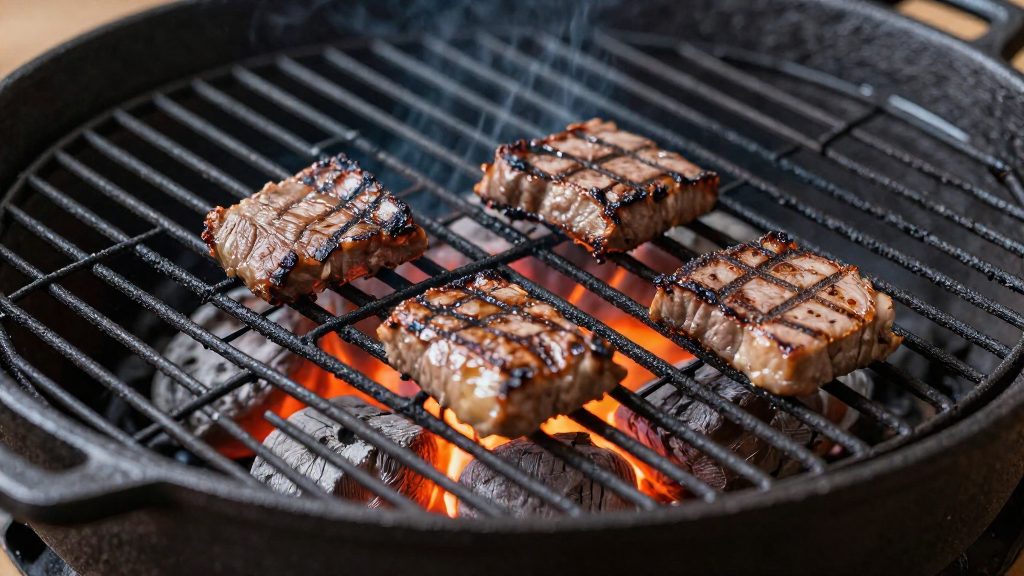
Cast iron grates are the stronger choice for searing steaks, burgers and chicken thighs. Preheat them with all burners on high and the lid closed until the grates are fully hot before placing any food. Cast iron holds this heat well, so the surface stays hot when meat contacts it, which helps form a browned crust.
Rust resistance
Stainless steel grates resist rust, which makes them easier to keep in good condition on a grill that stays outdoors between uses. This is the main practical advantage for households that cook occasionally and do not want to maintain the grates after every session.
Seasoning and oiling demands
Cast iron needs seasoning: a thin layer of oil bonded to the surface through heating. After each cook, while the grates are still warm, brush them lightly with a high smoke-point oil. Store the grill covered and dry. Stainless steel asks for less of this routine.
Gas grill fire and injury facts
Gas grills were involved in an average of 9,287 home fires per year between 2019 and 2023, according to NFPA as reprinted by the Jamaica Plain Gazette (2025). The table sets out the core figures that frame the operating rules below.
| Measure | Figure | Period |
|---|---|---|
| Average annual home fires involving gas grills | 9,287 (4,682 structure fires and 4,605 outdoor fires) | 2019–2023 |
| Share of gas grill home fires in which the grill had not been cleaned | About 20% | 2019–2023 |
| Average annual emergency-room visits for grill-related injuries | 21,682 | 2020–2024 (CPSC data) |
Operating rules for gas grills
- Open the lid before lighting. NFPA advises opening the lid before lighting a gas grill.
- Never leave the grill unattended. Stay with the grill from ignition until the burners are switched off.
The emergency-room figure shows that injuries are a separate risk from fires.
How to clean and maintain a gas grill
Routine cleaning keeps a gas grill working evenly and reduces the grease buildup that can cause problems. The main components to maintain are the cooking grates, the burner ports, and the grease tray, plus the propane connection.
Cleaning the grates after each cooking session
Clean the grates while they are still warm, but not hot enough to burn you. Burn off residue with the burners on high for a few minutes, then scrape the grates with a stainless steel or brass-bristle brush. Wipe the surface with a damp cloth or paper towel, then let the grill dry before the next use.
Burner ports and grease tray
Burner ports can become blocked by food debris and grease, which affects how evenly the flame spreads. Check each port visually and clear any obstructions with a thin wire brush or pick. Remove the grease tray, empty it, and wash it with warm, soapy water. Clean these parts whenever you see buildup, and inspect them periodically for signs of wear.
Checking the propane connection for leaks
NFPA advises checking propane tanks for leaks (Jamaica Plain Gazette reprint of NFPA release, 2025-05-21). A common method is the soapy water test:
- Turn off the burners and the tank valve.
- Mix liquid dish soap with water and brush it onto the hose, regulator, and tank connection.
- Open the tank valve slowly and watch for bubbles forming at any joint.
- If bubbles appear, close the valve, tighten the fitting, and retest. Replace any damaged hose rather than continuing to use it.
Inspect the hose for cracks, stiffness, or abrasion each time you clean the grill, and keep the tank stored upright and away from heat sources.
Which models are worth a look?
The Weber Spirit II E-310 is the model with the most concrete data available. According to NBC News Select (2026), it has three main burners, a smaller side burner and 529 sq in of cooking space.
| Spec | Weber Spirit II E-310 | Benchmark for a family of four |
|---|---|---|
| Main burners | 3 | 2 to 4 burners |
| Side burner | Yes, smaller than the main burners | Separate burner for a second heat zone |
| Cooking area | 529 sq in | At least 500 sq in |
| Margin over minimum | 29 sq in | Not applicable |
The E-310 meets the cooking-area minimum and falls within the burner range.
The Weber Spirit II E-330 is another model in the same line, but no burner, side-burner or cooking-area figures for it are supplied here, so no recommendation can be made without checking its specifications on Weber’s current spec sheet. Test it against the same three benchmarks: at least two burners, at least 500 sq in of cooking space, and a side burner if you want a separate zone.
Verifying each model against manufacturer spec sheets
- Confirm the main burner count and check whether the side burner is listed separately. Some retailers combine them.
- Use the cooking area in sq in from the manufacturer’s page, not the overall footprint, because footprint says little about usable grate space.
- Compare the same measurement across models. Cooking area figures from different sources may not measure the same surface.
- Record the figures in a table with the model name, burner count, side burner and cooking area. This makes the comparison objective.
Frequently asked questions
How many burners and how much cooking space does a family grill need?
For a household of four, NBC News Select (2026) suggests two to four burners and at least 500 sq in of cooking surface. Two burners is the minimum that lets you run a high-heat zone and a gentler zone at the same time.
Should I choose stainless steel or cast iron grates?
According to NBC News Select (2026), stainless steel resists rust, which suits a grill that stays outdoors between cooks. Cast iron sears better but needs more care, so pick it only if you are willing to maintain it regularly.
Which side-burner model has verified specifications for families?
The Weber Spirit II E-310 has three main burners, a smaller side burner and 529 sq in of cooking space, according to NBC News Select (2026). Use these figures as the benchmark when you compare other models with a side burner.