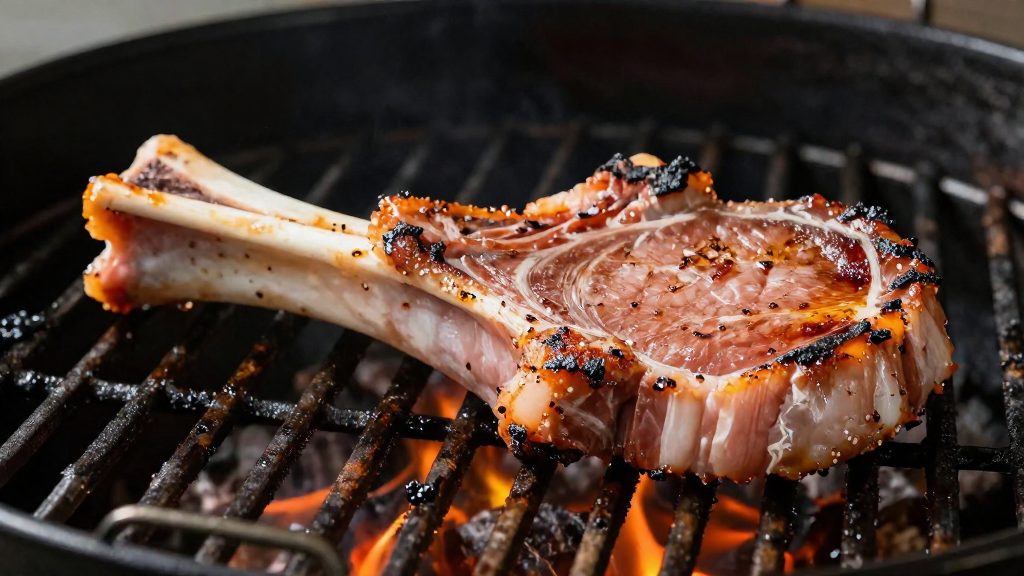
On a gas grill, a standard bone-in pork chop about 1½ inches thick takes roughly 20–26 minutes in total, according to America’s Test Kitchen (2026). The time comes from a sear over the hot side of the grill, followed by a finish on the cooler side, so the cook is split between two heat zones rather than run on high throughout.
How long to grill bone-in pork chops on a gas grill?
Choosing the cut
The method is built around two cuts: bone-in rib chops and center-cut loin chops. Both are cut about 1½ inches thick. The 20–26 minute window applies only to chops of that thickness, so a noticeably thinner or thicker chop will need a different time.
The method behind the timing
Preheat the grill first, then cook in two stages:
| Step | Burner setup | Duration |
|---|---|---|
| Preheat | All burners on high, lid closed | 15 minutes |
| Sear | Hot side only, one turn | 3–4 minutes per side |
| Finish | Cooler side, lid closed, turn once | 7–9 minutes |
Once the burners are preheated, leave one burner on and turn off the others. The seared chops then move to the side without flame, which lets the center cook through without the outside burning. The sear builds the browned surface, and the finish does most of the work of bringing the meat through.
Chowhound gives a shorter figure of up to 20 minutes for thick bone-in chops, including searing. That sits at the low end of the range above. For a 1½-inch chop, use the 20–26 minute window as the starting baseline and adjust from there.
Gas grill times by chop thickness
For bone-in pork chops on a gas grill, the sources give timings tied to a specific thickness, so thickness is the variable to plan around. America’s Test Kitchen (2026) tested bone-in rib or center-cut loin chops about 1½ inches thick and reports 20–26 minutes in total. Chowhound (2026) gives up to 20 minutes, including searing, for thick bone-in chops without naming a thickness. The two figures cannot be compared directly: Chowhound gives up to 20 minutes for thick bone-in chops without naming a thickness, while ATK’s 20–26 minutes applies to chops about 1½ inches thick. Use the ATK range as the baseline for a 1½-inch chop and rely on the thermometer. Use the ATK range as the baseline and expect longer times for chops thicker than 1½ inches.
The 1½-inch benchmark
The searing and finishing stages add up to the 20–26 minute total.
Thicker chops and the reverse sear
For thick chops, Chowhound recommends a reverse sear: cook over indirect heat until the chops reach about 100°F, then sear them over direct heat. Searing last means the surface spends less time over high heat while the interior comes up to temperature. The indirect phase has no fixed duration because it depends on thickness, so track the internal temperature with a thermometer rather than the clock.
| Method | Chop thickness | Heat sequence |
|---|---|---|
| ATK two-zone | About 1½ inches | Sear over hot side, then finish on cooler side |
| Chowhound direct-to-indirect | Thick bone-in | Sear over direct medium-high heat, then move to indirect |
| Chowhound reverse sear | Thick | Indirect to about 100°F, then sear over direct heat |
What internal temperature is safe for pork chops?
For bone-in pork chops, the internal temperature is the measure to rely on. The USDA set the safe temperature for whole cuts of pork, including chops, at 145°F. The figure was announced on May 24, 2011 (CIDRAP, 2011). It applies to the thickest part of the meat, so a reading of 145°F in the thickest part, followed by a 3-minute rest, meets the USDA guidance. Check each chop individually.
America’s Test Kitchen uses a different reference for removing the chops from the grill. Its method pulls bone-in rib or center-cut loin chops about 1½ inches thick at 135°F, which is the pull temperature (America’s Test Kitchen, 2026). Use 135°F as the trigger to take the chops off the heat, not as the final safety check.
Probe placement
Insert the thermometer from the side of the chop and keep the tip away from the bone. America’s Test Kitchen specifies this placement for its bone-in chops. Start checking the temperature once the chops have moved to the cooler side, since that is where the reading climbs toward the pull point.
Check each chop individually when cooking several at once. A reading taken from one chop does not confirm the others.
Why a thermometer replaces visual checks
The probe reading is the only reliable indicator here. Judge doneness by temperature, not by the look of the cut.
How to set up two-zone heat on a gas grill
Two-zone heat means one side of the grill runs hot enough to sear while the other stays cooler for indirect heat. For bone-in pork chops, this lets you brown the surface first and then finish the meat without burning the outside. Chowhound (2026) recommends preheating to about 375–400°F before cooking, and America’s Test Kitchen (2026) uses a specific burner sequence to build the two zones.
Step 1: Preheat every burner
- Turn all burners to high.
- Close the lid and let the grill preheat for 15 minutes.
- Keep the lid closed during this time so the heat builds evenly across the grate.
Step 2: Turn off one side
- After preheating, turn off the burner or burners on one side and leave one burner on.
- The side with the lit burner becomes the hot zone, used for searing.
- The side with the burner off becomes the cool zone, used for finishing.
Step 3: Confirm the zones
Check the grill thermometer before placing the chops. Chowhound suggests preheating to about 375–400°F, while ATK preheats all burners on high. Either way, the cool side should read noticeably lower because no flame is directly beneath it.
| Zone | Burner status | Role for pork chops |
|---|---|---|
| Hot zone | One burner lit, preheated | Direct searing over the flame |
| Cool zone | Burner off | Indirect cooking after searing |
Should you brine pork chops first?
Brining is optional for bone-in pork chops on a gas grill. According to Chowhound (2026), there are two routes: a dry brine, applied directly to the meat, or a wet brine, in which the chops soak in salted, sweetened water before cooking. Either one adds seasoning and prep time, so the choice depends on how far ahead you can plan.
Dry brine timing
A dry brine should rest on the chops for at least 1 hour. Overnight is the preferred timing, so if you have the time, season the chops the day before.
Wet brine ratio
The wet brine ratio is 1 tbsp kosher salt and 2 tbsp sugar per cup of water. Scale the mix to the volume of liquid you need:
| Water | Kosher salt | Sugar |
|---|---|---|
| 1 cup | 1 tbsp | 2 tbsp |
| 2 cups | 2 tbsp | 4 tbsp |
Dissolve the salt and sugar fully in the water before adding the chops.
Pat the chops dry
Whichever brine you use, pat the chops dry with paper towel before they go on the grill. Surface moisture left on the meat keeps the chops from browning properly during the sear, so this step should come after brining and immediately before grilling.
How long should pork chops rest?
Resting a bone-in pork chop after it leaves the grill is part of the cooking process. According to America’s Test Kitchen (2026), the chop rests for 5 minutes under a loose foil tent, and its internal temperature rises to 145°F during that time. This rise comes from residual heat: the outer layers stay hotter than the centre, so heat keeps moving inward after the chop leaves the flame. The centre continues to warm while the surface cools.
To tent the chops, lay a sheet of aluminum foil over them without wrapping or pressing it down. The foil shelters the seared surface you built over the hot zone, and the loose fit lets the chops rest without being sealed in.
Food safety guidance adds a 3-minute rest after the chop reaches the USDA temperature. Ground meat stays at 160°F, so the rest period applies only to whole cuts.
The two timings serve different purposes. The 5-minute rest comes from a cooking test that measured the temperature rise, while the 3-minute rest is the USDA’s minimum after the chop reaches the safe temperature. The two timings are not interchangeable. The USDA’s 3-minute rest begins after the chop has reached 145°F. In the ATK method the chop reaches 145°F only at the end of its 5-minute rest, so confirm 145°F with a thermometer and then let the chop rest a further 3 minutes.
Common mistakes that dry out bone-in chops
Most dry bone-in chops come from handling errors rather than from the grill itself. Three common mistakes can dry out chops: applying the wrong safety threshold, turning the meat too often, and pressing on it during cooking.
Applying the ground meat threshold to whole chops
The ground meat threshold of 160°F is a different standard from the one for whole cuts. Cooking a bone-in chop to 160°F goes well beyond the 145°F needed for whole cuts, and the extra time on the grill can leave the meat dry. Measure the thickest part of the chop with a probe thermometer and stop at the whole-cut threshold, not the ground meat figure.
Turning the chops repeatedly
Frequent turning is the second common error. Each flip interrupts crust formation on the surface and extends the time the chop spends over heat, which removes moisture gradually. Set a timer for each phase so the urge to check and flip stays in check.
Pressing down with a spatula
Pressing on chops with a spatula, a habit that often follows from wanting more contact with the grate, forces juices out of the meat and into the flames or onto the grate. The result is less moisture left inside the chop and more smoke from dripping fat. Leave the chops untouched while they sear, and lift them only to turn them, using tongs rather than a spatula pushed into the meat.
Frequently asked questions
What internal temperature should bone-in pork chops reach?
USDA (2011) sets the safe temperature for whole cuts of pork at 145°F in the thickest part, followed by a 3-minute rest. Color is not a reliable check, since safe pork can stay pink. America’s Test Kitchen (2026) pulls its chops at 135°F and lets them rise to 145°F during a 5-minute rest under loose foil.
Do bone-in pork chops need brining before grilling?
Chowhound (2026) suggests a dry brine of at least 1 hour, ideally overnight. For a wet brine, the ratio is 1 tbsp kosher salt and 2 tbsp sugar per cup of water. Pat the chops dry before they go on the grill, whichever method you use.
What should I do if my chops are thicker than 1½ inches?
The 20–26 minute window applies only to chops of about 1½ inches, so thicker cuts will take longer. For thick chops, Chowhound (2026) recommends a reverse sear: cook on indirect heat until the chops reach about 100°F, then sear them over direct heat.