Why gas works well for zucchini and peppers
Gas grills suit zucchini and bell peppers because heat is set with a knob rather than built from fuel. You adjust the flame directly, so one grate can hold a gentler zone for thin vegetable pieces and a hotter zone for thicker ones. Results are easier to repeat than with charcoal, where the fire must be lit, spread and adjusted by adding or moving coals while the vegetables are already on the grate.
Even heat across the grate matters because zucchini rounds and pepper strips are thin and cook quickly. Uneven spots produce some pieces that char while others stay pale.
Short cook times leave little margin for error, so control matters more than fuel volume. Brushing them with olive oil is covered in the prep section below.
On a gas grill, you can also move the vegetables to a cooler section of the grate if one side browns faster than the other.
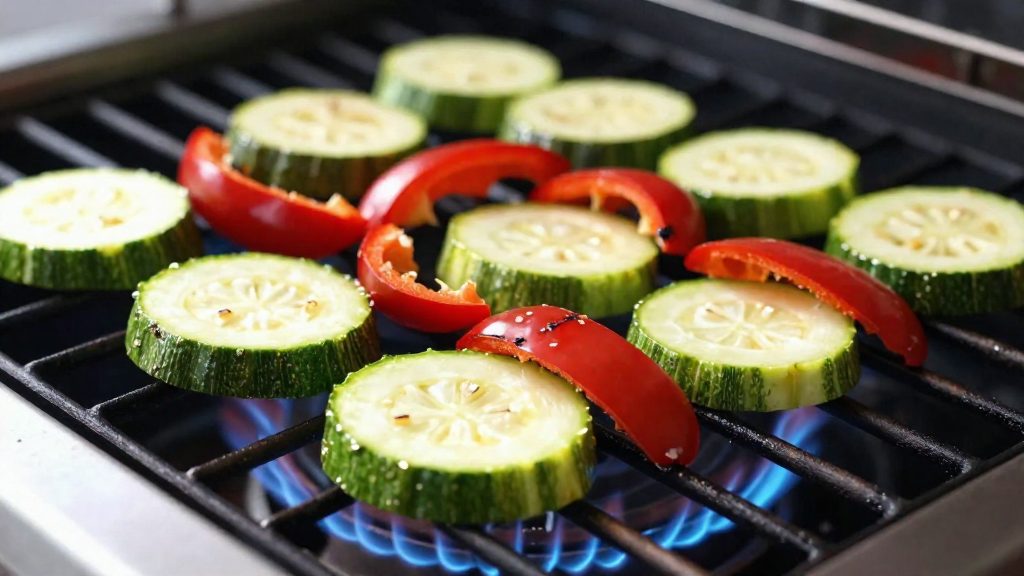
How should you cut zucchini and bell peppers for the grill?
Cut geometry determines how much vegetable surface touches the grate, how quickly heat reaches the centre and how much char develops. The two reference guides use different shapes for each vegetable, so the right cut depends on the texture and char you want.
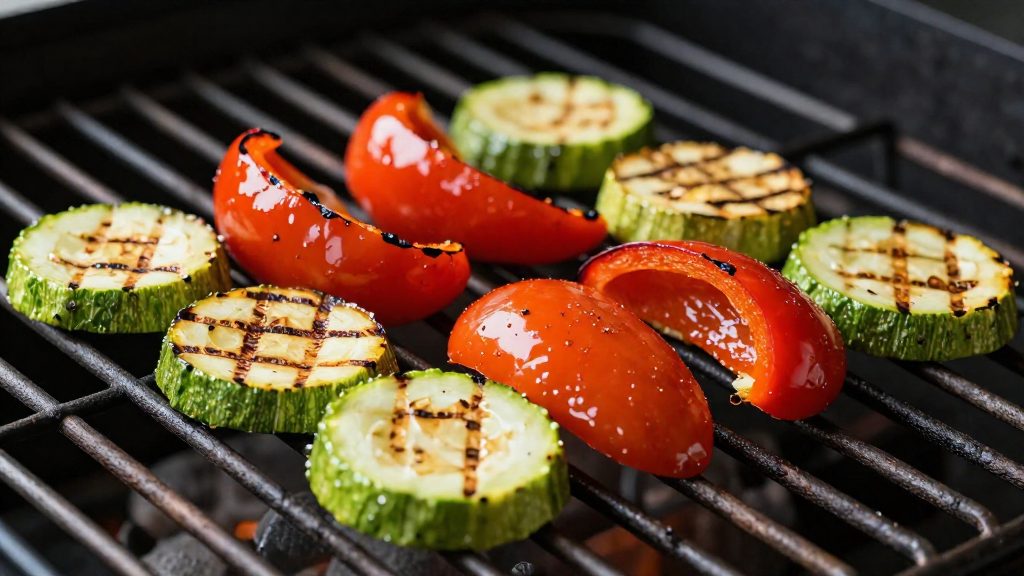
For zucchini, America’s Test Kitchen (2026) halves the vegetable lengthwise and scores the cut faces in a ½-inch crosshatch about ¼ inch deep. The scored flesh lies flat on the grate, and the grooves create raised ridges that take the grill marks. Safeway’s approach produces the opposite geometry: the zucchini is sliced into ½-inch rounds, so each piece presents a flat face and a uniform thickness to the grate.
For bell peppers, the guides diverge. America’s Test Kitchen keeps the pepper whole, with the stem, core and seeds removed first. Cut around the stem, lift it out, then scrape away the white membranes and seeds. Leaving the pepper whole lets the skin blister evenly around its full circumference. Safeway cuts peppers into strips instead, which gives more exposed flesh and more edges that char.
When cutting strips, keep the width consistent across the batch. Pieces of unequal width reach doneness at different times, so keep strips a similar width. As a practical tip, wider strips are less likely to slip through the grates.
| Vegetable | Cut | Result on the grill |
|---|---|---|
| Zucchini | Halved lengthwise, ½-inch crosshatch, ¼ inch deep | Grill marks on raised ridges, larger contact area |
| Zucchini | ½-inch rounds | Uniform thickness, flat faces |
| Bell pepper | Whole, stem, core and seeds removed | Even blistering of the skin |
| Bell pepper | Strips | More edges for char, faster cooking |
Prep and seasoning that prevent sogginess
Vegetables that reach the grate wet steam instead of browning, and browning is what gives grilled zucchini and bell peppers their flavour. Safeway (2026) notes that excess moisture prevents browning, so drying is the first step after cutting.
Drying the cut surfaces
Pat every piece dry with paper towels until the surface no longer feels damp. Pay particular attention to the cut faces, since they hold the most moisture. Dry the vegetables immediately before grilling rather than hours ahead, so that no water collects on the surface while they wait.
Brushing with olive oil
Safeway (2026) recommends brushing the vegetables with olive oil. Oil applied after drying stays on the surface instead of mixing with water on it, which helps the flesh colour and reduces sticking to the grate. Use a thin, even coat on all sides, and avoid pooling oil in the cavities of the bell pepper, where it drips and flares up.
Salt and seasoning choices
Salt draws water out of cut vegetables. If salt is applied long before grilling, the released liquid returns to the surface and works against browning. Season shortly before the vegetables go on the grate, and apply salt after the oil layer so that it adheres to the coating. Keep the seasoning simple, with salt and freshly ground black pepper, so that the natural sweetness of the zucchini and the peppers stays noticeable under the char.
What temperature should a gas grill be?
A gas grill for zucchini and bell peppers runs in two stages: a full-power preheat, then a lower working heat. According to America’s Test Kitchen (2026), the grill is preheated with all burners on high and the lid closed for about 15 minutes, after which the burners are lowered to medium-high. Safeway (2026) gives the working range for these vegetables as medium to medium-high heat, about 350–400°F. The preheat brings the grates to temperature so the vegetables make contact with a hot surface from the start. The lower working heat then holds the grill in the target range while the vegetables cook, which limits the risk of blackening the outside before the flesh is cooked.
| Stage | Burner setting | Lid | Target |
|---|---|---|---|
| Preheat | All burners on high | Closed | About 15 minutes |
| Cooking | Medium-high (ATK) or medium to medium-high, about 350–400°F (Safeway) | Closed in the ATK method | Per source |
The lid stays closed during cooking in the America’s Test Kitchen method, so the grill keeps its heat between turns. The two sources do not state the working heat in the same terms: America’s Test Kitchen gives a burner setting (medium-high after the preheat), while Safeway gives medium to medium-high at about 350–400°F. Either way, aim for medium to medium-high, not a full-power sear, once the vegetables are on the grate. Start from the preheat step each time, since the grill’s heat drops as soon as the lid opens and food is added.
How long do you grill zucchini and peppers?
Cooking time depends mainly on how the pepper is cut. Whole peppers take noticeably longer than strips (15–19 minutes in total versus 8–12), because the whole pepper is thicker and its skin has to blister. America’s Test Kitchen (2026) grills a whole pepper with the lid closed for 7–9 minutes on the first side, then 8–10 minutes after flipping, for a total of 15–19 minutes. Safeway (2026) cooks pepper strips for 8–12 minutes, turned once, at about 350–400°F.
| Vegetable | Format | Cook time |
|---|---|---|
| Bell pepper | Whole, first side, lid closed | 7–9 minutes |
| Bell pepper | Whole, second side | 8–10 minutes |
| Bell pepper | Strips, turned once | 8–12 minutes |
| Zucchini | Rounds, turned once | 6–8 minutes |
Load order for peppers and zucchini
Put the peppers on first. Zucchini needs only 6–8 minutes, so adding it at the start would overcook it before the peppers are done. Add the zucchini partway through the pepper cook. Turn each piece only once, so the vegetables keep their shape and the surfaces brown evenly.
Reconciling totals across formats
The two pepper formats give different totals, so do not treat them as interchangeable:
- Whole peppers: 15–19 minutes in total.
- Strips: 8–12 minutes in total, turned once.
If you grill whole peppers alongside zucchini rounds, start the peppers roughly 7–13 minutes before the zucchini goes on, so both finish together (15–19 minutes for the pepper minus 6–8 for the zucchini). If you use strips, the gap shrinks to a few minutes, so add the zucchini soon after the strips go on.
Cut format and when to use a grill basket
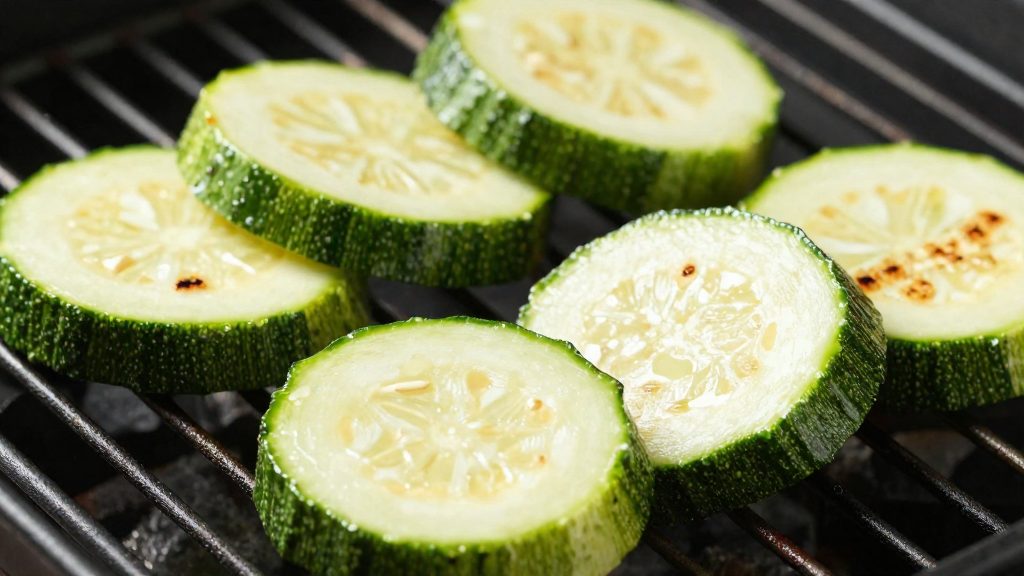
The cut format sets how much of each piece touches the grate and how many times it must be turned. America’s Test Kitchen (2026) grills the bell pepper whole and halves the zucchini lengthwise, so the pieces stay large and stable, and the pepper’s skin blisters while the flesh stays intact. Safeway (2026) instead cuts the zucchini into ½-inch rounds and the peppers into strips. Thinner, smaller pieces offer more grate contact per gram of vegetable, but they also demand more attention on the grill.
| Format | Cut | Turning | Cook time |
|---|---|---|---|
| America’s Test Kitchen (2026) | Zucchini halved lengthwise, pepper whole | Turned once, lid closed | 7–9 min, then 8–10 min more |
| Safeway (2026) | Zucchini ½-inch rounds, peppers in strips | Each piece turned once | Zucchini 6–8 min, peppers 8–12 min |
Whole or large pieces are the easiest to manage on a gas grill. A single turn with tongs is enough, and nothing falls between the grate bars.
Loose rounds and strips need a different setup. A grill basket or perforated tray keeps small pieces together and lets you move the whole load in one motion, which reduces turning effort. Load the basket in a single layer so each piece gets direct heat, and place it over the burners’ hottest zone.
For flipping, wait until the first side shows clear color before turning, then turn each piece once. Repeated flipping of loose vegetables tears them and cools the grate.
How do you know when the vegetables are done?
On a gas grill, doneness comes from visual and tactile signs, not from the clock alone. Zucchini and bell pepper show different cues, so each needs its own check.
On zucchini, look for char marks on the cut faces. The surface should change from pale green to browned and charred, with the scored crosshatch visibly darkened across the flesh rather than only at isolated spots. The flesh should still hold its shape when you lift it with tongs. Charring is the main signal here, since the skin of a halved zucchini is not peeled or separated the way pepper skin is.
Bell pepper is ready when its skin is blistered over most of the surface, with dark, bubbled patches where the skin has lifted from the flesh. Blistering alone does not mean the pepper is finished. Once it is off the grill, it needs a covered rest. According to America’s Test Kitchen (2026), the pepper rests covered for 5 minutes before peeling. The covering keeps the pepper warm while the blistered skin loosens, which is what allows it to come away in sheets. Peeling it straight off the grill skips this step and makes the skin harder to remove cleanly.
| Vegetable | Doneness signal | Check before moving on |
|---|---|---|
| Zucchini | Charred marks and browned cut faces | Flesh holds its shape under tongs |
| Bell pepper | Blistered, partly charred skin | Skin lifts from the flesh |
Cleaning the grates and safety tips
Grate residue and gas leaks are the main cleaning and safety risks when grilling zucchini and bell peppers on a gas grill. Sugars and oil from the vegetables char onto the bars, which makes the next batch stick and can feed flare-ups. A loose hose or fitting can release gas near an open flame. Address both before and after each session.
Scraping the grates after each session
Scrape the grates once they have cooled enough to handle safely. Use a stiff wire brush to lift charred residue from the bars, working from the back of the grate toward the front so debris falls into the grease tray rather than onto the burners. Zucchini leaves a thin film, while pepper skin leaves dark flecks that cling to the bars. Brush across the bars and then along them until no dark patches remain, then inspect the grates and the brush for loose bristles, which can end up in food. Empty the grease tray after each session.
Checking hose and fittings for gas leaks
Check the hose and fittings before lighting the grill and whenever you reconnect a propane tank. Mix liquid dish soap with water, open the lid, make sure all burner knobs are off, then open the tank valve and brush the solution over each connection, watching for bubbles. Bubbles indicate a leak. Turn off the gas at the tank and do not light the grill. Tighten the connection and test again. If bubbles persist, stop using the grill until the part is replaced or a qualified technician has checked it. Bubbles indicate a leak. Inspect hoses for cracks, stiffness or abrasion, and replace damaged hoses rather than taping them.
Managing oil flare-ups from brushed vegetables
Oil on zucchini and peppers can drip onto the burners and cause sudden flames. Trim excess oil before the vegetables go on the grate. If fat begins to drip and flames rise, move the vegetables to the cooler side of the grill, or turn off the burner under the flare-up. Do not pour water on a gas flame. Once the flare-up subsides, check the grate for fat buildup before continuing.
Frequently asked questions
Should I grill bell peppers whole or in strips?
America’s Test Kitchen (2026) grills a whole pepper for 7–9 minutes per side with the lid closed, then rests it covered for 5 minutes before peeling, for a total of about 15–19 minutes. Safeway (2026) cuts peppers into strips that take 8–12 minutes, so strips are the faster option if you want to skip the rest-and-peel step.
Why do my zucchini rounds stay pale instead of browning?
Safeway (2026) identifies excess moisture as the cause, so pat the rounds dry before brushing them with olive oil. Safeway also recommends medium to medium-high heat, about 350–400°F, for gas grilling.
In what order should I add zucchini and peppers to the grill?
Start the peppers first and add the zucchini partway through, since peppers need longer. Safeway (2026) gives 6–8 minutes for zucchini rounds and 8–12 minutes for pepper strips, with each piece turned once. This sequence helps both vegetables finish closer together.