Pork shoulder cooked at 225°F (107°C) takes roughly 60 to 90 minutes per pound, according to BBQ Host. An 8 lb shoulder therefore needs about 8 to 12 hours. BBQ Host calls these figures an estimate rather than an exact formula.
How long does pork shoulder take at 225°F?
Cook-time estimates by weight
Because the rate is per pound, total cooking time scales with the weight of the cut. Applying the 60 to 90 minute range to common sizes gives the following planning windows:
| Shoulder weight | Estimated cook time at 225°F |
|---|---|
| 4 lb | 4 to 6 hours |
| 6 lb | 6 to 9 hours |
| 8 lb | 8 to 12 hours |
These windows are calculated by multiplying the weight by 60 and 90 minutes. The 8 lb row matches the figure BBQ Host gives directly.
Why the times are approximate
The per-pound rate is a per-pound estimate, not a fixed timing. Actual duration depends on factors the rate does not capture, so the cook should not be scheduled to the minute. Planning for the upper end of the range leaves more room in the day than planning for the lower end, and avoids timing a meal around the earliest possible finish.
Checking doneness with a thermometer
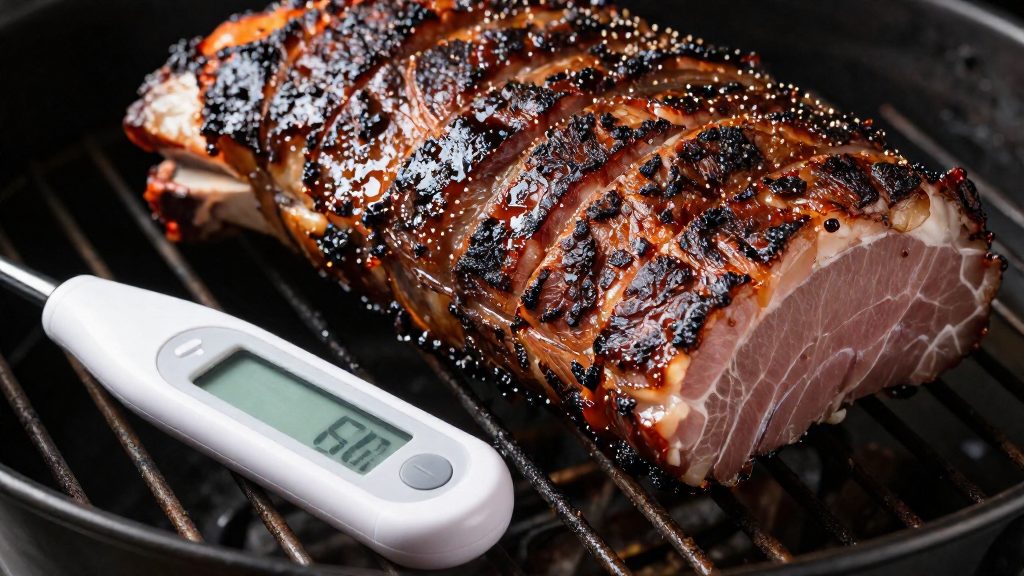
Time alone does not confirm that the meat is cooked. Health Canada lists 71°C (160°F) as the safe internal temperature for pork, both pieces and whole cuts, and advises checking doneness with a digital food thermometer.
Pork shoulder vs pork butt
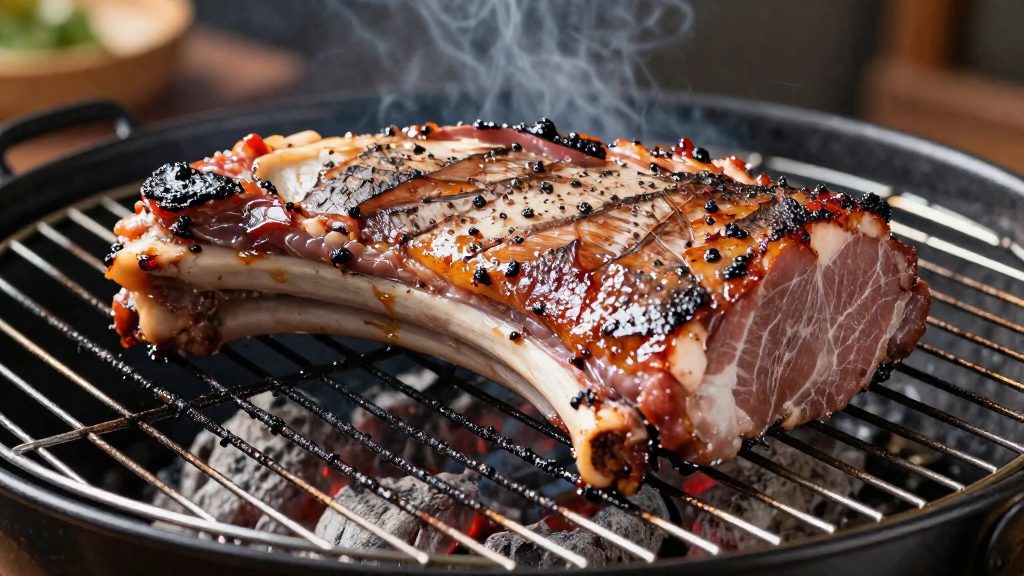
The whole pork shoulder is made up of two cuts. The Boston butt is the upper part, and it is the cut most often sold as “pork shoulder” or “pork butt” in grocery stores and butcher shops. The picnic shoulder is the lower part, a separate cut with a different shape and bone structure. Check the label for the name, because a picnic shoulder cannot be assumed to behave like a butt.
Bone-in vs boneless
- Bone-in: the shoulder blade stays in the meat during the cook. When weighing or buying, remember that the bone counts toward the total weight on the scale.
- Boneless: the piece is easier to trim, season, and handle, and it is simpler to slice or pull once cooked.
Whichever you choose, the internal temperature decides doneness, not the bone.
Fat cap and marbling
The fat cap is the layer of fat on one side of the shoulder. Leave it on during smoking and place it facing up, so the fat slowly bastes the meat as it renders. Trim only thick, hard patches that will not render, because a thin fat cap helps protect the surface from drying out.
Marbling is the fat distributed inside the muscle. It does not need trimming, and it softens as the meat cooks. A well-marbled butt generally holds moisture better over a long, low-temperature smoke than a lean piece, so choose a piece with visible fat throughout.
How do you check doneness with a probe?
On a pork shoulder cooked at 225°F, a single reading tells you the temperature at one point only, so pair it with a check of how the meat feels.
Probe placement matters more than the thermometer model. Insert the tip into the thickest part of the shoulder, away from the bone. A probe touching bone can give an inaccurate reading. If the cut is irregular or has several muscle sections, probe more than one spot before deciding.
Probe tenderness is the second signal. When the probe slides in with little resistance, the connective tissue has softened. If it meets firm resistance, the shoulder needs more cooking time, whatever the clock shows.
A practical check sequence:
- Read the display once the number has stabilised.
- Probe a second point to confirm the reading.
- Test the feel: if the probe enters smoothly, the meat is ready to rest.
Is 71°C enough, or should you go to 93–96°C?
For food safety, 71°C is enough. For pulled pork, it is not. The 71°C figure is the minimum for pork to be safe to eat, but pork shoulder is a tough cut that needs a much higher internal temperature to shred. Pulling at 71°C gives you safe meat that is still firm and hard to pull apart.
The higher pulling range is where the connective tissue in the shoulder breaks down and softens, so the meat separates into strands. The reference temperatures below answer different questions, so they should not be swapped for one another.
| Reference | Internal temperature | What it governs |
|---|---|---|
| Health Canada | 71°C (160°F) | Safe minimum for pork, whole cuts and pieces alike |
| BBQ Host, pulled-pork minimum | 195°F (about 91°C) | Lowest temperature at which to pull shoulder for shredding |
| BBQ Host, recommended pulling range | 200–205°F (about 93–96°C) | Target range for tender, shreddable pork |
| BBQ Host, sliced pork | 165°F (about 74°C) | Pull point for sliced pork, not shredded shoulder |
The 165°F figure is far below the pulled-pork minimum, which is why it applies only to sliced pork. If you are making pulled pork, set your target between 200°F and 205°F and treat 195°F as the lowest acceptable pull point.
Practical rule: choose your temperature by the result you want.
- Shredded pork: aim for 200–205°F. Do not pull below 195°F.
- Sliced pork: 165°F is the pull point cited for sliced cuts.
Should you wrap the shoulder?
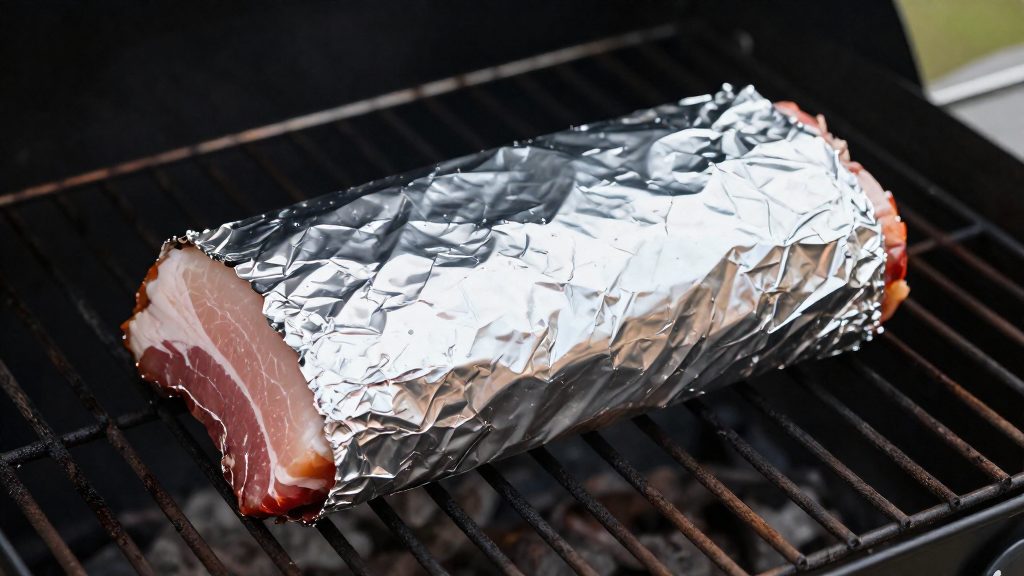
Wrapping is optional, but it is the standard way to move a pork shoulder through its mid-cook slowdown. BBQ Host suggests wrapping at about 150°F (65.5°C) internal temperature, in foil or butcher paper, a method known as the Texas crutch.
The stall is a plateau in internal temperature that usually appears partway through a long, low-heat cook. Moisture evaporating from the surface cools the meat, so the probe can sit almost flat for a long time even though the smoker is holding steady. Wrapping limits that evaporation, so the internal temperature climbs again at a steadier pace. Whether to wrap depends on your priority: a faster finish with more juice, or a firmer, more deeply coloured crust.
Foil versus butcher paper
Both materials slow surface evaporation, but they do it to different degrees:
| Wrap | Moisture retention | Effect on bark |
|---|---|---|
| Foil | Highest, since it seals the surface almost completely | Softens the bark and makes it more tender |
| Butcher paper | Moderate, since it lets some vapour escape | Keeps more of the bark’s texture and colour |
Foil suits cooks who want the shortest path to a tender, juicy pull. Butcher paper suits cooks who want to keep the crust they built during the first hours of smoking.
When to wrap
- Wrap once the internal temperature reaches about 150°F (65.5°C) and the stall has begun.
- Wrap tightly, keeping the bark covered, and return the meat to the smoker.
- If the bark is still pale or soft, delay wrapping to build more colour before the stall ends.
Do not wrap too early. Wrapping before the bark has set can leave the surface soft, and foil in particular will hold that softness.
Do you need to spritz?
Spritzing is optional. It means lightly wetting the outside of the meat during the cook, which keeps the surface moist and affects how the bark forms. Whether it is worth doing depends on the trade-off between surface moisture and the heat lost each time you open the lid.
Spritz liquids should be thin and mild so they add moisture without masking the pork. Common choices are apple cider vinegar, plain water, or diluted fruit juice. Apply them with a spray bottle or mop in light coats. Heavy application soaks the surface and softens the crust you are trying to build.
Lid opening is the main cost. Each time the lid lifts, hot air and smoke escape and the chamber temperature drops until the grill recovers. On a cook held at 225°F, frequent openings extend the total cook time. Spritz when the surface looks dry, not on a fixed schedule, and keep each opening brief.
Surface moisture and bark are the reason to spritz. A damp surface helps the rub adhere and encourages a darker, more even bark. Surface moisture is a visual and textural effect on the exterior. It does not replace the moisture the meat retains during a long, low cook. If the surface is already tacky and holding color, skipping a spritz costs little.
Best wood for smoked pork
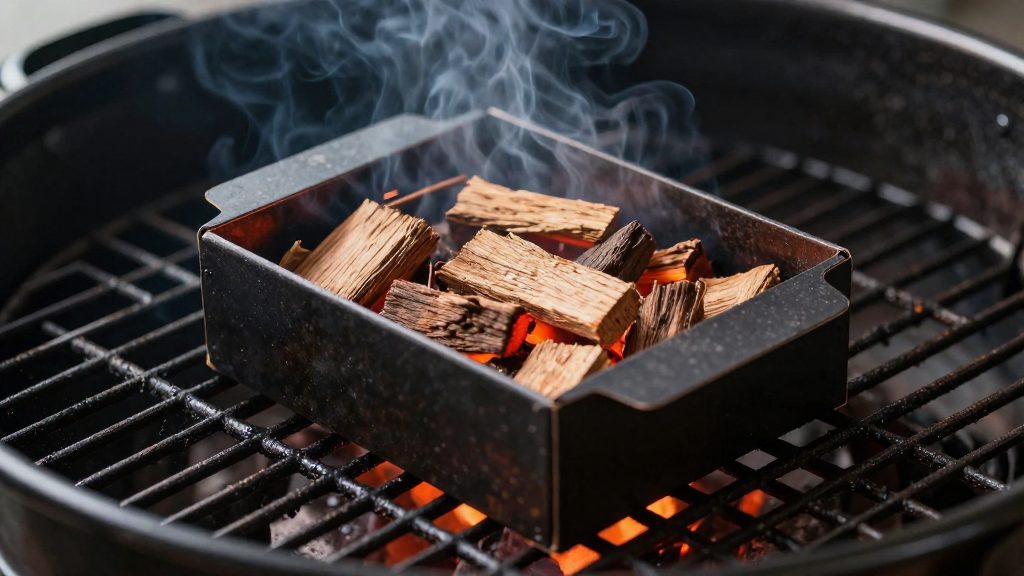
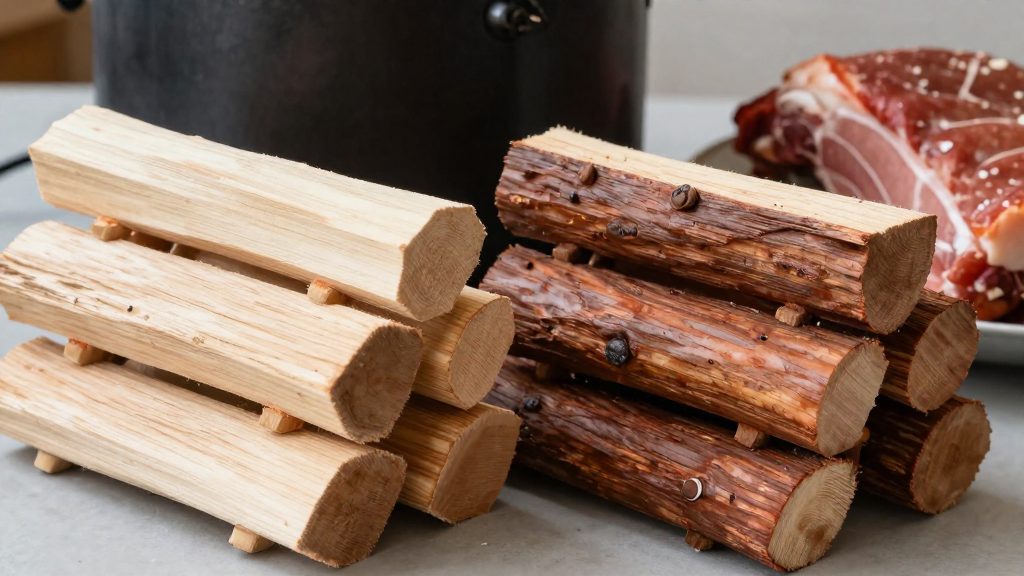
Wood species shape the flavour of a pork shoulder more than most other settings you control, because the meat takes on smoke compounds over a long cook. The main hardwoods differ mainly in smoke intensity and in how sweet the smoke tastes.
| Wood | Smoke intensity | Flavour profile on pork |
|---|---|---|
| Hickory | Strong | Bold, classic barbecue character |
| Apple | Mild | Light, sweet smoke that colours the bark without dominating |
| Cherry | Mild | Sweeter, fruity smoke with a rounded finish |
| Oak | Medium | Steady, balanced smoke that holds across long cooks |
| Pecan | Medium | Nutty smoke with a slight sweetness and moderate strength |
Hickory gives the strongest and most recognisable smoke, which is why it is the reference flavour for pulled pork. Because a shoulder can spend many hours in the smoker, hickory is best used in moderation, either as the main wood or mixed with a milder species. Too much of it can make the bark taste bitter or acrid.
Apple and cherry are the milder, sweeter options. Their smoke reads as lightly fruity and complements pork’s natural sweetness. They suit cooks who want a subtle profile, and they are less likely to overwhelm the meat during a long exposure to smoke.
Oak and pecan sit in the middle. Oak provides a consistent, balanced smoke that does not compete with the seasoning. Pecan adds a nutty note with a touch of sweetness at moderate intensity. Both work well as a base wood for the entire cook.
Resting, holding and food safety
After the shoulder comes off the smoker, the timing decisions are the rest, the room-temperature window, and the holding method before pulling. According to BBQ Host, the pork should rest for about 30 minutes before it is pulled. Plan this pause into your timeline so the meat is not rushed to the table.
Room-temperature window
BBQ Host states that cooked pork can stay at room temperature for up to 2 hours. Count this window from the moment the shoulder leaves the smoker and begins resting. If serving will be delayed beyond that, move the meat to an insulated holding setup rather than leaving it on the counter. Schedule the pulling so it falls inside the window whenever possible.
Holding in a faux Cambro
For longer waits, BBQ Host suggests holding the pork in a faux Cambro, a cooler used as an insulated container in place of a commercial food-holding cabinet. The method is simple:
- Let the shoulder rest first, then wrap it or place it in a clean container.
- Set the container inside the insulated cooler so the meat stays enclosed while it waits.
- Keep the lid closed between checks to limit heat loss and exposure.
- Pull the pork and serve it once you are ready, rather than reopening the holding box repeatedly.
The method described here relies on insulation rather than active heating, so it works best as a short bridge between the rest and service, not as a long-term store. Health Canada advises keeping hot food at 60°C (140°F) or above. Check the meat with a thermometer, and do not serve pork that has fallen below that temperature and stayed there for more than 2 hours.