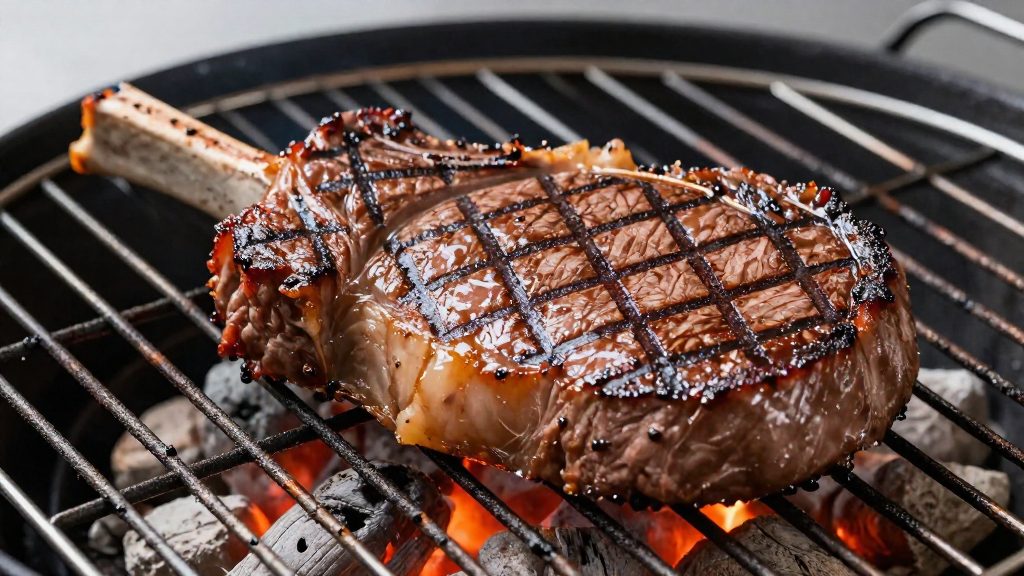
Reverse Sear Steak on a Charcoal Grill: Method and Temperatures
A reverse sear on a charcoal grill reverses the usual order of cooking. The steak is first brought up to temperature slowly over gentle, indirect heat, and only then browned over high heat in the final stage. Because the interior rises gradually, the meat reaches its target doneness almost evenly from edge to edge rather than forming a thick overcooked band beneath a fast crust.
What is a reverse sear on a charcoal grill?
The order of cooking
In a reverse sear, the gentle phase comes first. The steak rests on the cooler side of the grill, away from the coals, and absorbs heat from the surrounding air. During this stage the surface stays relatively dry and pale while the centre warms steadily. Once the interior is close to the desired doneness, the steak moves over the hot zone for the final sear, whose only job is to build a browned crust.
Smoked BBQ Source (2025) recommends steaks at least 1.5 inches thick for this method, since a thicker cut gives the slow phase enough time to work. Fogo Charcoal (2026) follows the same sequence in its two-zone guide.
Why gentle heat first gives edge-to-edge doneness
Heat travels from the outside of a steak toward its centre. With gentle heat, the difference between the outer layers and the core stays small for longer, so the whole cross-section approaches the target at a similar pace. The result is a fairly uniform colour from edge to edge, with less overcooked meat near the surface.
Searing last also limits how much the interior changes during the crust-forming step. The browning happens quickly on the outside, so the internal doneness established in the first phase is largely preserved.
Contrast with traditional high-heat-first searing
Traditional searing starts with hot, direct heat. The surface browns quickly, but the outer layers keep cooking while the centre catches up, which produces a wider band of grey, overcooked meat under the crust. The table below compares the two sequences.
| Aspect | Sear first (traditional) | Reverse sear |
|---|---|---|
| First step | Hot, direct heat browns the surface | Gentle, indirect heat warms the interior |
| Outer layers while the centre cooks | Keep cooking ahead of the centre | Stay close to the centre’s temperature |
| Overcooked band under the crust | Wider | Narrower |
| When the crust forms | At the start, while the interior is still cold | At the end, in a short final stage |
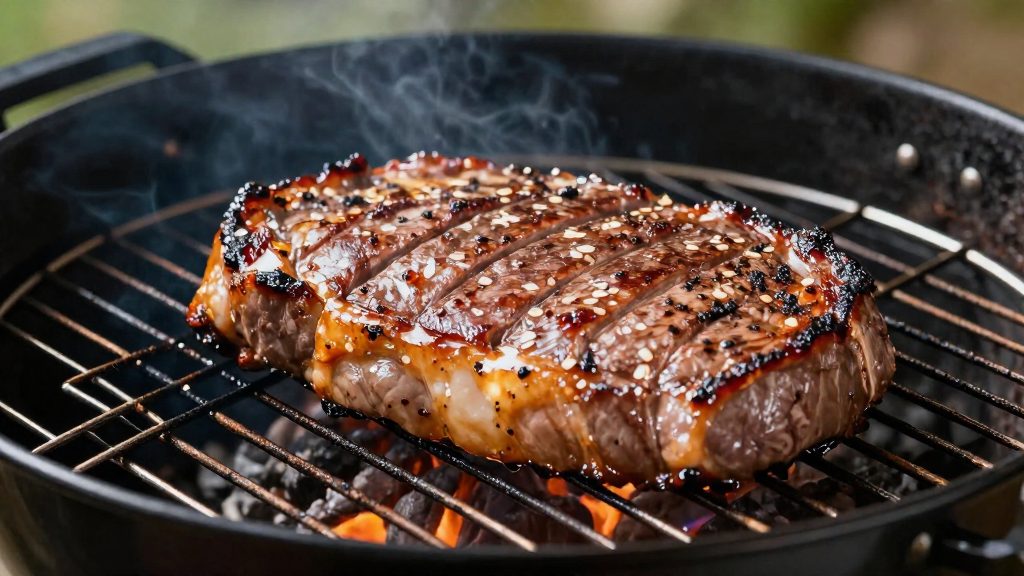
How do you set up a two-zone charcoal fire?
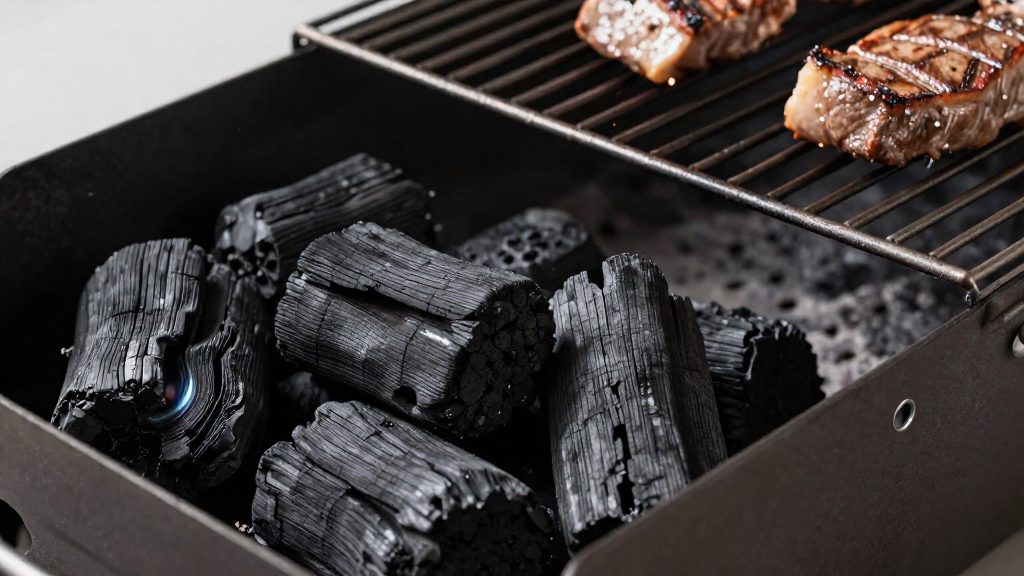
A two-zone fire puts the coals on one side of the grate and leaves the other side empty. The coals side is the direct zone, and the empty side is the cool zone, where the steak heats gently by indirect heat. For a charcoal reverse sear, the grill is held at about 200–250°F during this low phase, according to Smoked BBQ Source (Jordan Hanger, 2025-05-26).
Building the coal bed
On a Weber kettle, fill about two-thirds of a chimney starter with lump charcoal and light it. Once the top coals are fully lit, pour them onto one side of the charcoal grate.
Vent and temperature settings
Both vents start fully open. The bottom vent is then adjusted as the grill heats:
| Stage | Vent setting | Target |
|---|---|---|
| Start | Top and bottom vents fully open | Grill begins to heat |
| Once the grill reaches 180°F | Bottom vent closed about three-quarters | Hold the grill at 200–250°F |
Closing the bottom vent limits the airflow that feeds the coals, which slows the burn and lowers the temperature. Reducing airflow in this way keeps the grill in the 200–250°F range rather than letting it climb.
Positioning the steak
Place the steak on the cool side, directly opposite the banked coals, so that it is not exposed to direct flame during the low phase. Fogo’s guide uses the same two-zone principle at 250°F, banking the coals to one side or using a deflector to shield the food from direct heat, which is consistent with keeping the cool side clear of coals.
Which steaks work best for reverse searing?
Steak choice comes before the fire is lit. For a charcoal reverse sear, Smoked BBQ Source (Jordan Hanger, 2025) recommends steaks at least 1.5 inches (about 3.8 cm) thick. The same article uses a 1.5-inch ribeye as its tested example, which makes the ribeye a practical reference cut for this method. Thickness matters because the low-temperature phase runs long enough to bring the centre up gradually, and the final sear then only has to build the crust. A thin steak leaves little room for that gradual rise, so there is less margin for error.
The 1.5-inch figure is a minimum thickness.
Before cooking, plan the salting:
- Salt at least 20 minutes ahead. Fogo Charcoal (2026) suggests seasoning with salt at least 20 minutes before cooking. Salting this early gives the seasoning time to act on the meat before it reaches the grill.
- Season both faces evenly. A uniform layer keeps the crust consistent across the steak.
- Use the 20-minute wait to set up the grill. The sources only call for salting at least 20 minutes ahead. They do not require bringing the steak to room temperature, so do not leave raw meat out longer than the salting window.
Confirm the thickness before you season. A steak below 1.5 inches should be swapped for a thicker cut rather than reverse seared as is.
What temperatures should you pull and finish at?
In a reverse sear, the steak comes off the cool side of the grill before it reaches its final doneness, and the sear brings it up to temperature. For medium-rare, the Smoked BBQ Source (Jordan Hanger, 2025) sets a pull target of about 110–115°F internal, with the finished steak reaching 130–135°F after the sear.
| Stage | Internal temperature | Role |
|---|---|---|
| Pull (medium-rare) | 110–115°F | Steak leaves the cool zone |
| Finish after sear | 130–135°F | Target doneness after searing |
| Alternate pull point | About 125°F | Source’s rule of pulling about 5°F before the 130°F target |
The 125°F figure differs from the 110–115°F range, and the source does not reconcile the two. Both come from the same article, which does not say how they fit together. The gap between the 110–115°F pull and the 130–135°F finish is roughly 15–25°F, which the sear must cover.
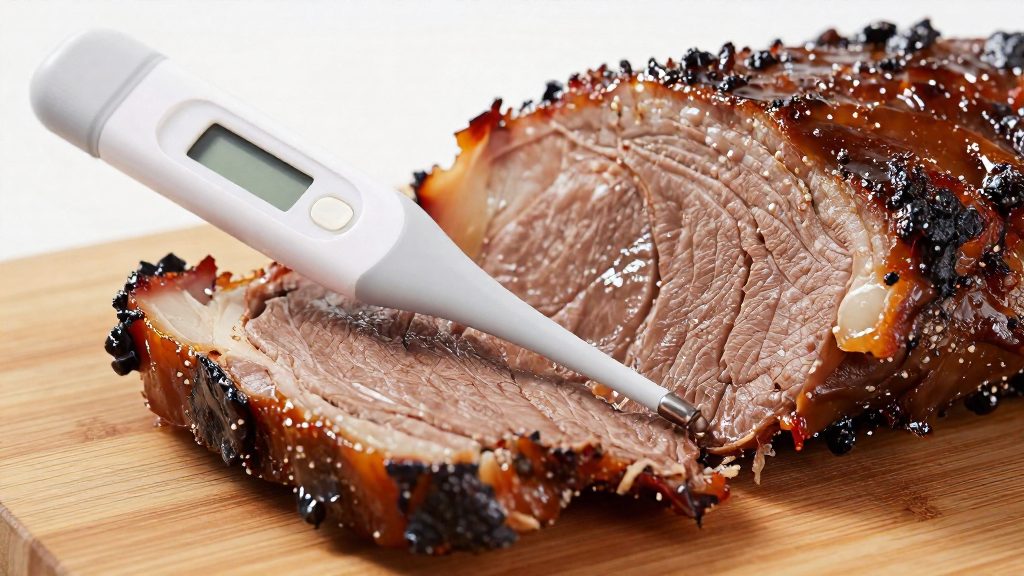
Recommendation: use the 110–115°F pull range. It is the medium-rare pull range the source states directly. The source also mentions pulling about 5°F before the 130°F target, which points to about 125°F. The two figures are not reconciled, so treat 110–115°F as the stated medium-rare pull range and check the temperature often. Use a probe thermometer in the thickest part of the steak to check each reading, and remove the steak as soon as it enters the 110–115°F range. Note that USDA guidance for whole cuts of beef is 145°F followed by a three-minute rest, so a medium-rare finish of 130–135°F is a personal-preference doneness below that guidance.
How do you get a hot sear with charcoal?
A hot sear on a charcoal grill comes from adding fresh charcoal on top of the lit coals while the steak rests. According to Smoked BBQ Source (Jordan Hanger, 2025), this step turns the low-temperature fire used for the first phase into a fire hot enough to brown the surface. The fresh fuel needs about 10 minutes to reach searing temperature, so the timing starts as soon as the steak comes off the grate.
Building the searing fire
- Add fresh lump charcoal directly over the lit coals once the steak is resting.
- Allow about 10 minutes for the new fuel to heat up before returning the steak.
- Place the steak over the hot side only for the sear, then move it back if the crust develops too quickly.
Lump charcoal is the fuel named in the Smoked BBQ Source method, and it is the same fuel used on the initial fire. The fresh addition is what raises the temperature, so the searing fire is a rebuilt fire rather than a separate one.
Managing the searing motion
The two sources give different flip intervals, and they describe different setups:
| Source | Flip interval | Setup described |
|---|---|---|
| Smoked BBQ Source (Jordan Hanger, 2025) | Every 30 seconds | Fresh lump charcoal added over lit coals on a Weber kettle |
| Fogo Charcoal (2026) | 1½–2 minutes per side | Two-zone cooking at 250°F, coals banked to one side or a deflector |
Use the 30-second flip when searing over fresh charcoal, since that is the context in which it was described. Fogo’s guide gives 1½–2 minutes per side in its 250°F two-zone method. The sources do not explain why the intervals differ.
Frequent flipping spreads the heat across the surface and limits the time any one spot spends over the hottest coals. Keep the steak moving across the grate, turn it with tongs rather than a fork so the juices stay inside, and check the surface colour between turns.
Common mistakes and safety tips
Most problems in a charcoal reverse sear come from losing control of the fire during the low-and-slow phase, or from handling hot equipment carelessly. Keeping the cooking chamber stable matters more than any single adjustment.
Lid-open heat loss is the most frequent error. Every time the lid comes off, the chamber loses heat and the temperature drops, which extends the cook. During the hold at about 200–250°F, read the built-in thermometer through the closed lid and open it only to add fuel or to check the steak.
Flare-ups happen when fat drips onto direct coals and ignites. Keeping the steak on the cool side of a two-zone setup keeps dripping fat away from the flames. If flames rise during the sear, move the steak to the cool zone until they subside rather than leaving it over the fire.
| Hazard | Cause | Handling |
|---|---|---|
| Temperature drift | Repeated lid lifts | Read the lid thermometer; open only when necessary |
| Flare-ups | Fat dripping onto direct coals | Move the steak to the cool zone until flames drop |
| Burns from grates | Grates stay hot after the cook | Use heat-resistant gloves and long tongs |
| Ash hazards | Hot ash in the ash catcher | Empty only when fully cold, into a metal container away from the grill |
Handling fresh charcoal: when adding charcoal on top of lit coals during the rest, as in the Weber kettle method from Smoked BBQ Source (Jordan Hanger, 2025-05-26), use gloves and keep the lid open for as short a time as possible.
Frequently asked questions
How much charcoal do I need for a reverse sear on a Weber kettle?
Smoked BBQ Source (2025) recommends lighting about two-thirds of a chimney of lump charcoal and placing it on one side of the grate, leaving the other side empty for the steak. While the steak rests, add fresh charcoal on top of the lit coals, which takes about 10 minutes to become hot enough to sear.
Why do the flip intervals differ between sources?
Smoked BBQ Source (2025) flips the steak every 30 seconds during the sear, while Fogo Charcoal (2026) cooks at 250°F in a two-zone setup and sears for 1½–2 minutes per side. Neither guide explains the difference, so treat them as two documented approaches rather than a single rule.
Do I need to salt the steak before the reverse sear?
Fogo Charcoal (2026) recommends salting the steak at least 20 minutes ahead, so 20 minutes is a minimum rather than a maximum. Keep the salted steak refrigerated until the grill is ready, as a basic food-safety practice.