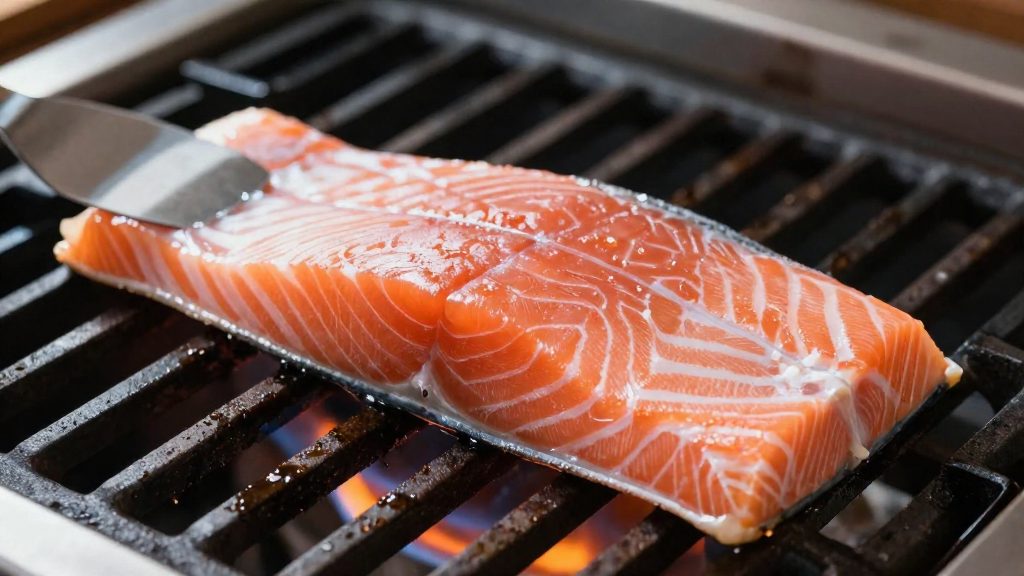
Salmon sticks mainly for two reasons: the grate is too cool or dirty for the fish to release cleanly, and moisture on the fillet stops the surface from searing. Each cause affects a different stage of cooking, so knowing both tells you which controls matter most. Heat and grate cleanliness act on the metal, while surface moisture acts on the fish itself.
Why does salmon stick to the grill?
Salmon contains proteins that bond to metal when the two meet before the surface has set. On a cold grate, that contact lasts longer, so the flesh grips the bars. According to America’s Test Kitchen / Cook’s Country (2022-06-08), the hotter the grill, the less likely fish is to stick, which makes grate temperature the first variable to control.
Cold metal and residue
Residue from earlier cooks adds a second barrier. Food debris and burnt particles sit between the fillet and the grate, and they bond with the proteins as well.
Surface moisture
Water on the fillet must evaporate before the surface can brown. While it does, the fish steams, and the flesh stays in contact with the grate for longer. Dry fish forms a crust instead of steaming, so a dry surface sets quickly and releases more easily.
| Cause | Effect on the fillet | Main control |
|---|---|---|
| Cold grate | Proteins bond before the surface sets | Full preheat |
| Residue on bars | Debris binds the flesh to the metal | Stiff brush, then oil-soaked rag |
| Surface moisture | Steaming delays searing | Dry surface before grilling |
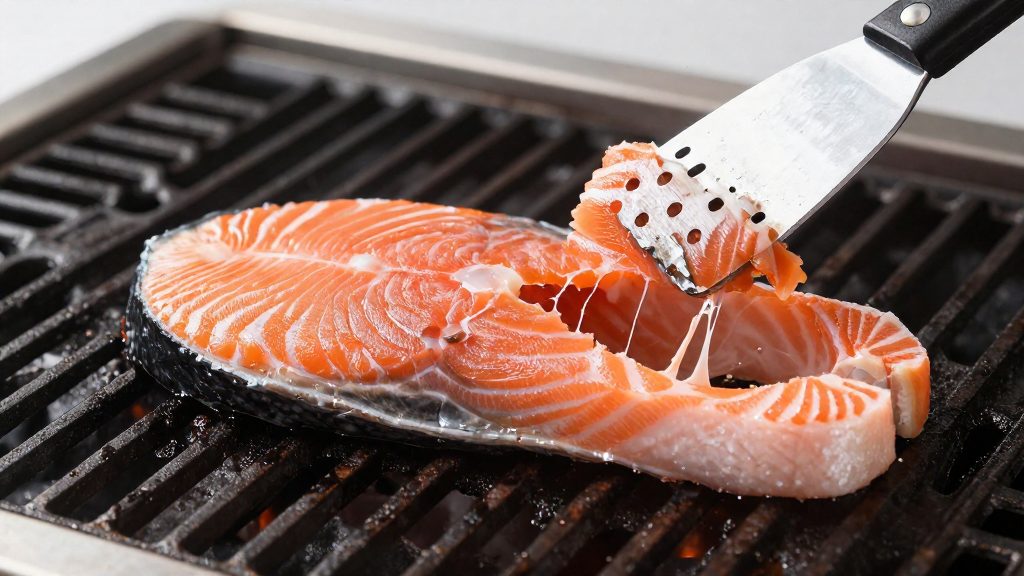
Start with a hot, clean grill
A full preheat is the first step against sticking. According to America’s Test Kitchen / Cook’s Country (2022-06-08), the hotter the grill, the less likely fish is to stick, so the grate should be fully heated before any fillet touches it. The setup differs by fuel:
| Grill type | Preheat setup | Preheat time |
|---|---|---|
| Gas | All burners set to high, lid closed | 15 minutes |
| Charcoal | Lit coals spread out, grates in place, lid closed | 5 minutes |
On a gas grill, set every burner to high, close the lid and let the grill heat for the full 15 minutes. Use all burners, not just the one under the fish area, so the grate reaches a uniform temperature. On a charcoal grill, spread the lit coals across the firebox rather than piling them in one spot. Place the grates on the grill, close the lid and heat for 5 minutes. Spreading the coals gives you an even base of heat, which keeps the fish from cooking unevenly on one side of the grate.
Once the grill is hot, clean the grate with a stiff brush. Scrape the bars thoroughly to remove residue left from earlier cooks. A clean grate gives the fish a smooth surface to sit on, and it reduces the chance of stuck pieces tearing away from the skin when you move the fillet. Work across the full grate, not only the centre, because fish is often placed near the edges during cooking.
Avoid placing the fillet on the grate while the bars are still dirty or the grill is only partly heated. Waiting until the full preheat time has passed is the simplest way to avoid both problems.
Oil the fish and the grates
Oiling works on two surfaces: the fillet and the grate bars. Drying the fish and lubricating the metal before the fillet touches it both help the salmon release cleanly once a crust has formed.
Pat the fillet dry
Remove surface moisture before any oil goes on. Pat each fillet dry with paper towels on both the flesh and the skin side. According to America’s Test Kitchen / Cook’s Country (2022-06-08), dry fish forms a crust instead of steaming, and a steamed surface is the part most likely to grip the grate.
Brush a thin oil layer on both sides
Brush a thin oil layer over the flesh and the skin. A light film is enough; excess oil pools on the fillet and drips off without adding any grip control. Oil both sides, because the skin stays on the grate when you serve the fish and benefits from the same barrier as the flesh.
Wipe the grates with an oil-soaked rag
Fold a rag or a few paper towels, soak them in oil and hold them with tongs. Wipe the grate bars, then repeat the pass. Holding the cloth with tongs keeps your hand away from the hot metal while you work. The aim is to lubricate the bars themselves before the fillet is placed, so the wipe is done on the grate, not on the fish.
Use oil-soaked rag only for lubricating the bars, and keep the same cloth off the fillet to avoid transferring grate residue onto the flesh.
Skin on or off?
Choosing between skin-on and skin-off fillets comes before the grill is lit, because it determines whether the flesh touches the grate. A skin-on fillet keeps a layer of skin between the flesh and the bars. A skin-off fillet exposes the flesh directly to the metal, so the surface must be prepared more carefully before the fish goes down.
Skin-off fillets need the most preparation. Wipe the grate with an oil-soaked rag or paper towels held in tongs, and repeat, as America’s Test Kitchen / Cook’s Country (2022-06-08) recommends. Any residue left on the grate meets the flesh directly, so the grate has to be clean and well oiled.
Skin-on fillets follow the same sequence under Weber’s 70/30 rule: the flesh side goes down first, then you turn the fillet onto the skin. The flesh still meets the grate during the first phase, so a hot, clean, oiled grate matters here too. Skin-on and skin-off fillets both need a hot, clean, oiled grate and a dry surface.
Your cooking method should guide the choice:
| Method | Fillet type | Flesh contact with grate | Preparation specified in the sources |
|---|---|---|---|
| Direct grilling | Skin-on | Flesh touches the bars during the first (flesh-down) phase | Pat dry, brush both sides with a thin layer of oil, and prepare the grate as above |
| Direct grilling | Skin-off | Flesh touches the bars directly | Pat dry, brush both sides with a thin layer of oil, and prepare the grate as above |
| Foil-packet method | Skin-on or skin-off | Flesh is enclosed in foil, which sits on the grate | Wrap in sturdy foil with a small gap on top; place on the unlit side of a preheated grill (about 375°F) with the lid closed, for 10 to 20 minutes depending on thickness, then rest about 10 minutes (Chowhound, 2026-06-06) |
Skin-off fillets suit direct grilling when you can keep the grate clean and the fish dry. If you want to avoid flesh contact entirely, or your grate is hard to keep clean, the foil-packet method keeps the fish from touching the bars directly.
When should you flip salmon?
Flip a salmon fillet when it releases easily from the grate, not after a fixed number of minutes. According to America’s Test Kitchen / Cook’s Country (2022-06-08), a fillet cooked covered for about 4 to 6 minutes is ready to turn once it is well marked and releases easily. The time is a guide. The release test is the deciding signal.
Place the fillet across the bars
Lay the fillet perpendicular to the grate bars, so the flesh crosses the bars rather than running along them. This orientation is the one the source specifies before cooking begins. Keep the fillet in this position for the whole first side so the surface develops the marks that signal it is ready to move.
Cook covered for about 4 to 6 minutes
Close the lid and leave the fillet undisturbed. Do not lift it early to check. Lifting the fillet before it has formed a crust makes it more likely to stick and tear, and each check lets heat escape. At the end of the covered period, look for two signs: the surface is well marked, and the fillet slides freely when you test whether it moves.
Turn with a fish spatula
Once the fillet passes the release test, slide a fish spatula under it in one smooth motion and turn it over. The thin, flexible blade of a fish spatula fits beneath delicate fish more easily than a standard spatula. If the fillet resists, close the lid for another short interval and test again rather than forcing it. A fillet that has not released is not yet ready, and a fillet that is pried loose can break apart.
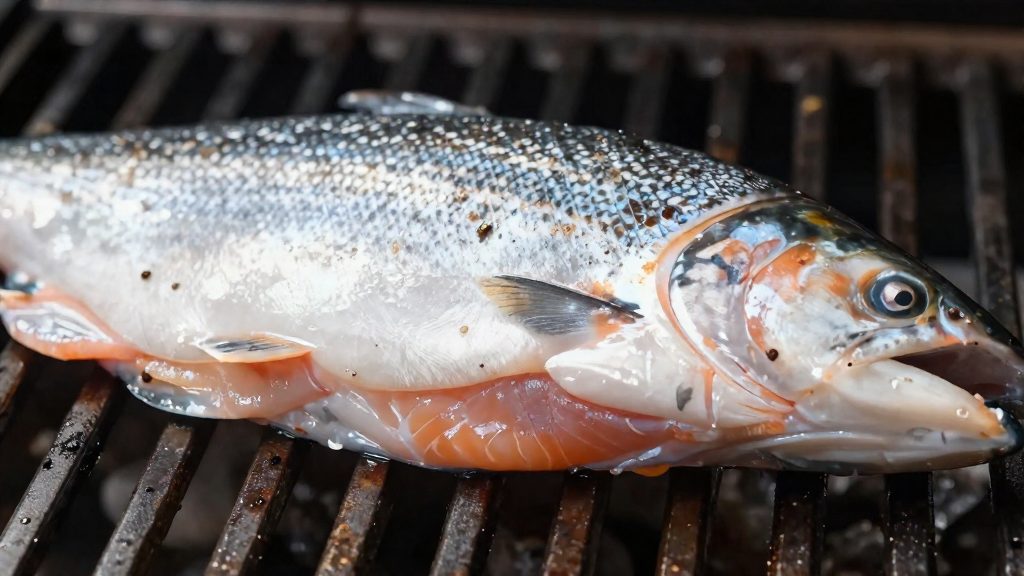
Use the 70/30 rule
Weber’s 70/30 rule divides cooking time between two phases. The fillet cooks flesh side down for about 70% of the total time, then cooks the remaining 30% after it is turned. Turn it only once it releases easily from the grate. Set the total time by the fillet’s thickness and how it looks, then divide it.
Splitting the time
Multiply the total cooking time by 0.7 to get the length of the flesh-side sear. Multiply it by 0.3 to get the finish on the skin side.
| Phase | Share of total time | Side facing the grate | Purpose |
|---|---|---|---|
| Flesh-side sear | 70% | Flesh down | Builds the main grill marks before turning |
| Finish | 30% | Skin down, after turning | Completes cooking through the fillet |
Keep the lid closed during the sear, as the preheating and covered-cooking steps require. Lifting it often lowers the grill’s temperature, which makes the fillet more likely to stick.
Serving with the skin left behind
When the fish is done, slide a spatula between the flesh and the skin. Lift the flesh away while the skin stays on the grate. This is the serving method that completes the rule: the skin, which is the part most likely to stick, never leaves the grate with the portion you plate.
Foil packet: a no-stick backup
When a fillet keeps sticking despite a hot, clean grate, a foil packet removes direct contact between the fish and the bars. The trade-off is texture: the fish cooks enclosed in foil rather than against the grate, so it does not develop the crust a direct-grilled fillet gets. In exchange, the fish rests on foil rather than directly on the bars, which avoids sticking to the grate. According to Chowhound (June 2026), this method is a valid alternative for fillets that will not come off the grill cleanly.
Wrap each fillet in sturdy foil, leaving a small gap open on top so steam can escape. Place the packets on the unlit side of the preheated grill, with the lid closed. Set the grill to about 375°F.
| Stage | Action | Duration |
|---|---|---|
| Wrapping | Sturdy foil, small gap left open on top | Before grilling |
| Cooking | Packets on the unlit side, about 375°F, lid closed | About 10 to 20 minutes, depending on thickness |
| Resting | Keep the packet closed after cooking | About 10 minutes |
Thicker fillets belong at the upper end of the cooking range, and thinner ones at the lower end. Resting the fish in its packet lets it finish cooking gently and keeps the juices in the flesh before serving. Open the foil carefully, away from your face, because the trapped steam is hot.
What internal temperature is salmon done?
Salmon is done when the thickest part reaches your chosen internal temperature and the flesh shows the visual changes described below. Use an instant-read thermometer for the first check and your eyes for the second, since the two together are more reliable than either alone.
Probing the thickest part
Insert the probe horizontally into the centre of the thickest section, through the side of the fillet rather than from above, so the tip sits in the middle and not near the surface. Avoid the thin tail end, which cooks faster and gives a reading that says little about the rest of the fillet. Wait until the number stops rising before you read it.
Target internal temperature
The USDA recommends a minimum internal temperature of 145°F for fish, including salmon. Check that the thickest part reaches 145°F on the probe before you serve it. Carryover heat will keep raising the reading for a short time after the fillet leaves the grill, so take it off as soon as it hits that mark rather than leaving it to climb well beyond. Do not wait for the final serving temperature you want, because the fish keeps cooking after it leaves the grill. This carryover heat raises the reading while the fillet rests, and the amount depends on the thickness of the fillet and how hot the grate was. Thicker fillets carry more heat and rise further, so pull them slightly earlier.
Visual cues in the flesh
Watch the side of the fillet as it cooks. Raw salmon looks glossy and translucent. As it cooks, the flesh turns opaque, starting at the edges and moving toward the centre.
| Check | Underdone | Done |
|---|---|---|
| Centre colour | Translucent, glossy | Opaque, slightly paler |
| Fork test at thickest point | Resists, stays in one piece | Separates into flakes along the layers |
| Texture when flaked | Moist and glassy at the centre | Moist, tender and no longer glassy |
Fish that flakes into dry, chalky pieces has gone past done.
Frequently asked questions
How do I know when the salmon is ready to flip?
Slide a fish spatula under the fillet and lift gently. If it releases with little resistance and the surface is well marked, it is ready; if it resists, give it more time. According to America’s Test Kitchen / Cook’s Country (2022-06-08), a covered cook of about 4 to 6 minutes is typically enough for a release test to pass on a properly heated grate.
What internal temperature should salmon reach?
The USDA recommends a minimum internal temperature of 145°F for fish, including salmon, according to the USDA FSIS safe minimum internal temperature chart. Check the thickest part with a probe, and remove the fillet as the reading approaches 145°F, because carryover heat keeps raising the temperature after it leaves the grill.
Does skin-on salmon stick less than skin-off?
No. Under Weber’s 70/30 method, the flesh side goes down first for about 70% of the cooking time, so the flesh contacts the bars during that phase. The skin helps only when you serve, since it stays on the grate as you lift the flesh away.