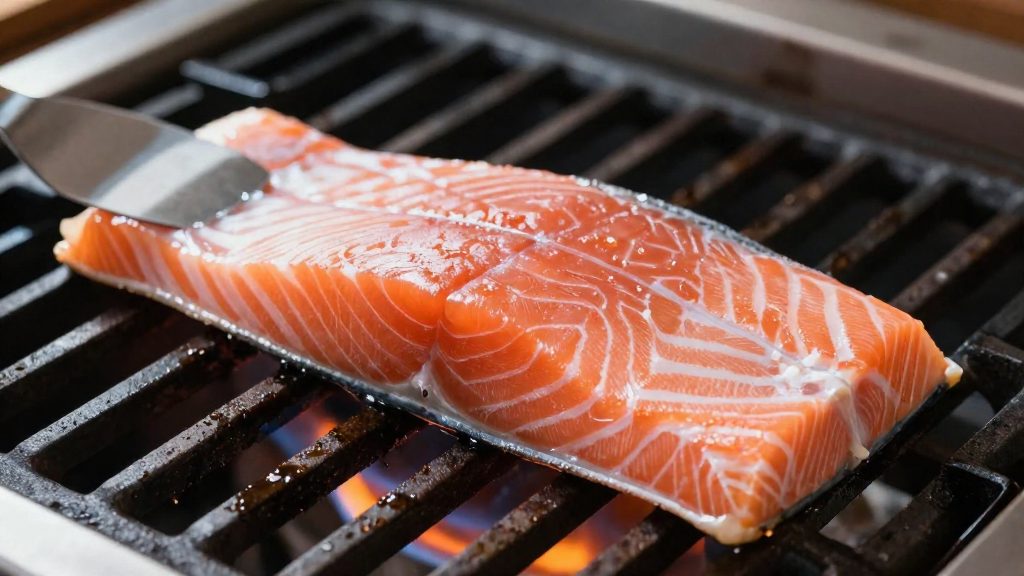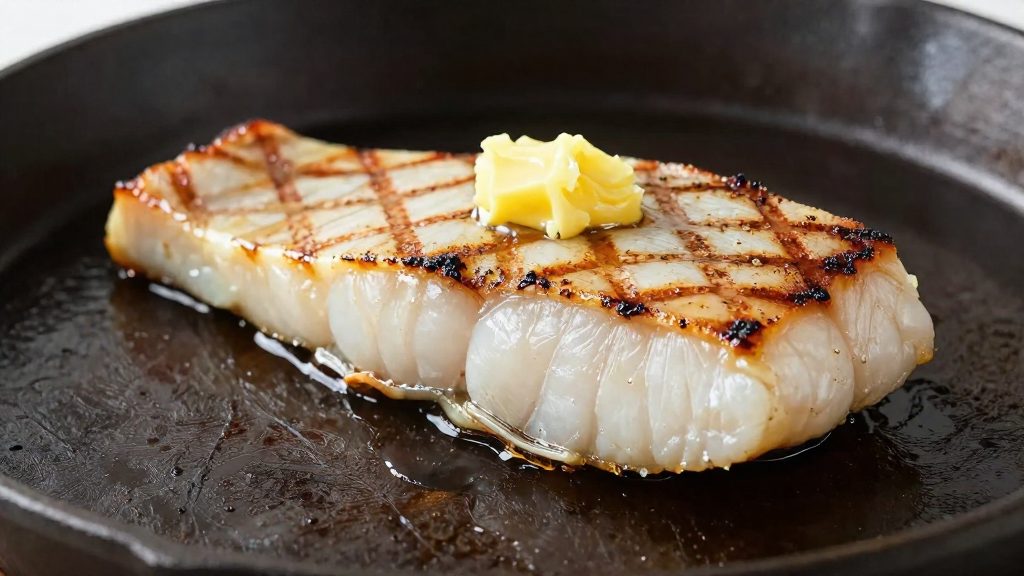
Halibut steaks suit the grill because they are cut thick enough to be flipped once without falling apart, and thickness gives the outside time to colour while the centre cooks through. Taste of Home (2026) builds its recipe on 1-inch steaks, and Weber (2026) uses 2-inch steaks, so the two sources cover the common thickness range. Both recipes use halibut, and Taste of Home also allows swordfish.
Why halibut steaks suit the grill
A steak cut across the fish, rather than a thin fillet, has enough body to sit on the grate and survive a turn with a spatula. The thickness also gives a buffer: the heat reaches the centre gradually, so the surface can take on colour before the middle is done. Thin fillets, by contrast, cook through quickly and can dry out before the surface browns.
The steak’s firm structure is what makes it workable on direct heat. Because the flesh holds together, the steak can be moved, flipped and checked for doneness without the pieces separating, which is the main practical reason cooks choose a steak cut for the grill.
Fish selection: halibut or swordfish
Taste of Home (2026) treats the two fish as interchangeable in its lemon-butter recipe, specifying “halibut or swordfish steaks.” Swordfish can be substituted if halibut is unavailable, and the same butter and lemon method applies to both. Choose steaks of similar thickness so the two pieces finish at the same time.
Thickness: 1 inch versus 2 inches
| Thickness | Source recipe | Heat setting noted |
|---|---|---|
| 1 inch (about 2.5 cm) | Taste of Home (2026) | Medium, covered |
| 2 inches (about 5 cm) | Weber (2026) | High, after 10-minute preheat |
A 1-inch steak is the easier choice on medium heat with the lid closed, since the gentler heat leaves more margin for error. Its recipe still takes longer in total than Weber’s high-heat 2-inch recipe. A 2-inch steak gives more time to build a crust before the centre is cooked. In the Weber recipe it goes on a high-heat grill and cooks about 4 minutes per side, roughly 8 minutes in total. The 1-inch Taste of Home steaks take roughly 10½ to 11½ minutes in total on medium heat (about 5½ minutes butter side down, then 5–6 minutes after flipping). Choose the thickness according to how much heat your grill can hold and how much control you want over the finish.
What ingredients make the lemon butter?
Both published recipes for herbed lemon butter share a core of butter, lemon juice, parsley, dill, sugar and pepper. They differ in how the butter is prepared and in the seasoning base. Taste of Home (2026) starts with softened butter, combined with lemon juice, dried minced onion, garlic salt, parsley, dill, sugar and pepper. Weber (2026) melts the butter and mixes it with lemon juice, onion powder, parsley, dill, sugar, salt and pepper.
Softened versus melted butter
The butter’s physical state changes how the sauce is applied. Taste of Home’s softened butter is spread over the steaks and left to stand for 30 minutes before use, so the herbs and seasonings can distribute through it. Weber’s melted butter stays liquid, so it can be brushed on evenly. In both methods the lemon juice and seasonings are mixed in before application; only the butter’s state and handling differ.
Seasoning base: onion, garlic and salt
Taste of Home uses dried minced onion and garlic salt, which provide onion and garlic flavour in a single step. Weber uses onion powder and plain salt, so its garlic flavour is absent and the salt level is set separately from any seasoned salt.
Herbs, sugar and pepper
Parsley and dill appear in both recipes. Sugar and pepper are also common to both, and they balance the acidity of the lemon juice and add mild heat. Neither source lists exact amounts for the herbs, sugar or pepper, so these should be adjusted to taste.
Measured quantities
Weber (2026) gives the only measured quantities in the consulted recipes: 3 tbsp butter and ½ tbsp lemon juice, a ratio of six parts butter to one part juice by volume. Taste of Home’s recipe lists the ingredients without amounts.
| Component | Taste of Home (2026) | Weber (2026) |
|---|---|---|
| Butter | Softened, stands 30 minutes | Melted, 3 tbsp |
| Lemon juice | Included | ½ tbsp |
| Onion | Dried minced onion | Onion powder |
| Salt | Garlic salt | Salt |
| Herbs | Parsley, dill | Parsley, dill |
| Sugar | Included | Included |
| Pepper | Included | Included |
How do you prep and oil the grill?
Preparing the grill for halibut involves three steps: preheating, cleaning and oiling the grate, and placing the steaks over direct heat. The two recipes in this guide set up the heat differently. Weber (2026) preheats on the high setting for 10 minutes before the fish goes on, while Taste of Home (2026) cooks over medium heat with the lid closed.
Preheating gives the grate time to hold steady heat. Weber’s 10-minute high-setting warm-up produces a hotter surface, which helps the fish sear quickly. A medium setting needs less lead time, but the grill should still be fully warm before any food touches it.
While the grill heats, scrape the grate with a stiff wire brush to remove residue from earlier cooks. Food residue makes fish stick, and halibut is a lean, delicate fish that tears easily when it does. Once the grate is clean, fold a paper towel, dip it in a neutral cooking oil, and hold it with long tongs. Wipe the bars lightly. Apply the oil just before placing the steaks, and avoid a heavy layer, which can cause flare-ups.
Next, place the steaks over the direct heat zone. Taste of Home places them butter side down first, so the seasoned surface contacts the grate immediately. Leave them undisturbed until the fish releases easily from the bars, then flip.
Lid position changes how the steak cooks:
| Lid position | Effect on halibut | Recipe source |
|---|---|---|
| Closed | Heat circulates around the fish, cooking the top surface more evenly | Taste of Home (2026) |
| Open | Direct contact and visual control, with faster response to flare-ups | General grilling practice |
How long do you grill halibut steaks?
Halibut steaks cook quickly, and the time depends mainly on thickness. Two published recipes give different timings because they use different cuts.
| Steak thickness | Source | Cook time |
|---|---|---|
| 1 inch | Taste of Home (2026) | About 5½ minutes butter side down, then 5–6 minutes after flipping |
| 2 inches | Weber (2026) | About 4 minutes per side |
For 2-inch steaks, follow Weber’s 4 minutes per side. For 1-inch steaks, follow Taste of Home’s two-stage timing. Use the thickness of your fish as the deciding factor, not the recipe title.
Butter application during the cook
After flipping, Taste of Home spreads the remaining herbed butter on the top side for the second stage of cooking. This keeps the butter on the fish during the final minutes rather than letting it run off early. Weber instead brushes the steaks with a melted butter and lemon juice mixture, so the butter goes on as a glaze rather than in two stages.
Checking doneness with a fork
Both recipes use the same test: the fish is done when it flakes easily with a fork. Insert the fork at the thickest point and twist gently. Opaque, separating flakes indicate the steak is ready. Firm, translucent flesh that does not separate needs more time, so check again in one-minute intervals rather than waiting for the full timing to pass.

What internal temperature is safe for halibut?
Halibut steaks are checked at their thickest point. A probe thermometer gives a measured reading at that spot, which is more reliable than judging by eye. The USDA and FDA recommend cooking fish to an internal temperature of 145°F (63°C). Measure it at the thickest point with a probe thermometer rather than relying on appearance alone.
Probe placement in the thickest part
- Insert the probe horizontally from the side, so the tip sits in the centre of the thickest section.
- Keep the tip clear of the grate and the pan. Contact with metal skews the reading.
- Thickness changes the method. On the thicker cut, the difference between edge and centre is larger, so the probe should go deeper and into the middle of the steak.
Flake test versus probe reading
| Check | What it tells you | Limitation |
|---|---|---|
| Flake test with a fork | Whether the flesh separates easily along its natural lines | Judges texture, not the temperature at the centre |
| Probe reading | The temperature at one exact point | Only as accurate as the placement |
Use the probe as the primary check and the flake test as a secondary confirmation. A steak that flakes but reads low at its centre should go back on the grill.
Carryover heat after leaving the grill
Fish keeps cooking briefly after it leaves the heat, because the outer layers continue to transfer warmth inward. Remove the steaks while the probe still reads slightly below your target, then let them rest on a warm plate so the residual heat finishes the cook.
Related reading
- Grilling halibut steaks with lemon butter: preparation and cooking time
- Grill zones and lid use for fish steaks
Charcoal, gas or pellet grill: any difference?
Each fuel type delivers heat differently, which changes how a halibut steak cooks. Charcoal gives intense direct radiant heat and adds smoke from the fuel. Gas gives the most precise control through separate burners. Pellet grills hold a set temperature automatically and produce steady wood smoke. The two recipes in this article call for different heat levels: Taste of Home (2026) specifies medium heat, and Weber (2026) specifies high heat. Your grill’s ability to hold that level steadily matters more than the fuel name.
| Fuel | Heat delivery | Heat control | Smoke flavour | Best fit for halibut steaks |
|---|---|---|---|---|
| Charcoal | Direct radiant heat from embers | Amount of charcoal and vent airflow | Strong, from the fuel and any added wood | High sear with a short cook time |
| Gas | Direct flame from burners | Independent burner knobs | Mild, unless a smoker box with wood chips is used | Steady medium heat and quick zone changes |
| Pellet | Convective heat from a firepot | Digital controller set temperature | Constant, from wood pellets | Gentle, low-temperature cooking with smoke |
Charcoal: direct heat and smoke
Charcoal grills heat the grate from below through glowing embers. Heat is adjusted by the quantity of charcoal and the airflow through the vents. Building a two-zone fire, with coals banked on one side only, gives you a cooler area to move the steaks to if dripping butter or oil hits the embers and flares up. A hot direct zone should be used briefly, and the steaks moved once they have seared.
Gas: adjustable burners and preheat control
Gas grills use separate burners, each with its own knob, which creates burner zones without rearranging fuel. Heat responds within seconds to a knob turn, so you can drop from high to medium while the lemon butter is spread on the steaks. Gas produces little smoke flavour on its own, so add wood chips in a smoker box if you want a smoky finish.
Pellet: low-temperature setting and wood smoke
Pellet grills feed wood pellets into a firepot and hold the temperature chosen on the controller. This makes them well suited to a gentle, low-temperature cook with constant wood smoke. Searing is generally less intense than on charcoal or gas, so a crisp exterior on halibut may be harder to achieve. Check your model’s maximum temperature before choosing this method.
Serving and storing leftover butter
Serve the steaks hot, with the herbed butter already spread on them. Make a little extra butter if you want more to spoon over, and keep it separate from the butter that touched the raw fish.
Resting the steaks before plating
Let the steaks rest briefly off the heat before moving them to plates. This gives the juices time to settle and keeps the butter from running off the fish as you plate. Rest them for a short pause only, since the fish should still be warm when served.
Refrigerating leftover herbed butter
Unused herbed butter should be kept in a sealed container in the refrigerator. Use leftover herbed butter within a few days, and discard any butter that touched raw fish or smells sour or off. Store it away from raw fish and the grill’s tools so that it does not pick up juices or residue.
Freezing herbed butter in portions
Shape the leftover butter into a log, wrap it tightly in plastic wrap or foil, and freeze it. Once firm, slice the log into rounds so that you can take out a single portion without thawing the whole batch. Each round melts quickly over hot steaks or in a warm pan. Thaw portions in the refrigerator rather than at room temperature, and do not refreeze butter after it has thawed.
Frequently asked questions
How can I tell when halibut steak is cooked?
Both Taste of Home (2026) and Weber (2026) use the fork test: the steak is done when the flesh flakes easily with a fork. Check the thickest part, since that is where the centre finishes last.
What goes into the herbed butter?
Taste of Home (2026) uses softened butter with lemon juice, dried minced onion, garlic salt, parsley, dill, sugar and pepper, and lets it stand 30 minutes before use. Weber (2026) melts 3 tbsp of butter with ½ tbsp of lemon juice, then seasons it with onion powder, parsley, dill, sugar, salt and pepper.
Can I reuse the butter that brushed the raw fish?
No. Discard any herbed butter that has touched raw halibut, and keep a separate portion for spooning over the cooked steaks. Discard any butter that smells sour or off, whatever its origin.