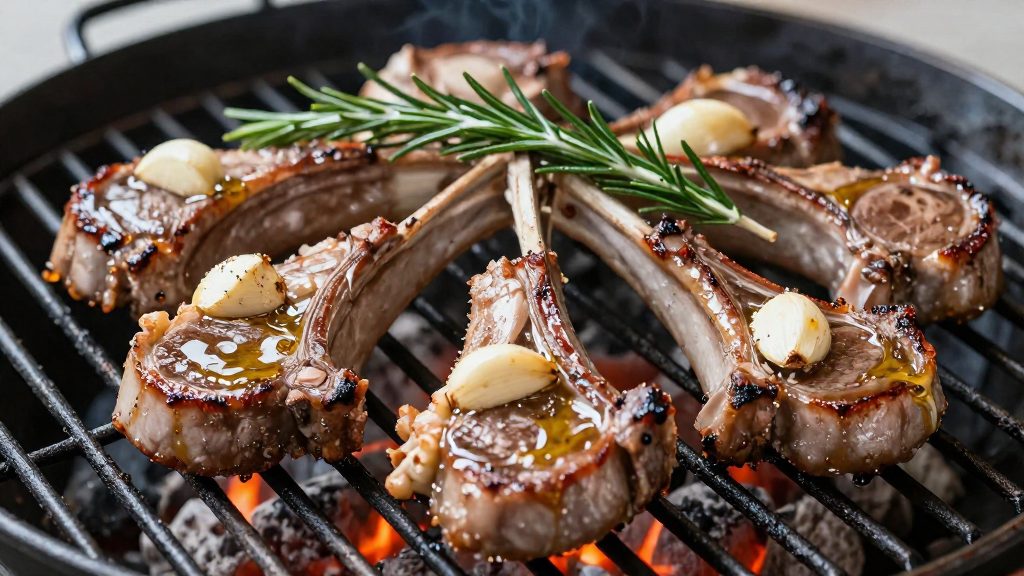
Both reference recipes use loin chops, the cut to select for this method. Lobel’s of New York specifies loin lamb chops of about 6 oz each and about 1½ inches thick, while Skinnytaste uses bone-in loin chops of about 3.5 oz each. The choice therefore comes down mainly to chop size, since only Skinnytaste specifies bone-in chops.
Which lamb chops are best for grilling?
Loin chops and the size question
Thickness matters most on a hot grill because a thicker chop gives the centre more time to reach the target doneness before the outside overcooks.
Thickness and weight
- Lobel’s of New York: about 1½ inches thick, 6 oz per chop, 12 chops.
- Skinnytaste: about 3.5 oz per chop, 8 chops.
A 6 oz chop weighs about 1.7 times a 3.5 oz chop (6 ÷ 3.5). The heavier, thicker Lobel’s chop carries more meat per piece and tolerates a wider margin of error on a hot grill. Lighter chops reach the centre faster and leave less room for timing error.
Bone-in versus boneless
Skinnytaste specifies bone-in chops, so buy bone-in if you follow that version. Lobel’s recipe is defined by its weight and thickness (6 oz, about 1½ inches), so buy to those dimensions regardless of whether the bone is kept. Whichever form you choose, keep the thickness consistent across the batch so every chop cooks evenly.
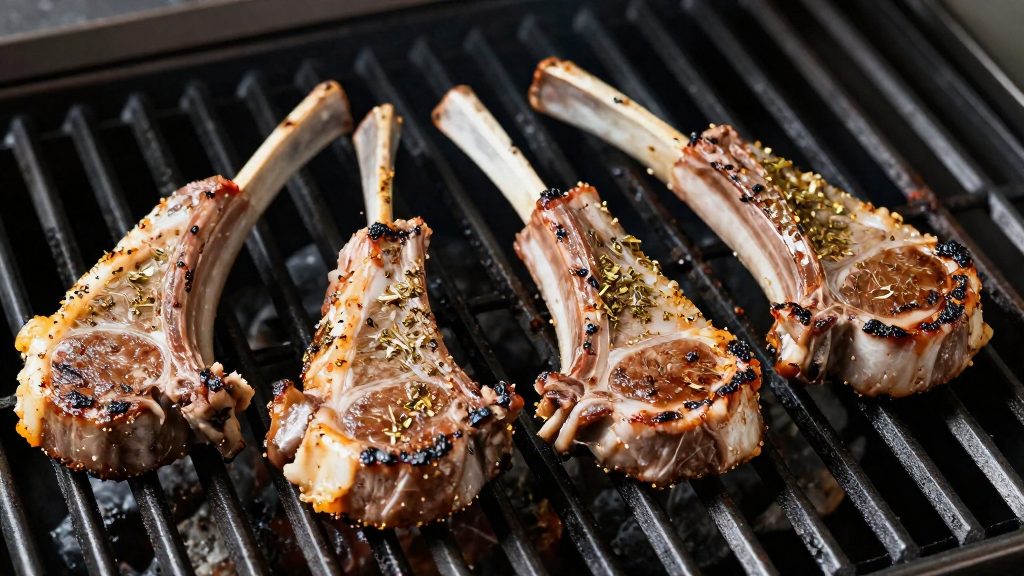
Garlic and rosemary marinade
The two reference recipes build the marinade from different ingredients. Lobel’s of New York uses red wine vinegar and dried rosemary, with minced garlic and olive oil. Skinnytaste uses lemon juice and fresh rosemary, with crushed garlic cloves. The table sets out the differences that affect how you assemble the marinade.
| Element | Lobel’s of New York | Skinnytaste |
|---|---|---|
| Acid | Red wine vinegar | ¼ cup lemon juice |
| Rosemary form | Dried | Fresh, 1 tbsp |
| Garlic preparation | Minced | 6 cloves, crushed |
| Oil | Olive oil | Not listed in the reference |
| Chops | 12 loin chops, about 6 oz each | 8 bone-in loin chops, about 3.5 oz each |
Rosemary form is the first adjustment. Dried rosemary is more concentrated than fresh, so a recipe written for dried herbs calls for less of it by volume. If you swap forms, reduce the quantity rather than matching the fresh amount spoon for spoon. The Lobel’s recipe does not give a rosemary quantity, so for dried herbs you will need to judge the amount by taste.
Acid choice shapes the flavour more than the tenderising effect you might expect. Red wine vinegar adds a sharper, wine-based tang that suits a robust, savoury profile. Lemon juice gives a brighter, more citrus-led result. Both are acidic, so either can be used in the same role within the marinade, but they should not be combined without adjusting the other ingredients.
Garlic preparation affects how strongly the flavour spreads through the marinade:
- Minced garlic is cut into fine pieces, which distribute evenly through the oil and acid.
- Crushed cloves are pressed or smashed, which breaks more of the cell structure and releases more of the garlic’s juice and oils.
How long should you marinate lamb chops?
The two reference recipes set very different minimum times. Skinnytaste marinates 8 bone-in lamb loin chops for at least 1 hour, according to Skinnytaste. Lobel’s of New York asks for at least 4 hours, and the recipe allows marinating overnight. Both recipes combine an acid with garlic and rosemary, so the choice of time mainly sets how long the meat soaks before cooking. A one-hour soak fits a short prep window, while a four-hour or overnight soak requires planning ahead.
Lobel’s gives an overnight window but no further limit. Because the source stops at overnight, keep the chops within that range rather than extending it. Skinnytaste does not describe a maximum time, so the one-hour minimum is the only figure to rely on from that recipe.
Once the chops have soaked, discard the marinade. Skinnytaste’s method throws it out after marinating, because it has been in contact with raw meat. Do not brush it onto the chops as a sauce during grilling, and do not serve it with the cooked meat. The Skinnytaste recipe describes no step for reusing it.
Lobel’s also tells you to bring the chops to room temperature before grilling. The recipe gives no duration for this step, so take the chops out of the refrigerator while the grill heats up. Pat them dry lightly if they look wet, so the surface can brown rather than steam. Keeping the chops cold until they hit the grill slows even cooking, so this resting step is worth doing even when the marinating window is short.
Charcoal or gas: setting up the grill
The two reference recipes cook lamb loin chops over direct heat but describe the heat differently. Lobel’s of New York calls for a moderately hot to hot grill, which works with either charcoal or gas. The Skinnytaste version specifies medium-high heat. Setting the grill to one of these levels before the chops go on determines whether the outside browns while the centre stays pink.
Two-zone fire for charcoal
A charcoal grill allows a two-zone fire, with one side hotter than the other:
- Light the charcoal and wait until the coals are covered in grey ash and glow evenly.
- Pile most of the coals on one half of the charcoal bed. Leave the other half with few or no coals.
- Place the cooking grate and let it heat through before adding the meat.
- Hold a hand above the grate over each zone to compare heat. The hotter zone is where you sear.
Sear the chops over the hot side, then move them to the cooler side if they brown faster than the centre cooks or if flare-ups occur. Clean grate bars make it easier to move the meat without tearing the crust.
Gas burner settings
On a gas grill, create the same contrast by lighting only some burners. Set the lit burners on one side to a medium-high or high setting for the direct zone. Keep the other burners off or on low for the cooler zone. Close the lid during preheating so the grate reaches a steady temperature before the chops are placed on it. The reference sources do not give a preheating duration, so judge readiness by the grate: it should be fully hot and the surface should sizzle immediately on contact.
Moderately hot versus medium-high
| Source | Heat level named | Practical reading on a gas grill |
|---|---|---|
| Lobel’s of New York | Moderately hot to hot | A range between medium and high burner settings |
| Skinnytaste | Medium-high | An upper-middle setting, below full high |
For a lamb chop cooked fairly quickly, both levels produce a well-browned crust. Choose the lower end of Lobel’s range if the chops are thick, since the surface can char before the interior is done.
How long do you grill lamb chops?
Lobel’s of New York gives 6 to 8 minutes per side for medium-rare on a moderately hot to hot charcoal or gas grill, for chops about 1½ inches thick and 6 oz each. Skinnytaste’s version grills smaller 3.5 oz bone-in loin chops for about 5 minutes per side over medium-high heat. The two timings differ mainly because of chop size, so the thickness of your chops matters more than the recipe name.
| Source | Chop weight | Per side | Heat level |
|---|---|---|---|
| Lobel’s of New York | 6 oz, about 1½ inches thick | 6 to 8 minutes | Moderately hot to hot |
| Skinnytaste | 3.5 oz, bone-in | About 5 minutes | Medium-high |
Adjusting time for chop thickness
Treat the Lobel’s timing as a starting point, not a fixed rule. Measure the chop thickness at its thickest point with a ruler. Chops close to 1½ inches will follow the 6 to 8 minute range. Thinner chops need less time per side and will overcook quickly, while thicker chops need more time on each side to bring the centre up to temperature without charring the outside.
Flipping once versus repeated turning
Turn each chop once at the midpoint of the cooking time. A single flip lets each side develop a browned crust in continuous contact with the grate and keeps the juices inside. Repeated turning prevents that crust from forming and extends the total cooking time, which dries the outer layer before the centre is done.
Lay the chops on the grill once, leave them untouched until the first side releases easily from the grate, then flip. Avoid pressing the chops with a spatula, since this forces juices out and does not speed up cooking.
Related reading
- Internal temperature targets for lamb chops
- Heat zone and fire setup for grilling
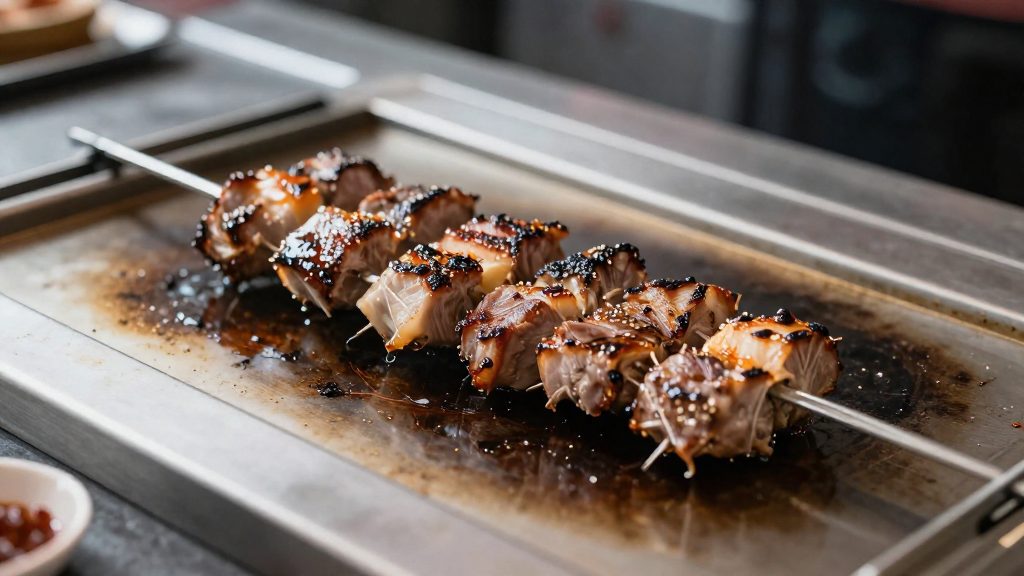
Safe lamb chop temperatures
The internal temperature is the most reliable way to confirm doneness in lamb chops. Colour is only a loose guide, and the chops in Lobel’s of New York’s recipe are about 1½ inches thick, so the centre can lag behind the surface. Skinnytaste gives about 145°F for medium-rare and 160°F for medium, which are the reference points used here.
| Doneness | Target internal temperature |
|---|---|
| Medium-rare | about 145°F |
| Medium | about 160°F |
Probe placement
Aim the probe at the thickest part of the chop, which is the last area to cook through. Keep the tip away from the bone so the reading reflects the meat rather than the bone. Because thickness varies between chops, check more than one chop per batch, especially when cooking several at once.
Instant-read thermometer versus visual checks
An instant-read thermometer gives a reading within seconds, so you can remove each chop as soon as it reaches its target and avoid overcooking the rest. Visual checks, such as pressing the meat to judge firmness or cutting into a chop to inspect the colour, are less precise. Cutting in also lets juices escape. Use visual checks only as a secondary guide, and rely on the thermometer for deciding when to take the chops off the grill.
Resting and serving
Once the chops leave the grill, let them rest before cutting. The Lobel’s of New York recipe for grilled loin lamb chops with rosemary specifies a five-minute rest before serving. During this pause the juices settle back into the meat, so the first cut loses less liquid onto the board.
Carryover cooking during the rest
Lamb keeps cooking after it comes off the heat. Heat stored in the outer layers continues to move toward the centre, so the core temperature can keep rising for a short time. This is carryover cooking. Because the temperature can keep rising, start checking early and pull the chops once the thermometer reads the target, such as about 145°F for medium-rare. The size of the rise depends on chop thickness and grill heat.
To rest the chops properly:
- Transfer them to a clean plate or rack, not the cutting board where they were trimmed.
- Leave them uncovered or loosely tented with foil, so the seared crust does not soften from trapped steam.
- Keep the timing consistent: about five minutes, as in the Lobel’s method, is enough for the juices to redistribute before serving.
Carving bone-in chops
The Skinnytaste version uses bone-in loin chops, which are usually served whole, one per portion. Carving them is simple:
- Stand the chop on its fat edge so the bone is upright.
- Cut along the side of the bone to separate the eye of meat from the bone.
- Serve the meat as a single piece or slice it across the grain.
- Place the bone on the plate beside the meat, or serve it with the bone attached for guests to hold.
Side dishes and variations
Both reference recipes keep the chops simple, so the sides and sauces carry most of the flavour contrast.
Herb substitutions
Matching the form matters more than the herb itself when you substitute. Thyme is a milder, more floral choice that suits the same grilling method. Oregano has a sharper, more pungent character, so it works best in small amounts or in a sauce where it can be balanced by fat and acid. Use dried herbs where the recipe calls for dried, and fresh where it calls for fresh, to keep the marinade’s intensity predictable.
Grilled vegetables cooked alongside the chops
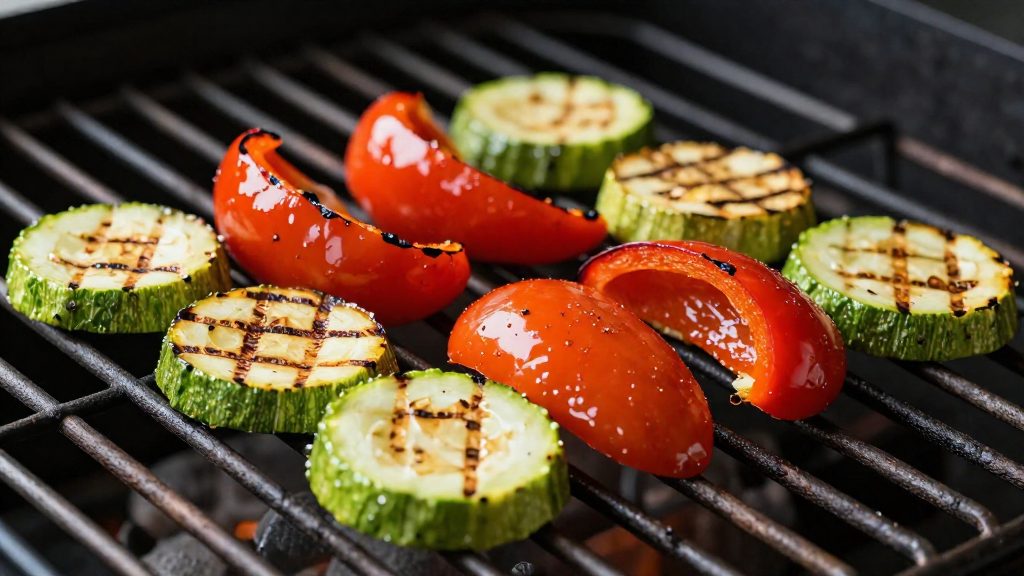
Vegetables can share the grill with the lamb. Use two-zone heat: place the chops over the hottest area and move the vegetables to a cooler section, so they cook through without burning before the meat reaches the target temperature. Cut vegetables into pieces thick enough to hold their shape on the grate. Bell peppers, zucchini, red onion and asparagus are common choices because they tolerate direct heat and take on smoky flavour quickly.
Sauces and condiments
Sauces should be served at the table rather than applied to the chops on the grill, since sugary or herb-heavy sauces can char. Mint sauce, tzatziki and chimichurri are widely used with lamb. Simple options include a lemon-and-olive-oil drizzle, which echoes the Skinnytaste marinade, or a red wine vinegar dressing that matches the Lobel’s approach.